








Garden Paving: How to Choose the Right Slabs for Your Garden
The best garden paving for most UK homes is Indian sandstone (from £20/m²) for natural character or porcelain (from £19/m²) for zero maintenance. Both are frost-proof, durable, and available in grey, buff, cream, and dark tones. Choose sandstone if you want warmth and natural variation. Choose porcelain if you want stain resistance and no upkeep. Avoid concrete slabs — they cost less upfront but deteriorate within 10 years.
Garden paving is the second-biggest investment most homeowners make in their outdoor space — after the house itself. Get it right and you have a surface that looks beautiful for 20-50 years. Get it wrong and you're relaying within a decade. This guide covers the five materials available, which sizes work for which gardens, what everything costs, and the decisions that matter most.
5 garden paving materials compared
| Material | From | Lifespan | Maintenance | Best for |
|---|---|---|---|---|
| Indian sandstone | £20/m² | 20-50 years | Annual clean, seal optional | Traditional and contemporary gardens |
| Porcelain | £19/m² | 30-50 years | None | Modern gardens, dining areas |
| Limestone | £25/m² | 15-30 years | Seal recommended, annual clean | Formal gardens, elegant settings |
| Granite | £27/m² | 50-100 years | Virtually none | Driveways, heavy-traffic areas |
| Slate | £25/m² | 20-40 years | Annual clean | Contemporary, dramatic gardens |
Indian sandstone — the UK's most popular garden paving
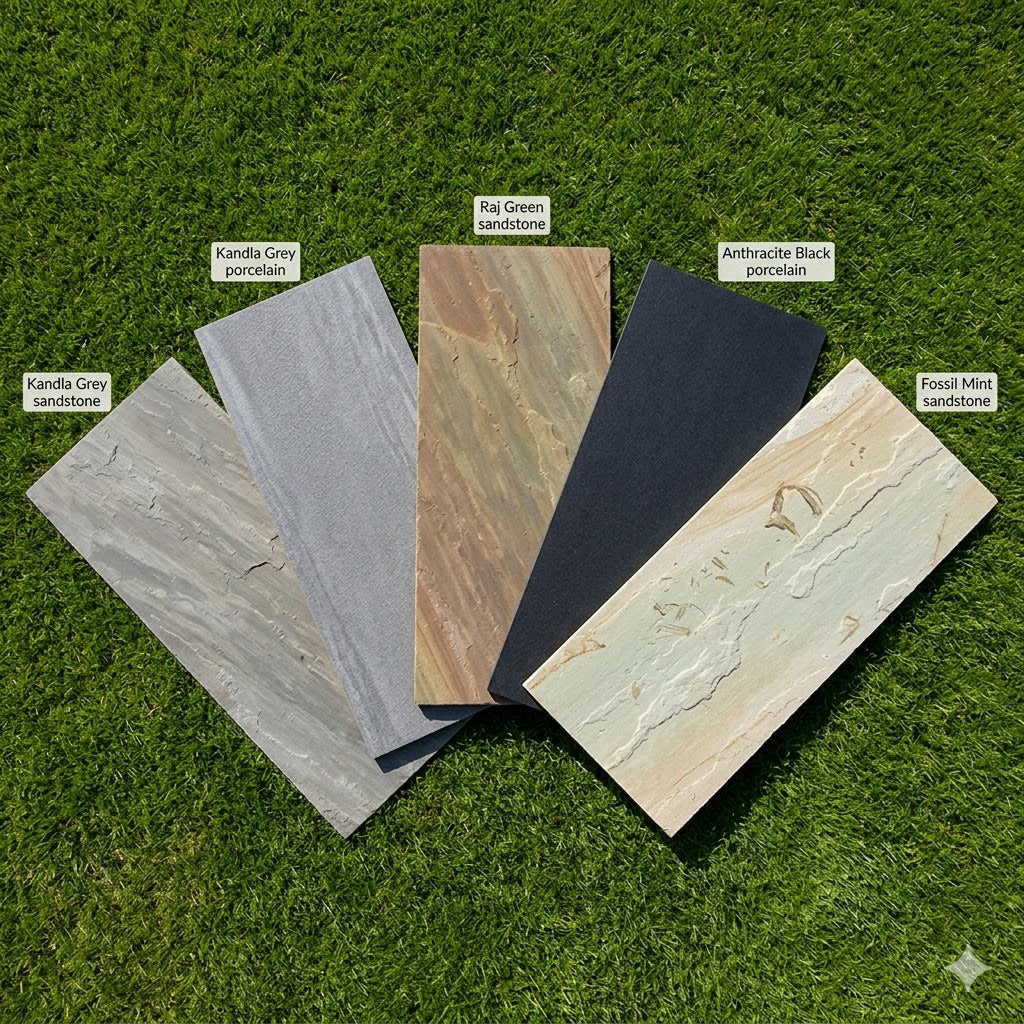
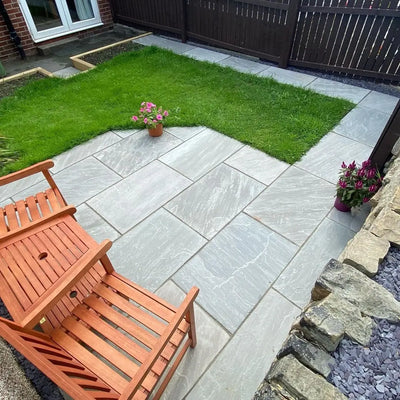
Indian sandstone dominates UK garden paving for good reason. Every slab has unique colour variation — no two patios look identical. The riven (naturally split) surface is slip-resistant in wet conditions and stays cooler barefoot in summer than porcelain. Six colours cover every garden style, from cool Kandla Grey to warm Raj Green and golden Rippon Buff.
The trade-off: sandstone is porous, so it benefits from sealing every 3-5 years and annual cleaning to prevent algae in shaded spots. Read our complete Indian sandstone guide.
Porcelain — zero maintenance, modern aesthetic
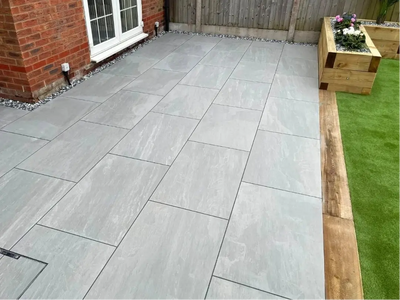
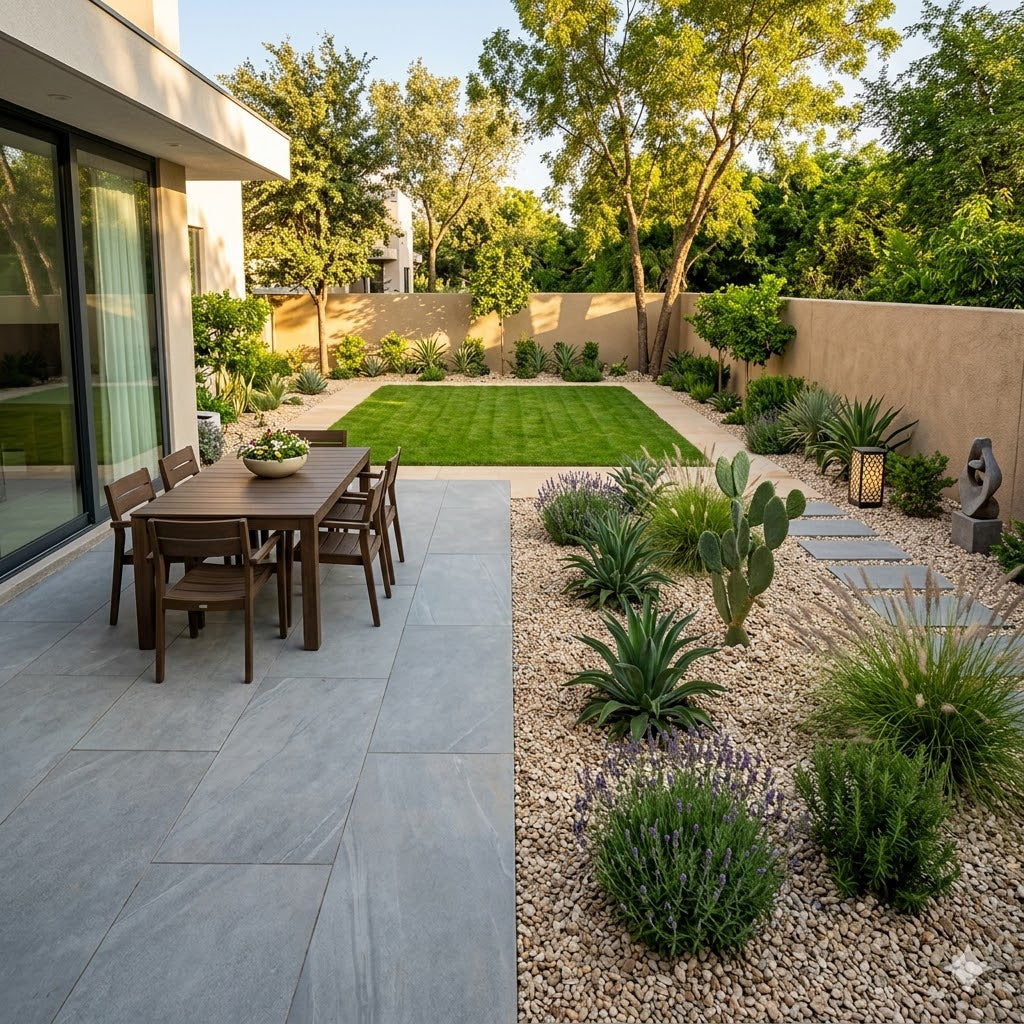
Porcelain paving never needs sealing, treating, or staining. Spills wipe off. Algae struggles to colonise the non-porous surface. The colour stays identical from year 1 to year 30. For dining areas near barbecues, cooking zones, and anyone who doesn't want to maintain their patio — porcelain is the practical winner.
The trade-off: porcelain has no natural variation (some find it lifeless), gets hotter than sandstone in direct sun, and requires SBR primer during installation. Read our complete porcelain guide and honest pros and cons.
Limestone — elegant and understated
Limestone has the most refined, subtle appearance of any natural stone — fine grain, soft colour variation, and a polished feel. It suits formal gardens and period properties. But it's softer and more porous than sandstone, making it more prone to staining and weathering. Sealing is strongly recommended.
Granite — virtually indestructible
Granite is the hardest natural stone available. It outlasts everything — 50-100+ years with zero deterioration. It's the standard choice for driveways and heavy-traffic paths. As patio slabs, granite is less common (the colour range is limited), but as setts and cobbles it creates beautiful borders and paths. Read our driveway paving guide.
Slate — bold and dramatic
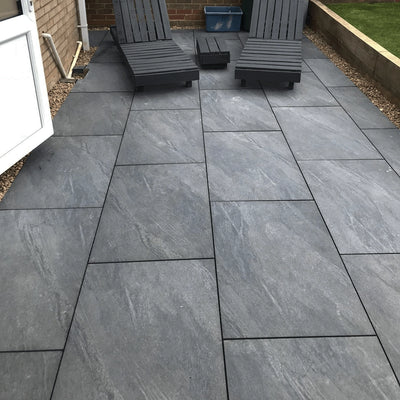
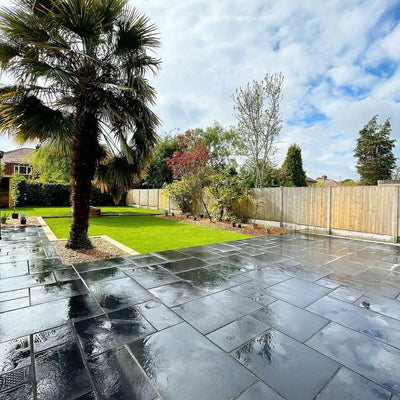
Slate offers deep blue-black and rustic tones that create dramatic contemporary gardens. The natural cleft surface has a layered texture unlike any other stone. Slate works best as an accent or feature — a full slate patio can feel dark and heavy, but slate paths, borders, or mixed with lighter sandstone creates striking contrast.
Not sure which material? Read our 5 materials ranked for UK gardens or sandstone vs porcelain comparison.
Sizes and formats
| Size | Slabs per m² | Look and feel | Best for |
|---|---|---|---|
| 600×600mm | 2.78 | Traditional square grid | Small patios, paths, budget projects |
| 900×600mm | 1.85 | Contemporary, fewer joints | Most popular — suits all garden sizes |
| 1200×600mm | 1.39 | Premium large format, minimal joints | Large patios, modern homes |
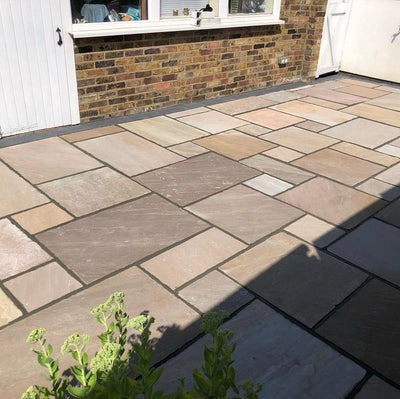
| Patio pack (mixed) | Varies | Random pattern, traditional character | Cottage gardens, period properties |
| 200×100mm setts | 50 | Cobbled, traditional | Driveways, borders, paths |
The rule of thumb: larger slabs make spaces feel bigger. A small garden with 600×600 slabs looks busier than the same space with 900×600. If in doubt, go 900×600 — it's the UK's most popular paving size for good reason.
Read our complete guide to choosing paving size and 8 laying patterns with diagrams.
Choosing a colour
Your paving colour should complement your house, not compete with it:
Red brick houses: Kandla Grey (neutral contrast), Raj Green (warm complement), or grey porcelain.
White/light render: Any colour works. Anthracite Black porcelain for maximum contrast. Kandla Grey for subtle harmony.
Yellow/cream stone (Cotswold, Bath): Rippon Buff sandstone matches the warm tones perfectly.
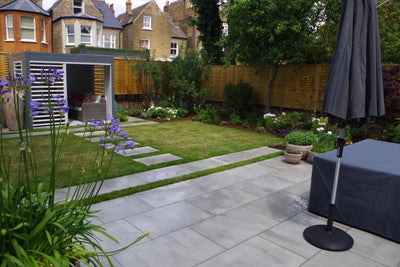
Modern grey render: Grey porcelain extends the palette. Add dark edging or green planting to avoid grey-on-grey flatness.
Period properties: Riven sandstone in warm tones (Raj Green, Rippon Buff, Autumn Brown) in a patio pack random pattern.
Not sure? Order samples — leave them in your garden for a few days and see the colour in sun, shade, wet, and dry. Read our sandstone colours guide for detailed photos.
How much does garden paving cost?
Material cost depends on what you choose. Total project cost depends on whether you DIY or hire a professional:
| Scenario (20m² patio) | Material | Total cost |
|---|---|---|
| DIY sandstone | Kandla Grey riven | ~£1,100-1,400 |
| DIY porcelain | Kandla Grey porcelain | ~£1,100-1,400 |
| Professional sandstone | Kandla Grey riven | ~£2,200-2,800 |
| Professional porcelain | Kandla Grey porcelain | ~£2,400-3,200 |
All our prices include VAT and free UK delivery — no extras at checkout. For exact figures based on your dimensions, use our patio cost calculator.
Installation basics
Every garden paving installation follows the same five stages, regardless of material:
1. Excavate — dig 200-250mm below finished level. Remove all topsoil, grass, and organic material.
2. Sub-base — lay and compact 100-150mm of MOT Type 1 aggregate. This is the foundation — skip it and the patio fails. Read our sub-base guide.
3. Mortar bed — spread 20-30mm of 5:1 semi-dry mortar (5 parts sharp sand, 1 part cement). Full bed, never spot-bed. Read our mortar mix guide.
4. Lay slabs — set each slab, tap level, maintain drainage gradient (1:80 away from house). For porcelain, prime every slab with SBR first. Read our laying guide.
5. Point joints — fill joints with jointing compound after 24-48 hours. Read our jointing compound guide.
Shortcuts that work: If you have sound existing concrete, you can pave over it and skip excavation and sub-base — saving £500-750.
Shortcuts that don't: Laying on bare soil or grass without a sub-base. The patio will fail within 6-12 months.
5 mistakes to avoid
Pressed concrete paving costs less upfront but fades, crumbles, and needs replacing within 10-15 years. Over 30 years, concrete costs more per year than natural stone because you replace it twice. Indian sandstone at £20/m² lasts 3-4x longer for a similar upfront cost. Read our lifespan comparison.
The sub-base is invisible once the patio is built — which is why people skip it. But it's the difference between a 20-year patio and a 12-month failure. MOT Type 1 costs approximately £100-150 for a 20m² patio. Not spending it guarantees you'll spend it later — plus the cost of ripping up and relaying. Read why →
Your patio must slope away from the house at 1:80 gradient (12.5mm per metre). Flat patios puddle. Patios sloping toward the house cause damp. Both are installation errors that cost nothing to avoid if planned before laying. Read the drainage guide →
Natural stone varies between photos and reality — colour depends on lighting, moisture, and batch. Porcelain varies less but can still look different in your garden than on a screen. Always order samples and see the material in your own garden, in your own light, before committing to a full order.
A patio without defined edges looks unfinished. Porcelain edging planks, sandstone setts, or bullnose copings frame the patio and create a designed, intentional look. Plan edging before laying — not after. Read 10 edging ideas →
Browse garden paving
Sandstone, porcelain, limestone, granite, slate — all in stock with free UK delivery. Order samples to see materials in your garden first.
Browse All Paving Order SamplesFrequently asked questions
What is the best paving for a garden?
Indian sandstone for natural character and warmth (from £20/m²). Porcelain for zero maintenance and stain resistance (from £19/m²). Both are frost-proof and last 20-50 years. The best choice depends on whether you prioritise natural beauty or no upkeep. Read our 5 materials ranked.
How much does garden paving cost per m²?
Indian sandstone from £20/m², porcelain from £19/m², limestone from £25/m², granite from £27/m² — all delivered free. A 20m² DIY patio costs approximately £1,100-1,400 total including sub-base and sundries. Professionally installed: £2,200-3,200. Use our cost calculator for exact figures.
What size garden paving slab is best?
900×600mm is the most popular UK paving size — fewer joints than 600×600, easier to handle than 1200×600, and suits all garden sizes. Use larger formats (1200×600) for big modern patios and smaller formats (600×600 or patio packs) for small gardens and traditional layouts. Read our size guide.
Is garden paving easy to lay yourself?
Indian sandstone is the most DIY-friendly material — the textured surface is forgiving of minor levelling imperfections, and calibrated slabs ensure consistent thickness. The hardest part is the sub-base preparation (excavation and compaction), not the slab laying itself. Porcelain is slightly harder to DIY due to the SBR priming requirement and specialist cutting. Read our step-by-step laying guide.
Does garden paving need sealing?
Porcelain: never. Granite: never. Sandstone: optional but recommended — sealing reduces staining and slows algae growth. Limestone: strongly recommended due to higher porosity. Read our sealing guide.
%20for%20natural%20character%20or%20porcelain%20(from%20%C2%A319/m%C2%B2)%20for%20zero%20maintenance.%20Both%20are%20frost-proof,%20durable,%20and%20available%20i...)