






Porcelain Paving: 7 Pros and 7 Cons Nobody Tells You
Porcelain paving is stain resistant, frost-proof, maintenance-free and colourfast — but it also gets hot in summer sun, sounds hollow underfoot, and requires SBR primer during installation or the mortar bond fails. We sell porcelain and sandstone in equal measure, so this is an honest assessment of both sides — not a sales pitch for either.
Most porcelain paving guides are written by suppliers who only sell porcelain. They list every advantage and quietly skip the disadvantages. We import and sell both porcelain and natural stone, so we have no reason to push one over the other. Here are the genuine pros and cons — including the ones you won't find on most paving websites.
The 7 pros
Porcelain never needs sealing, staining, oiling, or treating. Indian sandstone benefits from sealing every 3-5 years and annual cleaning. Timber decking needs oiling twice a year and replacing every 10-15 years. Porcelain needs a hose-down once a year if you feel like it. The non-porous surface doesn't absorb anything, so nothing penetrates, nothing stains, nothing grows. The maintenance cost over 20 years is effectively zero.
Red wine, cooking oil, barbecue grease, bird droppings, rust from garden furniture — all wipe off porcelain with a damp cloth. The same spills on sandstone can leave permanent marks without a sealant. If your patio doubles as an outdoor dining or cooking space, porcelain's stain resistance is a genuine practical advantage.
Porcelain has a water absorption rate under 0.5%. Virtually no moisture gets inside the slab. When temperatures drop below zero, there's no trapped water to freeze, expand, and crack the surface. Sandstone is more porous (3-6% absorption) and can suffer frost damage in severe winters — though this is rare with good-quality calibrated stone. For exposed, unsheltered patios in frost-prone regions, porcelain is the safer choice.
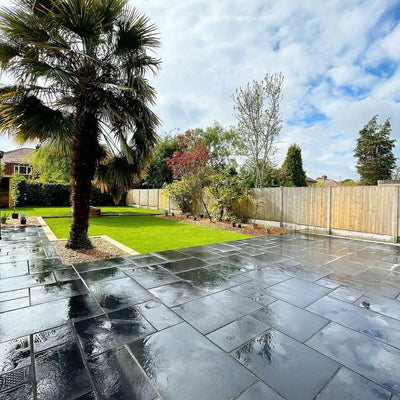
The colour in porcelain goes all the way through the slab — not a surface coating. UV exposure, rain, frost cycles, foot traffic — none of it changes the colour. A porcelain slab in year 20 looks identical to the day it was laid. Sandstone develops a natural patina over time. Some people love that ageing process. If you want permanent consistency, porcelain delivers it.
Every porcelain slab in our range carries an R11 anti-slip rating — tested and certified for safe use in wet outdoor conditions. The textured surface provides reliable grip even in rain. For pool surrounds, areas near water features, and north-facing patios that stay damp, the certified slip rating provides measurable reassurance.
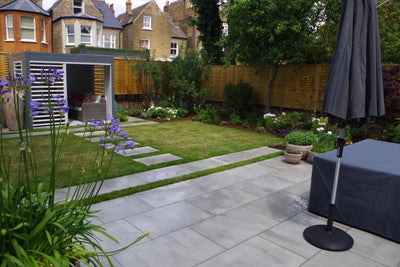
Porcelain is factory-made to exact dimensions. Every slab is the same size, same thickness, same edge profile. This allows tight 3-5mm joints that create the sleek, minimal-joint look that suits modern architecture and bifold door transitions. Sandstone — even calibrated — has natural dimensional variation that requires wider 8-12mm joints. If your design demands precision, porcelain delivers it inherently.
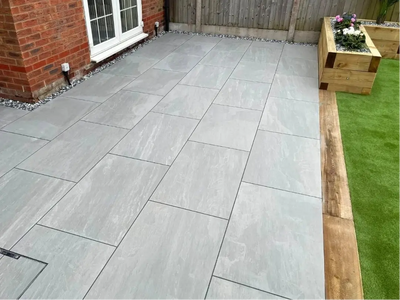
When you order 20m² of Kandla Grey porcelain, every slab matches. No surprises, no wildly different tones. For homeowners who want predictable, controlled aesthetics — particularly on front-of-house patios visible from the street — porcelain's consistency is an advantage. Natural stone's colour variation is charm for some, but an unwanted variable for others.
The 7 cons
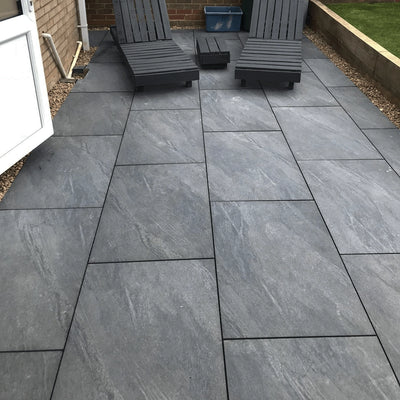
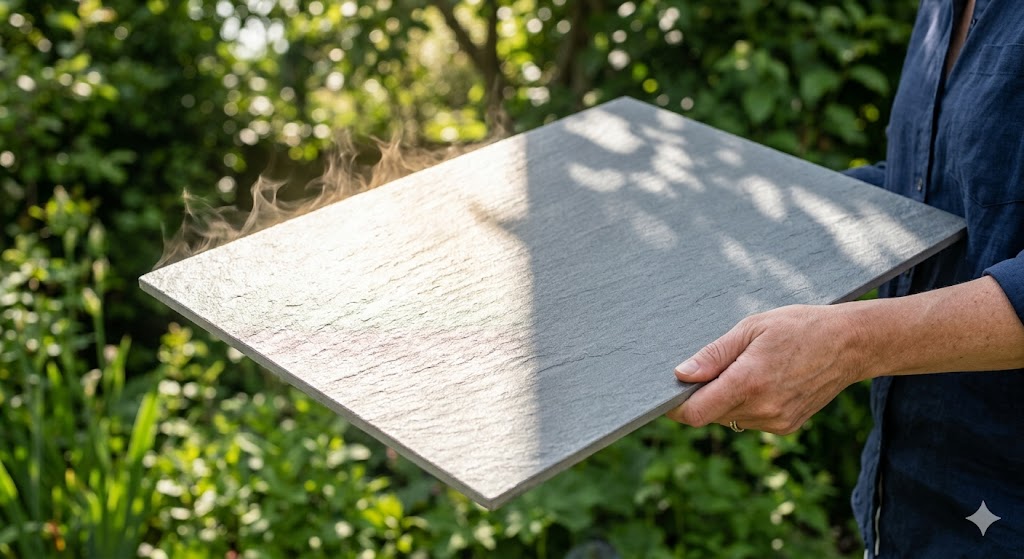
This is the con most porcelain suppliers don't mention. Dark porcelain in direct afternoon sun can reach 48-55°C — uncomfortable and sometimes unsafe for barefoot walking. The non-porous surface that makes porcelain stain resistant also means heat can't escape through evaporation. Light-coloured riven sandstone stays 10-15°C cooler in the same conditions. Solutions: choose a lighter colour, add shade over seating areas, or hose the patio before use. Read our full paving heat comparison.
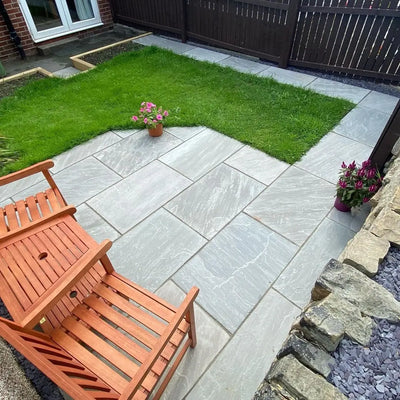
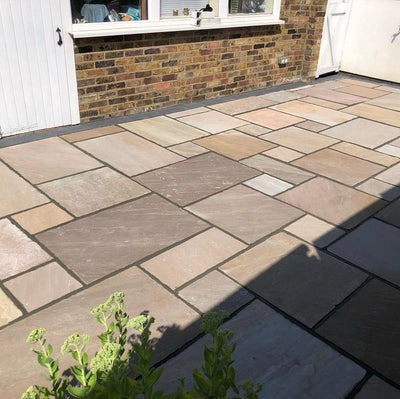
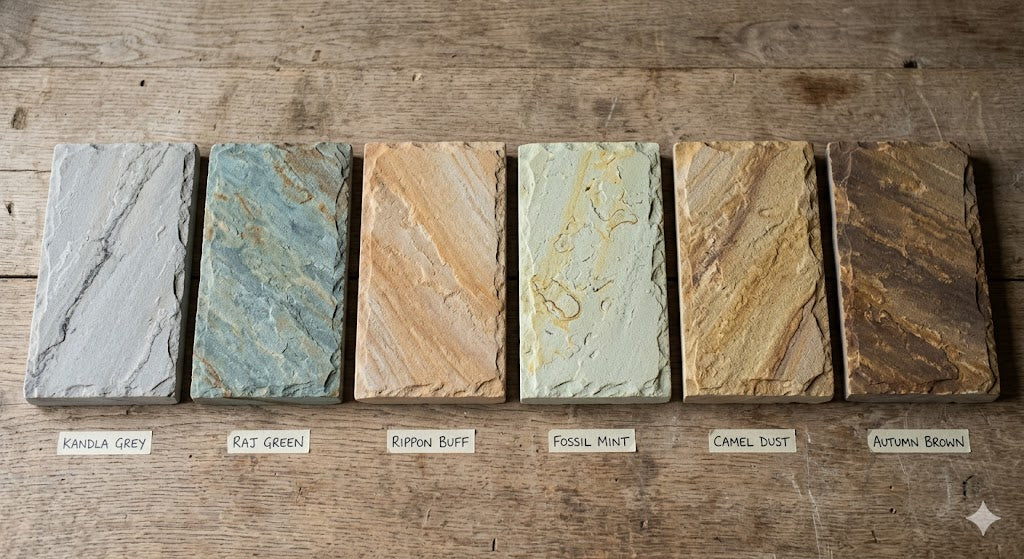
Porcelain's consistency (Pro 7) is also its weakness for many buyers. Every slab looks the same. There's no geological story, no fossil imprints, no unique mineral banding. On a 20m² patio, that uniformity can feel flat and manufactured compared to the depth and character of natural stone. If you've lived with natural stone before, porcelain can feel like moving from a handmade item to a factory product. Worth seeing a large area in person before committing.
Porcelain is extremely hard and dense. You can't cut it with a standard angle grinder and masonry disc — it'll chip, crack, or shatter. You need a diamond wet cutter with a porcelain-specific blade and continuous water cooling. For a DIY patio, this means hiring a wet cutter (£50-80 per day). Sandstone cuts cleanly with a standard angle grinder and diamond disc that most DIYers already own. For complex cuts around drain covers or curves, porcelain is significantly more demanding.
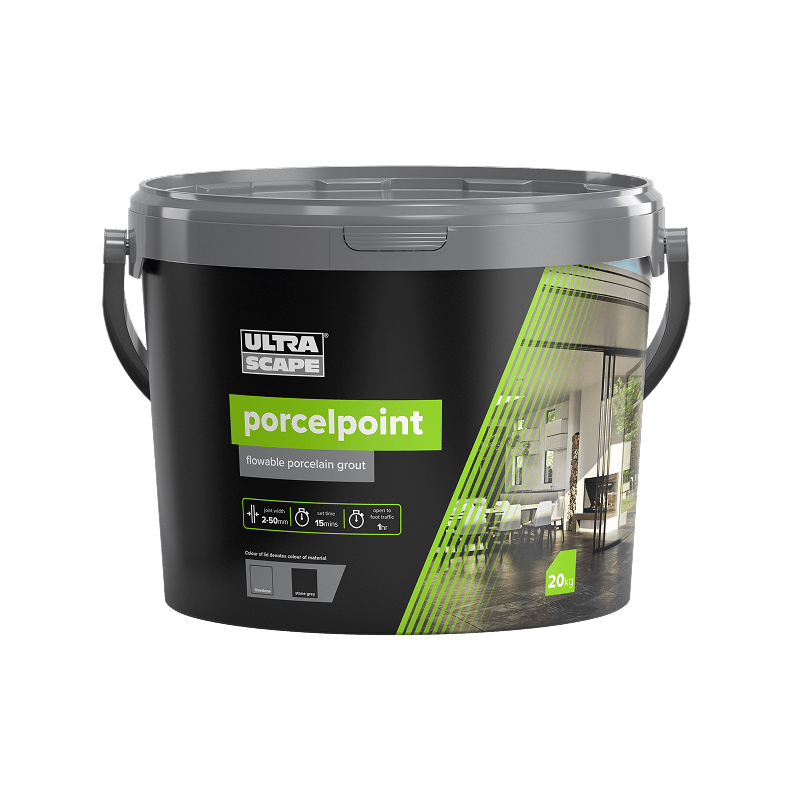
Because porcelain is non-porous, standard mortar won't bond to the back of the slab. Every porcelain slab must be primed with SBR bonding agent on the back before laying. This adds time and cost (approximately £15-25 for a 20m² patio). If you skip the SBR or don't apply it correctly, the mortar bond will fail within 12-24 months and slabs will lift. This is the single most common porcelain installation failure — and it's completely avoidable if you follow the method.
If you crack a porcelain slab in three years and need a replacement, the new slab must come from the same production batch to match. Different batches can have subtle colour differences that show on a laid patio. We always recommend ordering 10% extra and storing the spare slabs for future replacements. Natural stone doesn't have this problem — because every slab already varies, a replacement from any batch blends in naturally.
Tap a laid porcelain slab and it produces a hollow, ceramic sound. Walk across a porcelain patio and you hear it — a subtle but noticeable difference from the solid, dense sound of natural stone underfoot. This bothers some people and doesn't register with others. It doesn't indicate an installation problem — it's the natural acoustic property of a dense, factory-made slab on a mortar bed. But if you're used to the solid feel of stone, it can feel like something is wrong when it isn't.
The clean, uniform surface of porcelain makes jointing lines more visually prominent — especially on light-coloured porcelain with darker pointing. Over time, joint lines can collect dirt and algae that contrast sharply against the pristine slab surface. On natural stone, the organic colour variation disguises joint discolouration naturally. A stiff brush along the joints once a year keeps it under control.
So is porcelain paving worth it?
Porcelain is the right choice if: zero maintenance is your top priority, your patio is near cooking or dining areas where stains are likely, you want consistent modern aesthetics, or you're building a pool surround. The pros outweigh the cons for most UK patios.
Consider sandstone instead if: you want natural character and warmth, barefoot comfort in summer sun matters, you're on a tight DIY budget (easier to cut, no SBR needed), or you prefer the way natural stone ages over time. Read our full sandstone vs porcelain comparison.
We sell both materials in equal volume. Neither is better — they suit different priorities. The worst choice is buying porcelain without knowing about the heat issue, or buying sandstone without knowing about the sealing requirement. Now you know both sides.
See both for yourself
Order samples of porcelain and sandstone. Hold them in your hands, leave them in your garden, and decide with real products — not website photos.
Browse Porcelain Browse SandstoneFrequently asked questions
Is porcelain paving good or bad?
Porcelain paving is excellent for most UK patios — stain resistant, frost-proof, maintenance-free and colourfast. The genuine downsides are heat retention in direct sun, the need for SBR primer during installation, and a lack of natural character compared to real stone. For the majority of homeowners, the pros significantly outweigh the cons.
What are the disadvantages of porcelain paving?
The main disadvantages are: it gets noticeably hot in direct summer sun (48-55°C on dark colours), it requires SBR primer on every slab during installation, it needs a diamond wet cutter for any cuts, replacement slabs must match the original batch, and it lacks the natural variation of real stone. None are dealbreakers — they're trade-offs for the zero-maintenance benefit.
Does porcelain paving crack easily?
No — 20mm outdoor porcelain is extremely strong when properly installed on a full mortar bed over a compacted sub-base. Cracking almost always indicates an installation problem: insufficient sub-base, spot-bedding instead of full-bed mortar, or missing SBR primer causing debonding and flexing.
How long does porcelain paving last?
Porcelain paving lasts 30+ years with proper installation. The material is virtually indestructible — it won't fade, stain, crack from frost, or deteriorate from UV. The limiting factor is always the sub-base and mortar bed beneath it, not the porcelain itself.
Is porcelain paving slippery when wet?
Our porcelain range is R11 anti-slip rated — tested and certified safe for wet outdoor use. Always check the R-rating before buying from any supplier. R11 is the recommended minimum for outdoor residential paving in the UK.