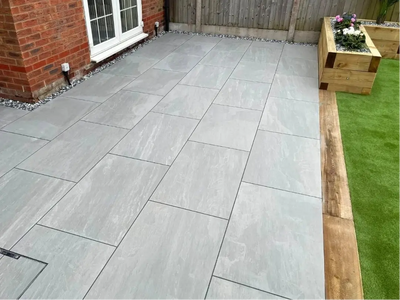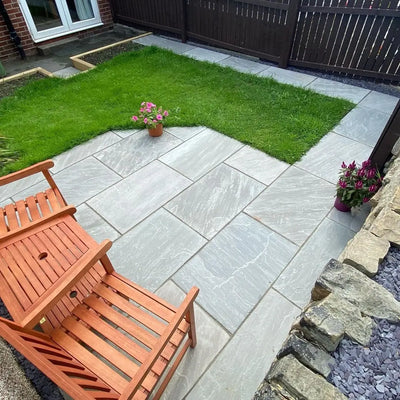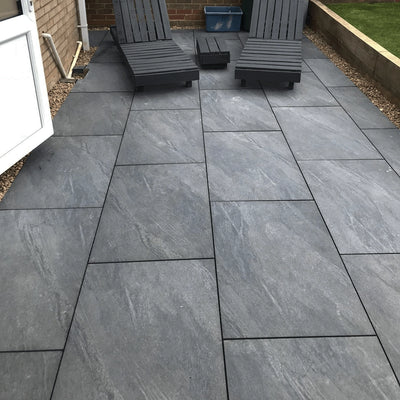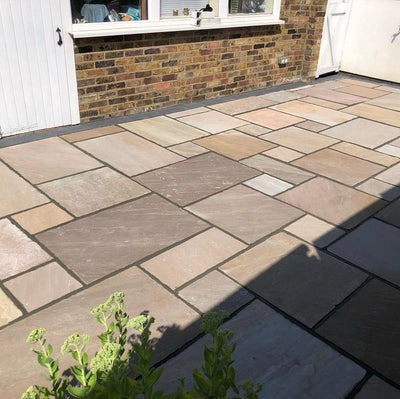







Indian Sandstone vs Porcelain Paving: Which Should You Choose?
We sell both Indian sandstone and porcelain paving. We import them from the same regions. We see customers choose one over the other every day. This guide isn't going to tell you one is "better" — they're different materials that suit different situations. What it will do is give you the honest comparison most paving websites won't, because most paving websites only sell one or the other.
The quick comparison
| Indian Sandstone | Porcelain | |
|---|---|---|
| Material | Natural stone, quarried in India | Man-made, kiln-fired clay and minerals |
| Typical cost | £20–28/m² delivered | £19.09–23.11/m² delivered |
| Appearance | Every slab unique — natural colour variation, veining, texture | Consistent colour and texture across all slabs |
| Maintenance | Occasional cleaning, optional sealing every 2–3 years | Virtually none — clean with water when needed |
| Porosity | Porous — absorbs water, can stain if unsealed | Non-porous — stain-proof, frost-proof, algae-resistant |
| Thickness | 18–22mm calibrated (natural tolerance ±2mm) | Exactly 20mm (±0.5mm) |
| DIY-friendly? | Yes — easier to cut and adjust | Harder to cut (needs diamond blade, no margin for error) |
| Slip resistance | Good (riven finish provides natural grip) | Excellent (R11-rated anti-slip surface) |
| Changes over time | Yes — colours mellow, patina develops | No — looks the same in year 20 as year 1 |
| Best for | Traditional, cottage, rustic, character | Modern, contemporary, low-maintenance |
Cost: what you actually pay
Indian sandstone is cheaper per square metre — typically £20–35/m² delivered for good quality calibrated stone. Porcelain runs £30–55/m² for the same area. That's a meaningful difference on a 20m² patio: roughly £400–600 over the course of a full project.
But the upfront price isn't the full picture. Indian sandstone may need sealing every two to three years (a tub of impregnating sealer costs £30–50 and covers 10–15m²). It may also need more frequent cleaning to prevent algae and moss build-up. Porcelain needs essentially nothing after installation.
If you're on a budget and don't mind spending an afternoon every couple of years on maintenance, sandstone gives you more patio for your money. If you'd rather spend more now and never think about it again, porcelain pays for itself in time saved over a decade.
Appearance: the real difference
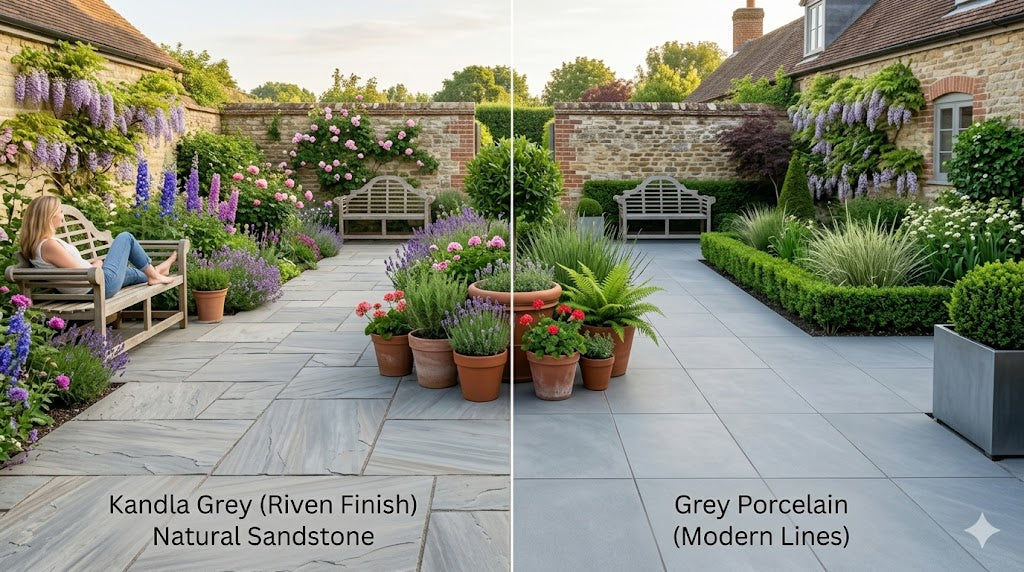
This is where most comparison guides get it wrong. They list colours and finishes and declare a winner. The real difference is philosophical.
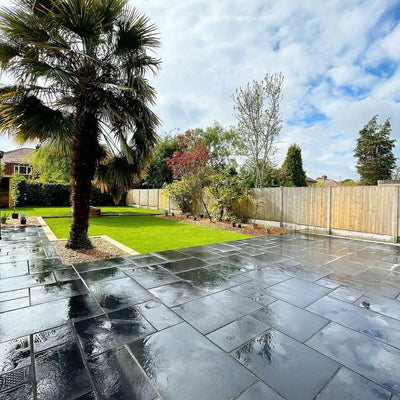
Indian sandstone is alive. Every slab is different. The colours shift between dry and wet. The surface develops a patina over the years. Moss creeps into the edges. The patio becomes part of the garden rather than sitting on top of it. People who love sandstone love it because it changes — because their patio in year five looks different from their patio in year one, and better for it.
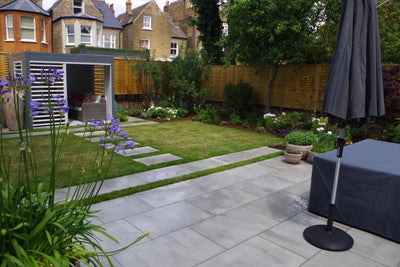
Porcelain is permanent. The colour you see in the showroom is the colour you'll see in 20 years. The surface won't weather, fade, or develop character. It will look exactly as it did the day it was laid. People who love porcelain love it because it doesn't change — because their patio in year ten looks exactly as sharp as the day the landscaper left.
Neither is better. They're fundamentally different design philosophies. The question is which one matches what you actually want.
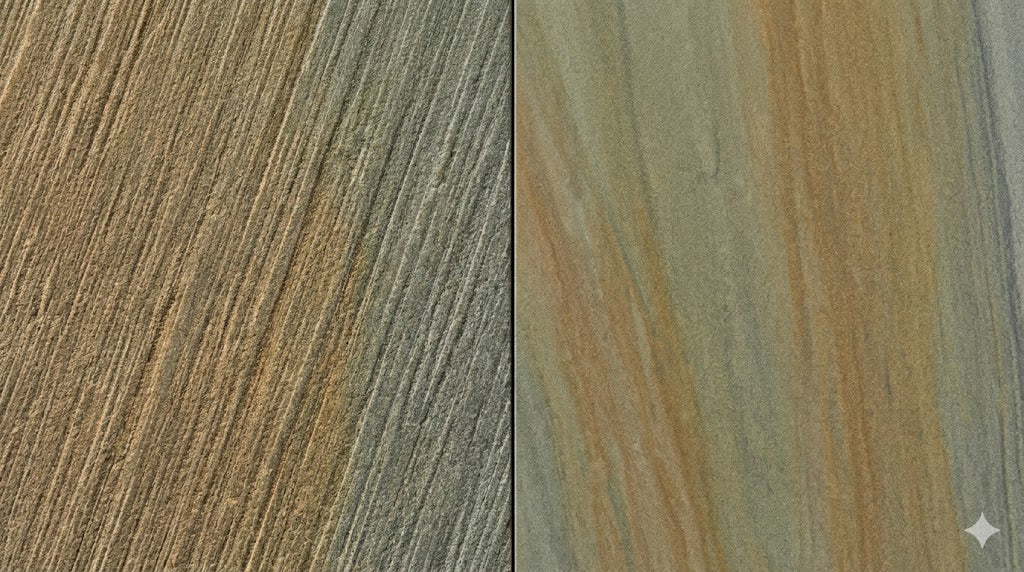
A note on "Kandla Grey Porcelain": Several manufacturers produce porcelain tiles designed to mimic the look of Kandla Grey sandstone. They're good reproductions — the colour is close, the texture is convincing. But they're not the same material. If you want the real thing with all its variation and character, that's sandstone. If you want the Kandla Grey aesthetic with zero maintenance, the porcelain version is an excellent alternative. Browse Kandla Grey Porcelain →
Maintenance: the day-to-day reality
Indian sandstone
Sandstone is porous. It absorbs water, which means it can also absorb stains from oil, wine, food, leaves, and anything else that sits on the surface. A properly applied impregnating sealer significantly reduces this — it closes the pores without changing the appearance of the stone.
Without sealing, sandstone will weather naturally. Colours will mellow. In shaded or damp areas, algae and moss may develop — some people consider this charming, others consider it a nuisance. A yearly scrub with warm soapy water and a stiff brush handles it. A pressure washer on a wide fan setting handles it faster.
The maintenance isn't arduous. It's an afternoon's work once or twice a year, plus a sealer application every two to three years if you choose to seal. But it does exist.
Porcelain
Porcelain has water absorption of less than 0.5%. In practical terms, this means it doesn't absorb stains, doesn't develop moss or algae (nothing has anything to grip onto), doesn't need sealing, and doesn't fade in UV light.
Maintenance amounts to hosing it down when it looks dirty. That's it. In a covered or sheltered area, you might not need to do even that.
If you're the kind of person who enjoys garden maintenance — out with the pressure washer on a spring Saturday, seal the patio in May — sandstone is fine. If maintenance is the thing you dread most about owning a garden, porcelain removes it from your list entirely.
Durability and longevity
Both materials will last decades if properly installed. The stone itself isn't the weak point in either case — it's the installation. A sandstone patio on a proper sub-base with full mortar bed and correct pointing will easily last 25–30 years. Porcelain will last the same or longer.
Where they differ is in what happens if something goes wrong:
Sandstone is relatively forgiving. A cracked slab can be lifted and replaced without disturbing the surrounding slabs. A stained slab can often be cleaned or sealed. Minor surface damage from a dropped tool blends into the natural texture.
Porcelain is less forgiving. The surface is extremely hard and scratch-resistant in normal use, but if a slab does crack (from impact, not wear), the clean break is very visible against the uniform surface. Replacement slabs need to be from the same batch to colour-match perfectly. And because the material is harder, cutting replacement slabs on site is more difficult.
Keep spares. Whichever material you choose, buy at least 5–10% more than you need. Store the extras somewhere dry. If you ever need to replace a damaged slab in five years' time, the exact colour match might no longer be available — especially with porcelain, where production runs can shift tone slightly between batches.
Installation differences
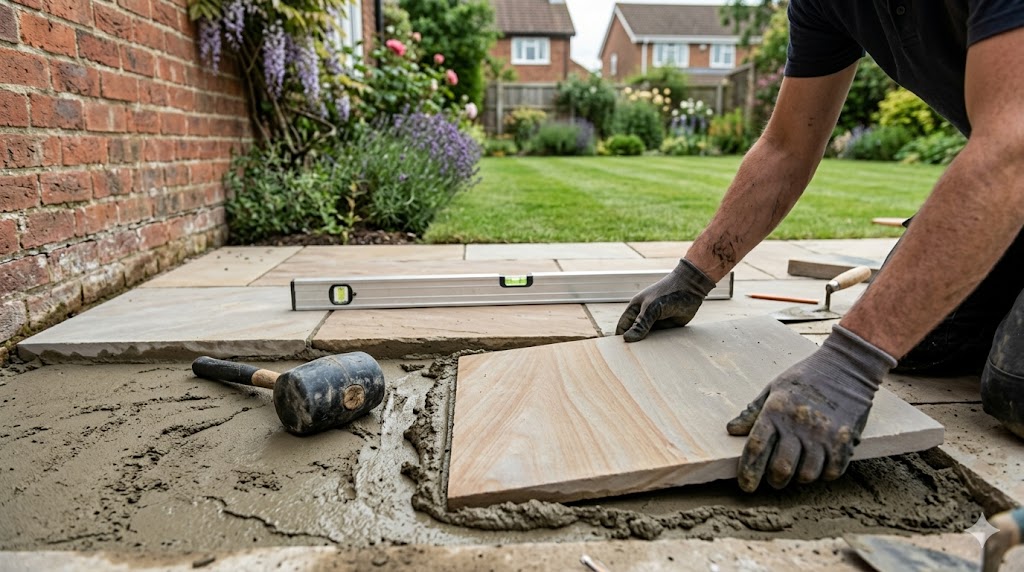
The sub-base preparation is identical for both materials: excavate, lay and compact 150mm of MOT Type 1, mortar bed on top. The differences start when you pick up the slabs.
Indian sandstone is softer and easier to cut. A standard angle grinder with a diamond blade handles it quickly. Because the slabs have natural thickness variation (±2mm even when calibrated), the mortar bed needs to be adjusted slab by slab — a bit more here, a bit less there. This is actually helpful for DIYers because it means small errors in the sub-base can be absorbed by the mortar bed.
Porcelain is extremely dense and hard. Cutting requires a good-quality diamond blade and a steady hand — the material doesn't forgive a wobbly cut the way sandstone does. Because the slabs are precisely 20mm thick (±0.5mm), the sub-base and mortar bed need to be much more accurate. There's less room to adjust. Porcelain also requires a priming slurry on the back of every slab without exception (sandstone benefits from priming but can sometimes bond adequately without it on riven finishes).
If you're laying paving for the first time as a DIY project, sandstone is more forgiving. If you're hiring a professional landscaper, the installation differences are irrelevant — they'll handle either material competently. Choose based on the finished result you want, not the installation process.
Environmental considerations
Indian sandstone is a natural product, quarried from sedimentary rock beds in Rajasthan and other Indian states. The extraction process uses minimal chemicals and relatively low energy. The stone is cut, calibrated, and shipped. The main environmental cost is transport — typically by container ship from India to UK ports.
Porcelain is manufactured from clay, feldspar, quartz, and other minerals fired at 1,200–1,400°C. The firing process is energy-intensive. However, porcelain can theoretically be manufactured closer to market (though most outdoor porcelain sold in the UK is produced in India, Spain, or Italy).
Neither material is particularly harmful. Sandstone is a natural resource with a finite supply but enormous reserves. Porcelain uses common minerals but consumes significant energy in production. Both can be reclaimed and reused. If environmental impact is a major factor in your decision, the difference between them is marginal.
Which should you choose? Real scenarios
"We want a traditional cottage garden patio that ages gracefully"
You want natural variation, warm tones, and a surface that mellows into the garden over time. You don't mind a bit of maintenance.
→ Indian sandstone (Raj Green or Rippon Buff)"We've just built a modern extension with floor-to-ceiling glass"
You want clean lines, consistent colour, and a seamless transition from indoor tiles to outdoor paving. Low maintenance is important.
→ Porcelain (Kandla Grey Porcelain 900×600)"We have young kids and a dog — the patio gets hammered"
You need stain resistance, easy cleaning, and a surface that handles spills, muddy paws, and footballs without showing damage.
→ Porcelain"We're on a budget and want the biggest patio we can afford"
You want maximum coverage for minimum spend. You're happy to maintain it yourself.
→ Indian sandstone (Kandla Grey 600×600)"We're doing this as a DIY project over two weekends"
You want a material that's forgiving to cut, easy to adjust, and doesn't punish small errors.
→ Indian sandstone (Riven finish)"We want the Kandla Grey look but we're lazy about maintenance"
You love the cool grey aesthetic of Kandla Grey sandstone but don't want to seal or scrub. You want it to look the same in ten years.
→ Kandla Grey Porcelain"We rent out a holiday let and need a patio tenants won't destroy"
You need bulletproof durability, stain resistance, and absolutely zero maintenance between guests.
→ PorcelainCan you mix both materials?
Yes, and it's becoming more common. Some homeowners use porcelain for the main patio area (where food, drink, and foot traffic are concentrated) and Indian sandstone for paths, borders, or seating areas further from the house. This gives you the low-maintenance benefit where it matters most and the natural character where you can enjoy it.
If you do mix, keep the colour palette cohesive. Kandla Grey sandstone and Kandla Grey porcelain are designed to sit together — the porcelain reproduces the same grey tones. Using a warm sandstone (Rippon Buff) next to a cool porcelain (silver grey) will look like two different gardens meeting in the middle.
The bottom line
There's no wrong answer here. Both materials make excellent patios that last decades. The decision comes down to three things:
Do you want natural character or manufactured consistency? If you love the idea of your patio developing a unique personality over time, choose sandstone. If you want it to look pristine and identical in year 15, choose porcelain.
How much maintenance are you willing to do? If "none" is the answer, choose porcelain. If an afternoon twice a year doesn't bother you, sandstone is fine.
What's your budget? Sandstone gives you more patio per pound. Porcelain costs more upfront but saves on long-term maintenance.
We sell both because both are excellent products. The right one depends on you, your garden, and how you want to use your outdoor space.
See them both in person
Order samples of any sandstone or porcelain colour. A sample in your actual garden light is worth more than any comparison guide.
Browse Sandstone Browse PorcelainFrequently asked questions
Is porcelain paving better than Indian sandstone?
Neither is objectively better — they serve different needs. Porcelain is lower-maintenance, more stain-resistant, and dimensionally consistent. Sandstone is cheaper, has natural character, and is easier to work with for DIY projects. The best choice depends on your priorities, budget, and the look you're going for.
Is Indian sandstone slippery when wet?
Riven Indian sandstone provides good natural grip in wet conditions thanks to its textured surface. Sawn sandstone is smoother and can become slippery if algae develops. Porcelain paving is typically R11 anti-slip rated, which gives reliable grip even when wet. If slip resistance is a primary concern, textured porcelain or riven sandstone are both good options.
Does Indian sandstone fade?
Indian sandstone doesn't fade in the way that paint or dye fades. The colours mellow over time as the surface weathers and develops a patina. Most people find this enhances the appearance. If you want to preserve the original colour as closely as possible, an impregnating sealer will slow the weathering process. Porcelain does not change colour over time.
Can I lay porcelain myself?
Yes, but it's harder than laying sandstone. Porcelain requires more precise sub-base preparation (the uniform thickness means there's less room to adjust with the mortar bed), a good-quality diamond blade for cuts, and priming on every slab. If you've laid sandstone before, you can handle porcelain. If you've never laid paving, start with sandstone or hire a professional for porcelain.
Which is better value long-term?
Over 20 years, the total cost of ownership is roughly similar. Sandstone costs less upfront but has ongoing maintenance costs (sealer, cleaning products, time). Porcelain costs more upfront but has virtually zero ongoing costs. The calculation depends on how you value your time and whether you enjoy garden maintenance or consider it a chore.