









Patio Drainage: How to Stop Your Patio Flooding
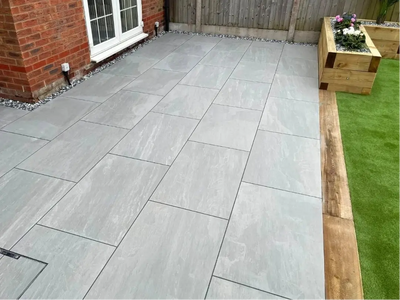
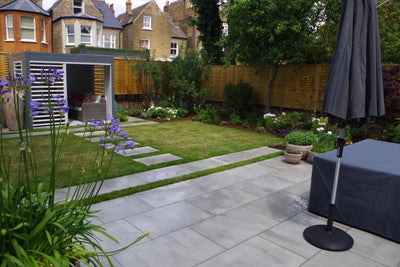
Every patio must slope away from the house at a minimum gradient of 1:80 (12.5mm per metre). This gentle fall is invisible to the eye but moves rainwater away from your walls and off the paving surface. If your patio puddles after rain, the gradient is wrong, the drainage is blocked, or the jointing compound has sealed water in rather than letting it run off. All three are fixable.
Patio drainage isn't glamorous — nobody photographs their drainage channel for Instagram. But it's the difference between a patio that stays clean and safe for 20 years and one that puddles, grows algae, damages pointing, and potentially causes damp in your house. Most drainage problems are caused by installation mistakes that cost nothing to avoid if you plan them before laying.
Why patio drainage matters
Standing water on a patio causes four problems that get worse over time:
1. Damp and structural damage. If the patio slopes toward your house — or is level with no fall — rainwater sits against the wall. Over time it saturates the brickwork, bridges your damp-proof course, and causes internal damp. Fixing rising damp costs £2,000-6,000. Correct patio drainage costs nothing extra during installation.
2. Algae and slip hazards. Standing water creates permanently damp patches where algae thrives. Algae on paving is the #1 cause of outdoor slip injuries in the UK. Read our non-slip paving guide for more on preventing slippery surfaces.
3. Joint failure. Water sitting in and around joints softens mortar-based pointing and can wash out jointing compound over time. Freeze-thaw cycles crack saturated joints. Well-drained patios with proper falls keep joints drier and they last significantly longer.
4. Staining and discolouration. Puddles leave tide marks on natural stone as minerals in the water deposit on the surface during evaporation. Porcelain resists this, but sandstone and limestone show puddle marks clearly — especially on lighter colours like Fossil Mint and Rippon Buff.
The gradient: getting the fall right
The patio surface must slope away from your house. The standard minimum gradient is 1:80 — meaning 12.5mm of fall per metre of patio depth. On a 4-metre-deep patio, that's 50mm lower at the far edge than at the house wall.
| Patio depth | Fall at 1:80 | Visible? |
|---|---|---|
| 2 metres | 25mm | No — completely unnoticeable |
| 3 metres | 37.5mm | No — invisible to the eye |
| 4 metres | 50mm | Barely — only if you look along the surface edge |
| 6 metres | 75mm | Slightly — consider a steeper gradient near the house, shallower at the far end |
How to set the fall: Use string lines pegged at the correct height at both the house wall and the far edge. The sub-base, mortar bed, and slab surface all follow the same gradient. Check with a long spirit level and a shim — a 12.5mm spacer at one end of a 1-metre spirit level should bring the bubble to centre when placed along the fall direction.
Critical rule: The finished patio surface must be at least 150mm below your damp-proof course (DPC). The DPC is the horizontal line visible in the mortar between bricks, usually 2-3 courses above ground level. If your patio level approaches the DPC, you need to lower the whole build — not reduce the drainage gradient.
Where does the water go?
The gradient moves water off the patio surface — but it has to go somewhere. There are four options, from simplest to most engineered:
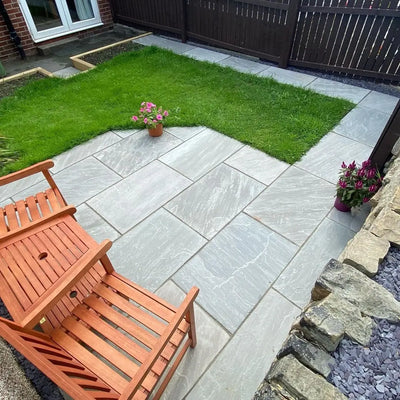
The simplest solution: the patio slopes to the garden and water runs off the edge onto grass or planting beds. The soil absorbs it naturally. This works for most UK residential patios where the garden is lower than the patio edge and the soil drains reasonably well. No additional drainage infrastructure needed.
Doesn't work if: the garden is higher than the patio edge (water runs back), or the soil is heavy clay that doesn't absorb quickly (water pools at the patio edge).
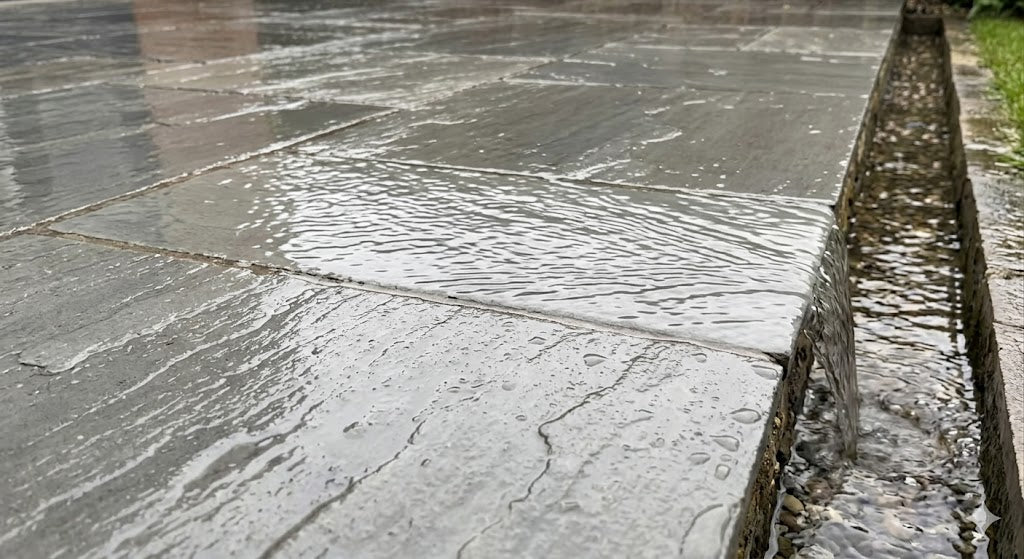
A narrow metal or plastic channel set into the patio surface at the low edge (or where the patio meets the house wall if the fall runs toward the house on an existing build). Water flows along the gradient into the channel, which drains to a soakaway, drain, or garden. Available in stainless steel, galvanised steel, or polymer concrete with slotted or grated covers.
Best for: Patios against a boundary wall where water can't run off onto a garden. Patios on clay soil where run-off pooling is a problem. Situations where you need to intercept water before it reaches a specific area.
Cost: £30-60 per metre for domestic channel drain with grate.
A pit filled with rubble or a purpose-made soakaway crate, buried in the garden near the patio's low edge. Water drains into the soakaway and gradually disperses into the surrounding soil. Suitable for most UK gardens where the water table is low enough and the soil has reasonable permeability.
Size: A typical domestic soakaway for a 20m² patio is approximately 1m × 1m × 1m — filled with clean hardcore or a plastic soakaway crate. It should be at least 5 metres from any building.
Cost: £100-200 DIY (crate + excavation) or £300-500 professionally installed.
A trench filled with gravel around a perforated pipe, running along the low edge of the patio. Water enters through the gravel, flows along the pipe, and drains to a soakaway, existing drain, or lower part of the garden. A French drain is the most effective solution for large patios, clay soil, or properties with known drainage issues.
Size: Typically 300mm wide × 300-500mm deep, running the full length of the patio edge.
Cost: £20-30 per metre DIY (perforated pipe + gravel + geotextile membrane).
Porcelain vs sandstone: drainage differences
The paving material affects how water behaves on the surface:
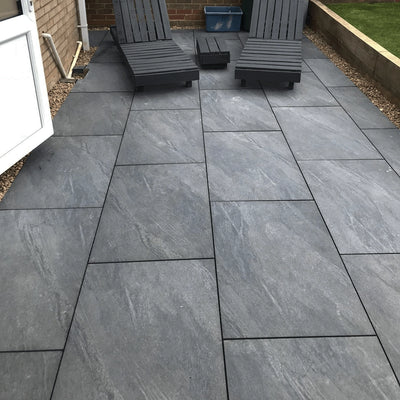
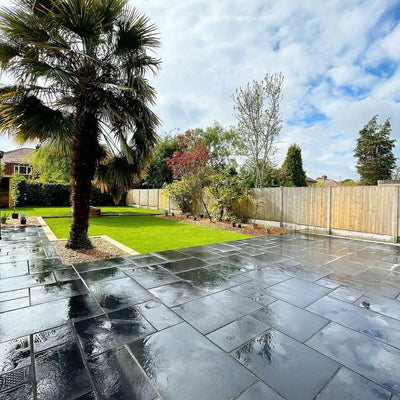
Porcelain is non-porous — water sits on the surface until it runs off via the gradient. This means porcelain relies entirely on the gradient and drainage infrastructure to manage water. If the gradient is wrong, water puddles and stays. The upside: porcelain doesn't absorb water, so it dries faster once the gradient does its job and there's no risk of frost damage from absorbed moisture.
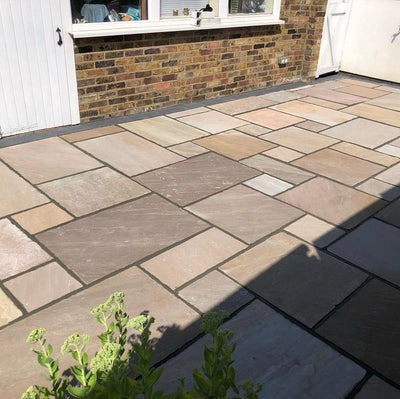
Sandstone is porous — it absorbs some rainwater into the stone itself, which reduces surface run-off during lighter showers. The stone releases this moisture gradually through evaporation. This means sandstone is slightly more forgiving of imperfect gradients during light rain. In heavy downpours, sandstone saturates quickly and behaves like porcelain — the gradient and drainage become critical.
Both materials need the same 1:80 minimum gradient. Porcelain is less forgiving if you get it wrong.
3 drainage mistakes that cause flooding
The most damaging mistake. A flat patio puddles everywhere. A patio sloping toward the house channels every raindrop into your wall. Both are caused by not setting the gradient before laying. Always set string lines at the correct fall BEFORE laying the sub-base — the gradient starts at sub-base level, not at slab level.
If the patio surface is higher than your DPC, rainwater running against the house wall bridges the damp barrier and moisture enters the internal walls. Building regulations require a minimum 150mm gap between patio surface and DPC. If your ground level is too high, lower the build — don't compromise the gap.
A raised edge, retaining wall, or planter at the low end of the patio that blocks water from running off the surface. Water has nowhere to go and pools against the obstruction. If you need a raised edge at the low side, install a drainage channel before the obstruction to intercept the water.
Fixing an existing patio that puddles
If your existing patio already floods, you have three options depending on severity:
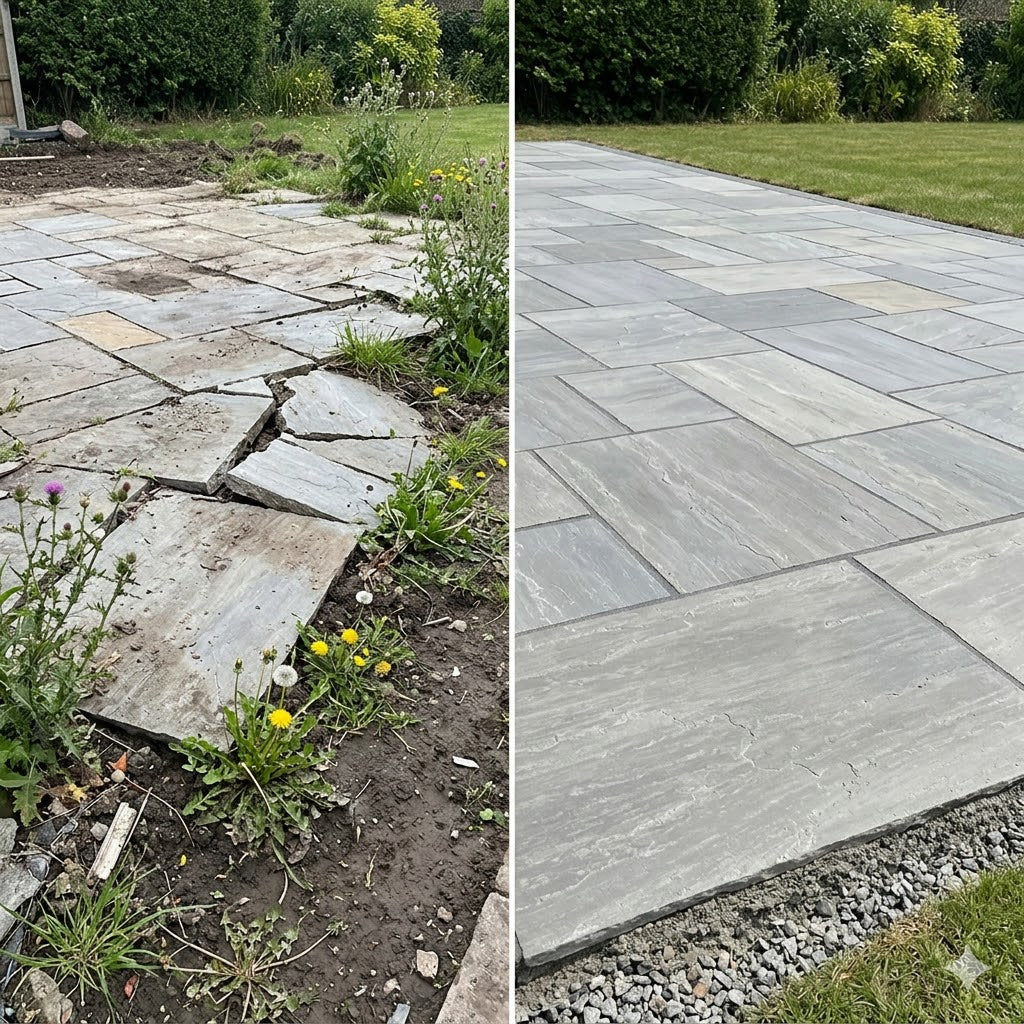
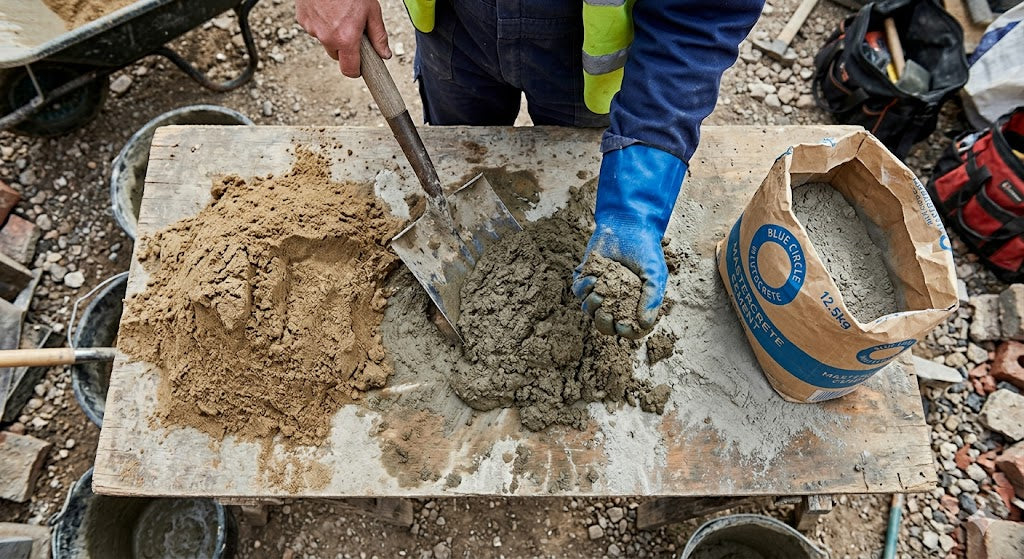
Minor puddles in one or two spots: Lift the affected slabs, add mortar underneath to raise the low spots, and relay. This corrects localised dips without re-laying the entire patio.
Widespread puddles across the surface: The gradient is wrong. Options are to lift and relay the patio with the correct fall (expensive but permanent), or install a retrofit drainage channel at the house-side edge to intercept water before it reaches the wall (cheaper, addresses the damp risk but doesn't fix the surface pooling).
Water pooling against the house wall: Urgent — this causes damp. Install a linear drainage channel along the house wall immediately to intercept water. Long-term, the patio needs re-laying with the correct away-from-house gradient.
Planning a patio? Get the drainage right from the start
Browse our paving range — all prices include VAT and free UK delivery.
Browse Paving Slabs Order SamplesFrequently asked questions
What gradient should a patio be?
Minimum 1:80 (12.5mm of fall per metre) sloping away from the house. On a 4-metre-deep patio, that's 50mm lower at the garden edge than at the house wall. This gradient is invisible to the eye but moves rainwater effectively off the surface.
Does a patio need a drain?
Most residential patios don't need a drain if the gradient directs water onto a lawn or garden bed that absorbs it naturally. You need a drain channel or soakaway if: the patio is bordered by walls on the low side, the soil is heavy clay that doesn't absorb water, or the patio is larger than 30m² where run-off volume overwhelms the garden.
Why does my patio flood?
Three common causes: the gradient is flat or slopes toward the house (installation error), a raised edge or wall is blocking water from running off (design error), or the drainage outlet is blocked with debris (maintenance issue). Check all three before assuming the worst.
Can you fix patio drainage without relaying?
For minor dips that cause localised puddles, yes — lift individual slabs and add mortar to raise the low spots. For widespread drainage failure (wrong gradient), a retrofit drainage channel along the house wall protects against damp but won't fix surface pooling. Major gradient problems require relaying.
Is porcelain harder to drain than sandstone?
Porcelain is non-porous, so all water sits on the surface until the gradient moves it off. Sandstone absorbs some light rainfall, providing a small buffer. In heavy rain both materials depend entirely on the gradient. The same 1:80 minimum fall applies to both — porcelain is simply less forgiving of imperfect gradients.
.%20This%20gentle%20fall%20is%20invisible%20to%20the%20eye%20but%20moves%20rainwater%20away%20from%20your%20walls%20and%20off%20the%20paving...)