






Can You Lay Paving on Soil or Grass? The Honest Answer
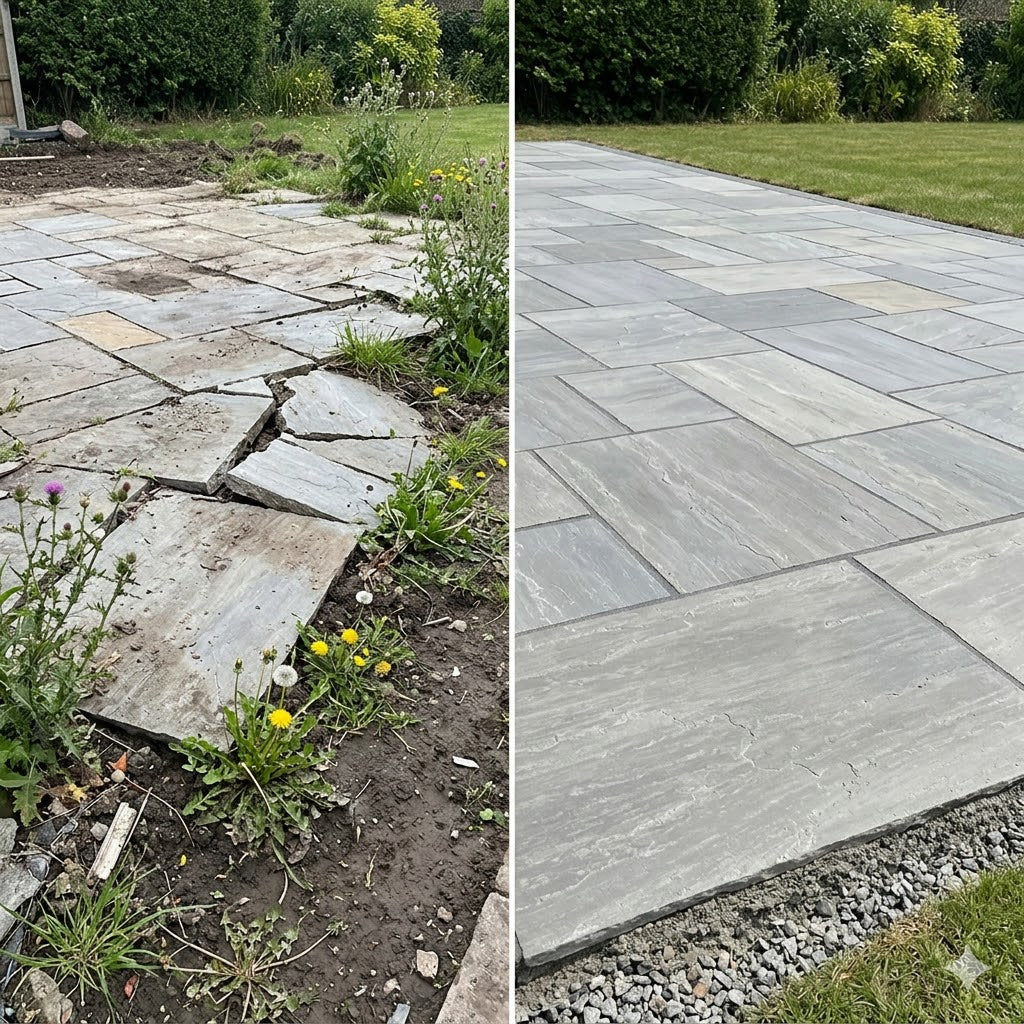
Individual stepping stones can be laid directly on grass or soil — set each slab on a small mortar pad and they'll handle foot traffic for years. But a full patio or path laid directly on soil or grass will fail. Without a compacted sub-base, the ground shifts with moisture and temperature changes, slabs sink unevenly, joints crack open, and the surface becomes a trip hazard within 6-12 months. A proper sub-base costs £150-250 in materials for a 20m² patio — skipping it to save that amount guarantees failure.
This is the most common paving shortcut people ask about — and the one most likely to end in an expensive redo. The temptation makes sense: stripping turf, excavating 200mm of soil, laying and compacting a sub-base, and hiring a skip is the hardest, dirtiest part of any patio project. Skipping straight to the slabs sounds appealing. Here's why it doesn't work, what actually does, and the one exception where laying on grass is fine.
The short answer
| What you want to do | Can you? | Will it last? |
|---|---|---|
| Stepping stones through lawn | Yes ✓ | Years — individual slabs on mortar pads handle foot traffic |
| Temporary path on soil | Sort of | Months — slabs will move and become uneven, fine as a temporary measure |
| Full patio on soil | No ✗ | Fails within 6-12 months — sinking, cracking, trip hazards |
| Full patio on grass | No ✗ | Grass rots underneath, creates unstable layer, slabs sink |
| Patio on sand (no sub-base) | No ✗ | Sand shifts and washes out — slabs move within weeks of rain |
Why laying a patio on soil fails
It's not the paving that fails — it's the ground underneath. Soil does four things that a compacted sub-base doesn't:
When it rains, soil absorbs moisture and swells. When it dries, it shrinks. This constant expansion and contraction moves the slabs above — some sink, some lift, joints crack open. Clay soil is the worst offender — it can expand by 10-15% when saturated. Even sandy soil shifts enough to cause visible movement within one wet season.
Water trapped in soil freezes and expands in winter, pushing slabs upward. When it thaws, the slabs don't settle back to their original position — they've already broken their mortar bond. After one or two UK winters, slabs on soil develop visible ridges and lips that become trip hazards.
Undisturbed soil has varying density across any area — some spots are harder, some softer. Under the uniform weight of paving slabs, the softer spots compress more than the hard ones. The result: an uneven surface that develops dips and bumps within months. A compacted sub-base eliminates this by creating a uniform-density foundation.
Grass, roots, and organic matter trapped under paving decompose over time, creating voids in the soil. Slabs sitting over these voids eventually sink into the gap. This is why laying directly on grass (without removing turf) is worse than laying on bare soil — the decomposing grass layer creates an unstable, gas-producing layer between the soil and the mortar.
The exception: stepping stones on grass
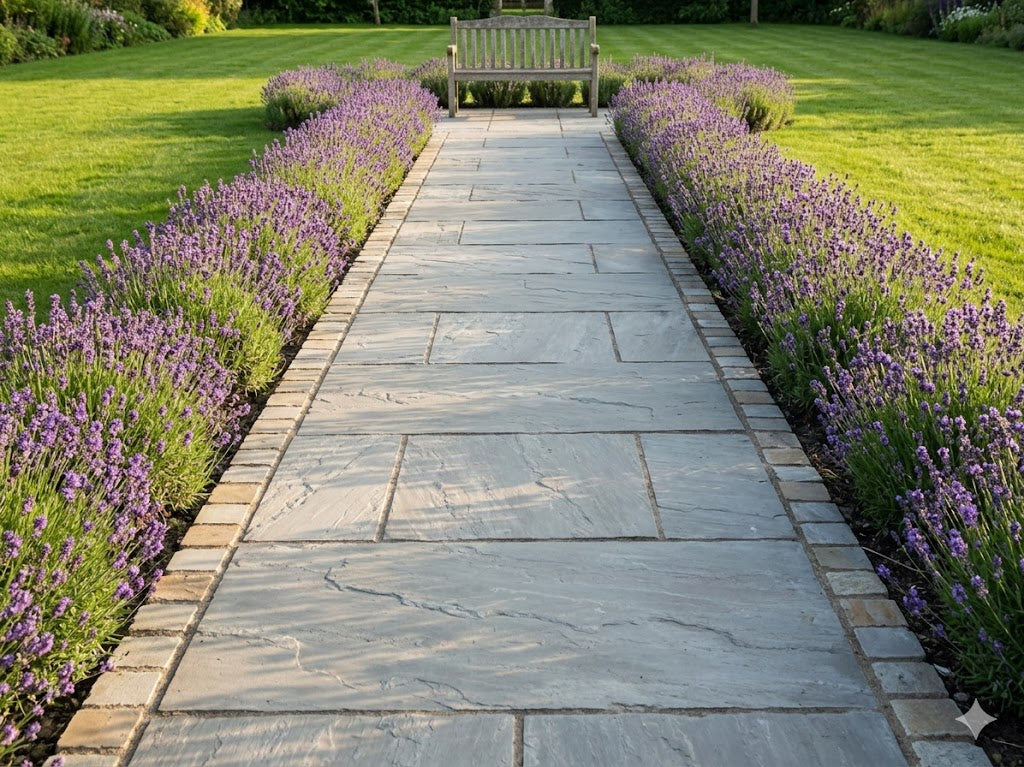
Stepping stones are the one scenario where laying on grass works reliably. Here's why: each slab is independent. If one sinks slightly, it doesn't affect the others. There's no mortar bed connecting them, so soil movement doesn't crack anything. And individual slabs under foot traffic only (no furniture, no heavy loads) don't apply enough pressure to cause significant settling.
Method: Place the slab on the grass. Cut around it with a spade. Remove the turf and excavate 50mm. Fill with a trowelful of mortar (5:1 sand:cement). Set the slab on the mortar, tap level with a rubber mallet. The slab should sit flush with the surrounding grass so the mower passes over it.
Best materials: Kandla Grey sandstone 600×600 or Kandla Grey porcelain 600×600. Match the colour to your main patio. Read our garden path ideas for more stepping stone layouts.
The right way: what goes under a patio
A permanent patio needs layers — each one serving a specific function:
| Layer | Depth | Purpose |
|---|---|---|
| Excavation | 200-250mm below finished level | Remove topsoil, grass, roots, and organic material |
| Sub-base (MOT Type 1) | 100-150mm compacted | Creates a rigid, load-bearing, free-draining foundation |
| Mortar bed | 20-30mm | Bonds slabs to the sub-base, allows fine levelling |
| Paving slab | 20-22mm | The finished walking surface |
| Jointing compound | Fills joints | Locks slabs together, prevents weed growth |
The sub-base is what separates a patio that lasts 20 years from one that fails in 12 months. MOT Type 1 is a graded aggregate that, once compacted with a plate compactor (wacker plate), creates an incredibly stable, free-draining foundation that doesn't move with moisture or temperature changes.
Read our complete sub-base guide for the full excavation and compaction method, or our guide to laying porcelain paving if that's the material you're using — porcelain needs priming as well as a full mortar bed.
How much does a proper sub-base cost?
The sub-base is the step people skip to save money — but the savings are modest compared to the cost of failure:
| Item | Cost (20m² patio) |
|---|---|
| MOT Type 1 aggregate | £100-150 (approximately 3 tonnes) |
| Wacker plate hire | £35-50/day |
| Skip hire (excavated soil) | £200-300 |
| Total sub-base cost | £335-500 |
Compare that to the cost of ripping up a failed patio and starting again: the same sub-base cost PLUS re-buying damaged slabs, re-buying mortar and jointing compound, and skip hire to dispose of the old materials. A failed patio typically costs 60-80% of the original project to fix — because the sub-base work that was skipped first time has to be done anyway, plus all the removal work on top.
For full project costs, use our patio cost calculator.
What about weed membrane under paving?
Weed membrane between the sub-base and mortar bed is not necessary and can cause problems. The membrane prevents the mortar from bonding to the compacted sub-base, creating a slip layer that allows the mortar bed to slide. Weeds in a properly pointed patio come through the joints, not up through 150mm of compacted aggregate and 20mm of mortar. Weed prevention comes from good jointing compound, not membrane. Save it for gravel paths where it serves a real purpose.
Do it right the first time
Browse our paving range — all prices include VAT and free UK delivery. Order samples to choose your material before starting.
Browse Paving Slabs Order SamplesFrequently asked questions
Can I lay paving slabs directly on soil?
Not for a permanent patio. Soil moves with moisture and temperature changes, causing slabs to sink, lift, and crack. Individual stepping stones on soil work for foot traffic, but any continuous paved surface needs a compacted MOT Type 1 sub-base to remain stable long-term.
Can I lay paving on grass without removing it?
No. Grass trapped under paving decomposes, creating voids and an unstable layer that causes slabs to sink unevenly. Always strip the turf and remove all organic material before laying paving. For stepping stones, remove only the turf directly under each slab.
Can I lay paving on sharp sand without a sub-base?
Sand alone is not a sub-base. It shifts, washes out with rainwater, and doesn't provide the rigid foundation that paving needs. Sand is used as part of the mortar bed ON TOP of a compacted sub-base — never as the base itself. Read about laying on concrete for the only shortcut that actually works.
What is the cheapest way to lay a patio?
The most affordable reliable method is: DIY excavation, MOT Type 1 sub-base (compacted with a hired wacker plate), mortar bed, and good-value paving like Kandla Grey sandstone from £20/m². A 15m² DIY patio costs approximately £895 all-in. There is no lower-cost method that lasts — skipping the sub-base just delays the cost.
How deep should I dig for a patio?
200-250mm below your desired finished level. This allows for 100-150mm of compacted sub-base, 20-30mm of mortar bed, and 20mm of paving slab. On clay soil, dig 250mm to allow a deeper sub-base for better drainage. Read our complete sub-base guide.