





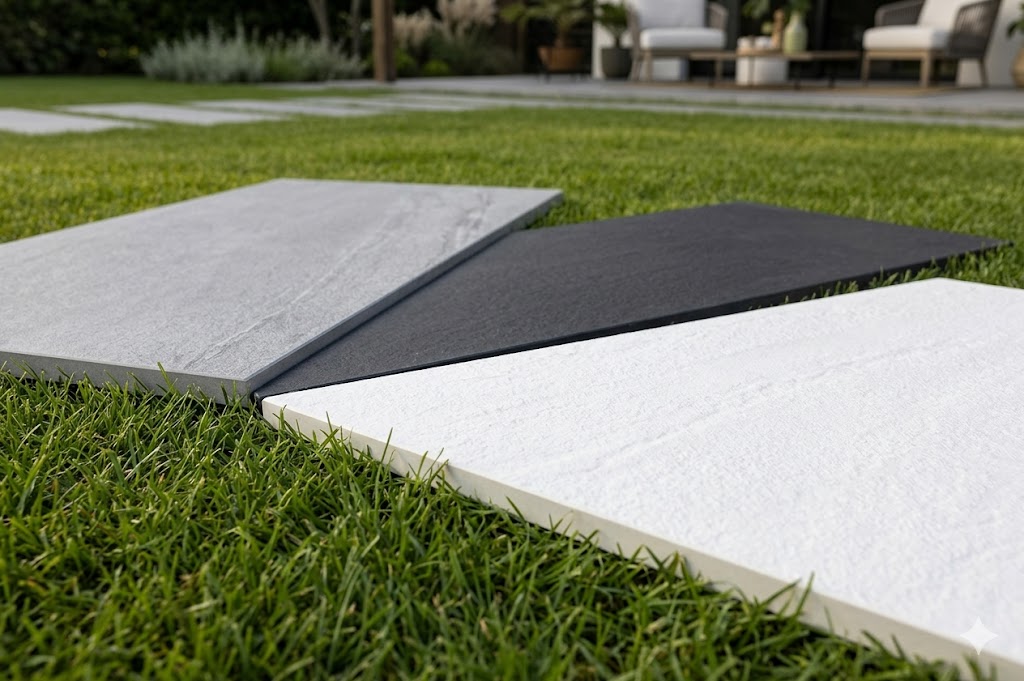
Porcelain Paving: The Complete UK Buyer's Guide
Looking to buy porcelain paving slabs for your UK patio? You're in the right place. This guide covers exactly what you need to know before spending several hundred pounds on materials for a typical 25m² garden patio.
Porcelain paving has become the UK's fastest-growing outdoor flooring choice for good reason: it looks brilliant, lasts 25+ years, needs virtually zero maintenance, and costs less than you probably think. But not all porcelain paving is created equal, and making the wrong choice wastes money.
This buying guide gives you real, current price ranges — plus a live link so you always see today's exact figure — explains sizes and what they suit, covers the specifications that actually matter (R11 slip ratings, 20mm thickness), and helps you choose correctly for your specific garden.
At Universal Paving, we sell porcelain paving slabs in multiple colours and sizes. This isn't a sales pitch — it's the practical information we wish every customer knew before they started shopping around.
Genuine 20mm outdoor porcelain paving runs roughly £22.50–26/m² at Universal Paving, with the most popular greys (including Kandla Grey) around £23–24/m² — all including VAT and free UK mainland delivery. For a typical 25m² patio that's about £560–650 in materials, or roughly £1,075–1,350 professionally installed. For the exact price on any slab today, check the live prices here.

What Is Porcelain Paving? (And Why It Costs What It Does)
Porcelain paving is manufactured outdoor flooring made from fine clay, minerals, and pigments pressed at extreme pressure (400+ tons) then fired at 1,200–1,400°C. This vitrification process creates a dense, glass-like material that's virtually indestructible.
Key characteristics:
- Water absorption: under 0.5% (essentially waterproof)
- Thickness: 20mm for outdoor use (never buy thinner for patios)
- Slip rating: R11 minimum for UK outdoor applications
- Frost resistance: completely frost-proof (vitrified surface)
- Lifespan: 25+ years with minimal maintenance
Why it costs what it does: the manufacturing process is expensive. High-pressure pressing, extreme kiln temperatures and quality control all add up. Suspiciously low-priced porcelain (under about £15/m²) typically comes from lower-quality manufacturing with inconsistent sizing and inferior frost resistance.

UK Porcelain Paving Prices 2026: What You'll Actually Pay
Here are honest, current price bands for quality outdoor porcelain paving (all including VAT and free UK mainland delivery). For today's exact figure on any slab, check the live prices here.
Materials cost per m²
Best-value range (from around £22.50/m²):
- Kandla Grey 900x600 — our bestseller
- Anthracite Black 900x600
- County Light Grey 900x600
- Earthcore Grey, Hammerstone Beige and other 900x600 greys and beiges
Mid range (around £24–25/m²):
- Kandla Grey 1200x600 (large format)
- Kandla Grey Mix Pack (multiple sizes for a random-pattern layout)
Premium range (£25/m²+):
- Specialist finishes, imported European porcelain and unique colours typically sit here.
Total project costs (materials only)
15m² small patio: roughly £340–370
25m² standard patio: roughly £560–650
40m² large patio: roughly £900–1,000
All prices include free UK mainland delivery.
Add installation costs
Professional installation typically adds £20–28/m² for labour, rising to around £28–35/m² in London and the South East.
Total installed cost for a 25m² patio: materials (£560–650) + labour (£500–875 depending on region) = roughly £1,075–1,350 in most of the UK, toward the top of that band in London/SE.

Porcelain Paving Sizes: Which Format for Your Garden?
Porcelain paving comes in multiple sizes. Choosing correctly affects both aesthetics and budget.
900x600mm (most popular)
Coverage: about 46 slabs per 25m² (each slab covers 0.54m²)
Price: from around £22.50/m²
Best for:
- Standard UK patios (15–40m²)
- Contemporary designs
- Balance between coverage speed and manageability
- Two-person DIY installation (slabs are heavy but handleable)
Why it's popular: the sweet spot between large format (dramatic but heavy) and small format (fiddly installation). Creates a modern look without excessive cutting.
1200x600mm (large format)
Coverage: about 35 slabs per 25m² (each slab covers 0.72m²)
Price: around £24–25/m²
Best for:
- Large open patios (30m²+)
- Minimalist contemporary designs
- Creating visual space (fewer joints = cleaner appearance)
- Professional installation recommended (slabs very heavy)
Pros: bold, dramatic, modern aesthetic; fewer joints to maintain.
Cons: heavy (two people minimum), more expensive per m², cutting is more difficult.
600x600mm (square format)
Coverage: about 70 slabs per 25m² (each slab covers 0.36m²)
Price: comparable to 900x600, from around £22.50/m²
Best for:
- Small gardens (under 20m²)
- Intricate patterns
- Areas requiring lots of cutting (around curves, obstacles)
- Solo DIY installation (lighter individual slabs)
Pros: easier handling, less wastage with cutting, suits small spaces.
Cons: more joints to install and maintain, installation takes longer.
Mix packs (multiple sizes)
Typical contents: a combination of 900x600, 600x600, 600x290 and 290x290
Price: around £24–25/m²
Best for:
- Random-pattern layouts
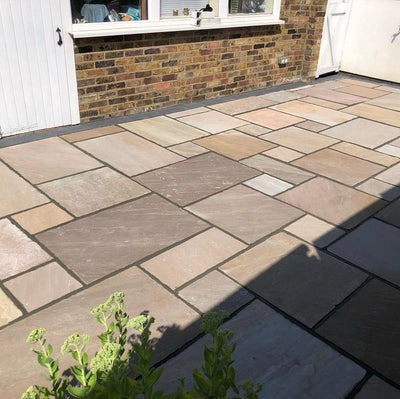
- Traditional "natural stone" appearance
- Breaking up large monotonous areas
Pros: creates visual interest, traditional aesthetic.
Cons: more complex installation, takes longer, higher cost.
Porcelain Paving Colours: What's Available in the UK
Colour choice dramatically affects garden aesthetics. Here's what sells best in the UK:
Grey porcelain (around 60% of UK sales)
Why it dominates: contemporary, neutral, suits modern properties, pairs with any furniture colour.
Options:
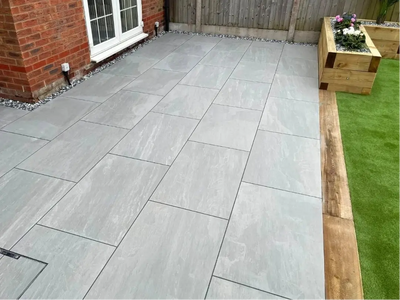
- Kandla Grey: silver-grey with subtle blue undertones (most popular)
- County Light Grey: pale grey, stone-effect finish
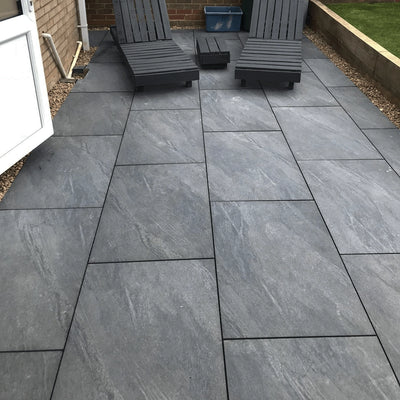
- Anthracite: dark charcoal-grey, bold contemporary
Browse the full grey range — all R11-rated, free UK delivery.
Black porcelain (around 15% of UK sales)
Anthracite Black: deep charcoal-black with tonal variation.
Best for: ultra-modern designs, dramatic contrast, minimalist gardens.
Consider: shows dust and pollen, and gets hot in summer sun.
Beige / buff porcelain (around 10% of UK sales)
Warm neutral tones, softer than grey, suits traditional properties.
Multi-colour / stone-effect (around 10% of UK sales)
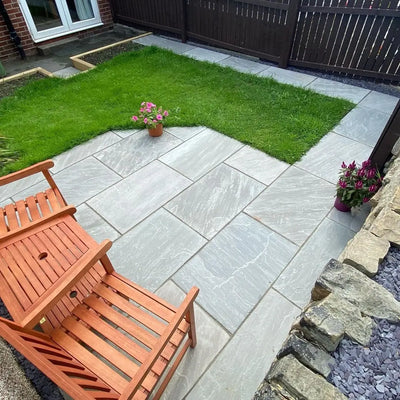
Mimics natural slate or mixed-tone sandstone for a traditional aesthetic.
White / cream (around 5% of UK sales)
Light porcelain: pale, bright, contemporary.
Best for: maximising light in small or shaded gardens.
Consider: staining potential (though porcelain resists better than natural stone).
Critical Specifications: What Actually Matters
Don't buy porcelain paving without checking these specs:
1. Thickness (must be 20mm for outdoor)
20mm: correct for UK outdoor patios — all Universal Paving porcelain.
16mm: lighter duty, usable but less robust.
10mm: indoor only — do not use outdoors (it will crack).
Why it matters: outdoor porcelain needs structural strength for frost cycles, foot traffic and furniture weight. 20mm is the industry standard.
2. Slip rating (must be R11 minimum)
R-rating scale: R9 (low slip resistance) to R13 (extreme grip).
R11: the standard for UK outdoor porcelain — adequate wet grip.
R10 or below: not suitable for UK outdoor use (too slippery when wet).
R12–R13: overkill for domestic patios (very aggressive texture).
All Universal Paving porcelain is R11-rated as standard.
3. Frost resistance (must be frost-proof)
Vitrified porcelain with under 0.5% water absorption is inherently frost-proof. Lower-quality porcelain sometimes has higher absorption, which means a frost-damage risk.
Check: look for "vitrified" or "fully vitrified" in the product specs.
4. Calibrated sizing
Quality porcelain has consistent dimensions (±2mm tolerance). Lower-quality porcelain varies by ±5mm, which means difficult installation with inconsistent joints.
Universal Paving porcelain is calibrated for professional results.

Porcelain Paving vs Natural Stone: The Honest Comparison
The most common buyer question. Here's the truth:
Porcelain paving wins on:
- Zero maintenance (never needs sealing)
- Stain resistance (non-porous surface)
- Colour consistency (every slab identical)
- Frost-proof performance (vitrified composition)
- Lower lifetime cost (no sealing or annual treatment)
Natural stone wins on:
- Authentic character (no two slabs identical)
- Natural variation (organic appearance)
- Develops a patina (ages beautifully)
- Tactile quality (real stone texture)
- Staying cooler underfoot in summer sun
On price: upfront, porcelain and sandstone are now broadly comparable — both popular greys land in the low-£20s per m². Porcelain no longer carries the big premium it once did, but it isn't automatically cheaper upfront either. Its real advantage is lifetime cost: no sealing, ever.
The verdict: choose porcelain for low-maintenance consistency, natural stone for authentic character. Both last 25+ years. Universal Paving stocks both premium porcelain and natural sandstone.
Installation Costs: DIY vs Professional
Porcelain paving requires a specific installation method (full mortar bed + SBR priming). This affects DIY feasibility.
Professional installation
Labour cost: £20–28/m² depending on region and complexity (higher in London/SE).
What you get:
- 100mm compacted sub-base
- 40–50mm full mortar bed
- SBR priming slurry applied to every slab back
- Professional levelling and jointing
- Workmanship guarantee from a reputable installer (typically 12 months)
Total cost (25m² patio): materials (£560–650) + labour (£500–875) = roughly £1,075–1,350.
DIY installation
Feasible if:
- You have paving experience
- You understand mortar bedding
- You own or hire a plate compactor, mixer and wet saw
- You have time (3–5 days for 25m²)
Additional DIY costs:
- SBR primer: £50–60
- Cement: £50
- Sharp sand: £80
- Jointing compound: £60
- Tool hire: £100–150
- Total extra: £340–400
DIY total cost (25m² patio): materials (£560–650) + supplies (£340–400) = roughly £900–1,050, saving around £175–300 versus professional.
Worth DIY? Only if you have experience. Porcelain is unforgiving — installation failures are expensive to fix, and the saving is modest for several days of hard work.
Where to Buy Porcelain Paving in the UK (and What to Avoid)
Buy from:
- Specialist paving suppliers (Universal Paving, established brands)
- Direct importers (better pricing, quality control)
- Suppliers showing exact stock levels
- Companies with physical samples available
- Suppliers including free UK delivery
Avoid:
- Marketplace sellers with no stock (dropshipping)
- Prices too good to be true (under about £15/m² raises quality concerns)
- No R-rating or thickness specified
- "Indoor/outdoor" claims (outdoor-only should be 20mm minimum)
- No sample service available
Universal Paving offers:
- Samples from £5 (delivered in a few days) — order samples here
- Real-time stock visibility
- Free UK mainland delivery
- Phone support: 0115 646 3218
- A full range of grey, black, beige and light porcelain in stock
How to Calculate How Much You Need
Simple formula:
- Measure the patio area (length × width = m²)
- Add 10% for cutting wastage
- Calculate slabs needed based on format
Example (25m² patio, 900x600 slabs):
- 25m² × 1.10 (10% wastage) = 27.5m² needed
- 27.5m² ÷ 0.54m² per slab = 51 slabs
- At around £22.50/m²: 27.5 × £22.50 ≈ £620 total
Coverage guide:
- 900x600: 0.54m² per slab (about 18.5 slabs per 10m²)
- 1200x600: 0.72m² per slab (about 13.9 slabs per 10m²)
- 600x600: 0.36m² per slab (about 27.8 slabs per 10m²)
Most Popular Porcelain Paving Products
Based on actual UK sales — all 20mm, R11-rated, in stock with free UK delivery. For today's exact price on each, see the live range.
- Kandla Grey 900x600 — best-selling grey, stone-effect finish, contemporary blue-grey tones.
- Anthracite Black 900x600 — bold dark grey/black, modern aesthetic.
- County Light Grey 900x600 — pale grey, stone-effect, bright and contemporary.
- Kandla Grey 1200x600 — large-format premium, same colour in bigger slabs.
- Kandla Grey Mix Pack — multiple sizes for a random-pattern, traditional appearance.
The Verdict: Should You Buy Porcelain Paving?
Buy porcelain paving if you want:
- Low-maintenance outdoor flooring (zero sealing, minimal upkeep)
- Consistent colour that never fades
- Frost-proof performance
- A modern, contemporary aesthetic
- A stain-resistant surface
- A 25+ year lifespan
- Competitive pricing (low-£20s per m²)
Consider natural stone instead if you want:
- Authentic natural variation
- Organic character and patina
- A traditional appearance
- Real-stone tactile quality
For most UK homeowners, porcelain paving delivers strong long-term value through minimal maintenance and reliable performance — which is why sales have grown so sharply over the past decade.
Ready to buy? Order samples from £5, browse the full range with live pricing, and get free UK mainland delivery on every order.
Your patio deserves quality materials and correct installation. Porcelain paving delivers both when specified properly.