






How to Choose the Right Paving Size for Your Patio
The size of your paving slabs affects everything — how your patio looks, how much it costs, how easy it is to lay, and how many cuts you need. It's one of those decisions that seems minor but makes a visible difference to the finished result. This guide covers the three most common formats for Indian sandstone and porcelain paving, when each works best, and how to decide.
The three standard formats
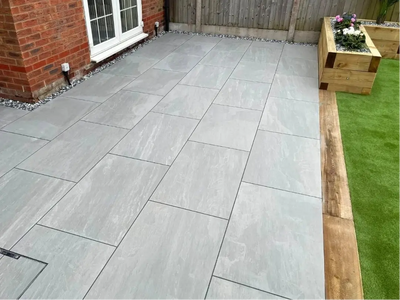
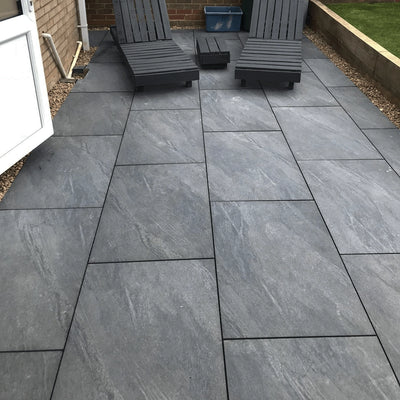
The most popular individual slab size in the UK. Large enough to make a space feel generous, small enough to handle without mechanical lifting. A 900×600 slab weighs approximately 25–30kg in sandstone and 20–22kg in porcelain at 20mm thickness.
Coverage: Each slab covers 0.54m². You need approximately 19 slabs per 10m².
Best for: Modern patios, rear extensions, wide open spaces, contemporary gardens. The rectangular format creates a linear, directional look — especially effective when laid in a running bond pattern with the long edge facing the house.
The traditional paving square. Versatile, easy to handle, and the most budget-friendly option per square metre in most ranges. Slightly lighter than 900×600 — around 18–22kg per slab in sandstone.
Coverage: Each slab covers 0.36m². You need approximately 28 slabs per 10m².
Best for: Smaller patios where 900×600 would look oversized, traditional garden styles, paths and walkways (two slabs wide makes a comfortable 1.2m path), and tighter budgets. The square format is also the easiest to lay in a basic grid pattern.
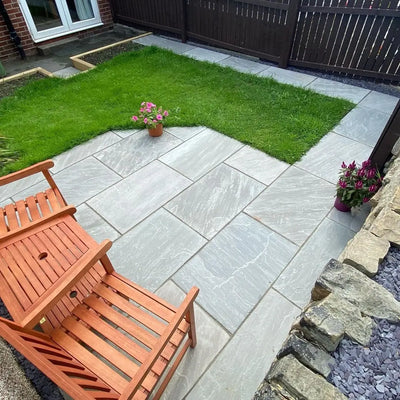
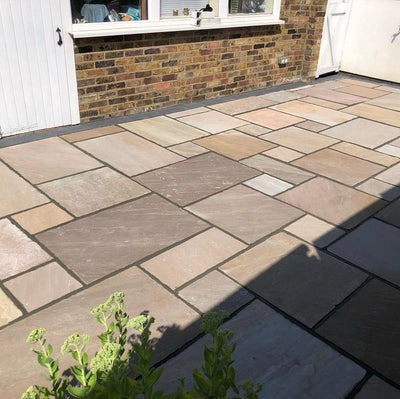
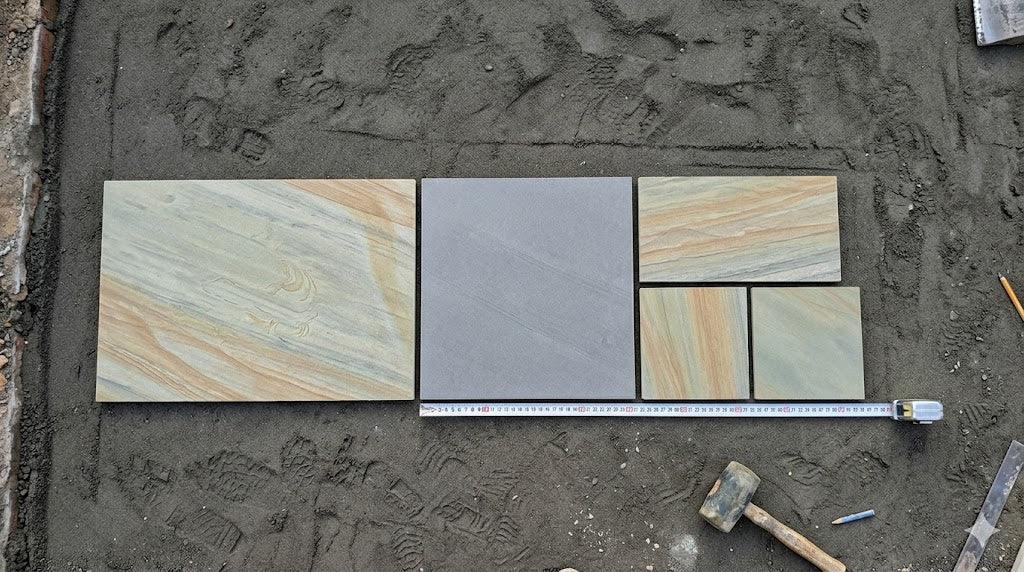
A patio pack contains a mix of sizes — typically 900×600, 600×600, 600×290 and sometimes 290×290 — in a pre-calculated ratio that creates a random-looking but repeating pattern. The pack is designed to cover a specific area (usually 15–20m²) without needing additional slabs.
Coverage: Varies by supplier — our packs are specified in m² on the product page.
Best for: Traditional and cottage gardens, larger patios where a single-size layout might feel monotonous, and projects where you want a more organic, less uniform appearance. Patio packs are the traditional choice for Indian sandstone patios.
How size affects the look of your patio
Larger slabs make spaces feel bigger. Fewer joints mean fewer visual interruptions, which makes the eye travel further across the surface. A small courtyard laid in 900×600 looks noticeably more spacious than the same area in 600×600. This is the main reason 900×600 has become the default for modern patios and extensions.
Smaller slabs add texture and detail. More joints and more variation in layout create a busier, more textured surface that suits informal gardens and traditional settings. A cottage garden patio laid in a mixed patio pack looks warmer and more characterful than the same area in uniform large slabs.
Mixed sizes create movement. The varying scale of a patio pack leads the eye around the surface and prevents the monotony that can affect large, single-format patios. This is why patio packs remain the most popular option for sandstone specifically — the natural variation in the stone pairs well with the variation in the layout.
A design principle worth remembering: the slab size should be proportional to the space. A tiny 6m² patio laid in 900×600 slabs will look like it's been tiled with three rows of stone. The same space in 600×600 or a patio pack feels more resolved. Conversely, a large 40m² patio in 600×600 can feel like a car park without the visual interest that larger or mixed formats provide.
How size affects cost
In most ranges, 600×600 is the cheapest per square metre because it's the highest-volume format with the simplest processing. 900×600 typically costs 5–15% more per square metre. Patio packs are usually priced between the two.
However, larger slabs mean fewer joints, which means less pointing compound, less cutting time, and faster installation. If you're paying a landscaper by the day, the labour saving on a 900×600 patio vs. a 600×600 patio can partially offset the higher material cost.
The hidden cost of cuts: complex patio shapes (L-shaped, curved edges, angles) require more cutting. Larger slabs generate larger offcuts — some of which are too small to use and become waste. If your patio shape is irregular, 600×600 slabs often produce less waste because the smaller format creates smaller, more usable offcuts. Factor this in when calculating how much to order.
How size affects installation
900×600: Heavier and requires two people to position comfortably. The weight means each slab beds into the mortar more readily. Fewer slabs to lay per square metre, so the project moves faster. But each slab needs to be more precisely aligned — errors are more visible with the longer edge.
600×600: Light enough for one person to handle. Easier to adjust and reposition. More joints to point, which adds time at the finishing stage. The square format is simpler to lay in a basic grid but can be slightly tedious on larger areas.
Patio pack: Multiple sizes mean you need to plan your layout carefully before laying. The trick is to open all packs simultaneously and avoid creating lines where joints align across more than two slabs. Most suppliers provide a laying pattern diagram — follow it, at least loosely.
Which size for your project?
"Small courtyard, 8m², modern townhouse"
Limited space that needs to feel as open as possible. Clean, contemporary setting.
→ 900×600 — fewer joints, more spacious feel"20m² family patio behind a semi-detached"
General-purpose patio for dining, playing, barbecuing. Budget is a consideration.
→ 600×600 or mixed patio pack — best value, versatile"Cottage garden, 25m², surrounded by planting"
Traditional setting where the patio should feel natural and organic, not uniform.
→ Mixed patio pack — variation suits the informal setting"New build extension with floor-to-ceiling glass"
The patio is a visual extension of the indoor living space. Clean, large-format tiles inside.
→ 900×600 (or 1200×600 in porcelain if available) — matches the indoor scale"Garden path, 1.2m wide, 8m long"
A functional path connecting the patio to the garden shed, side gate, or lawn.
→ 600×600 — two slabs wide gives a comfortable 1.2m path with minimal cuttingHow to calculate how much you need
Measure your patio area in square metres (length × width). Then add 10% for cuts and waste. For irregular shapes, break the area into rectangles, calculate each one, and add them together.
Quick reference: a 900×600 slab covers 0.54m², so you need about 1.85 slabs per m² (or 19 per 10m²). A 600×600 slab covers 0.36m², so you need about 2.78 slabs per m² (or 28 per 10m²). Our product pages show coverage per pack and per pallet — use those figures rather than calculating from scratch.
Browse by size
All sizes in stock at our Nottingham warehouse with free UK mainland delivery.
900×600 Sandstone 600×600 Sandstone