






8 Paving Laying Patterns Every Homeowner Should Know
The laying pattern affects how your patio looks as much as the colour or material. The same Kandla Grey sandstone laid in a running bond looks completely different from a stack bond or random pattern. Some patterns make spaces feel bigger, some add formality, some hide cutting errors. Here are eight patterns, when to use each, and how hard they are to lay.
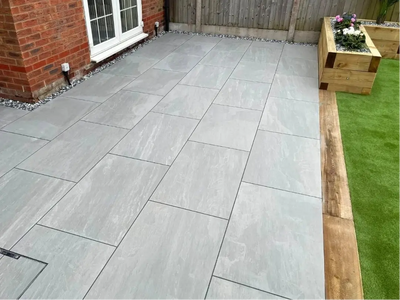
Each row is offset by half a slab from the row below — exactly like brickwork. This is the most popular pattern for 900×600 paving because the staggered joints create a clean, directional look that draws the eye across the patio.
│ ││ ││ │
└──────────┘└──────────┘└──────────┘
┌──────────┐┌──────────┐┌────────
│ ││ ││
└──────────┘└──────────┘└────────
Each row offset by 50% — like brickwork
Why it works: The staggered joints prevent any continuous line running across the patio. This makes the surface read as a unified plane rather than a grid of individual slabs. The directional flow suits long, narrow gardens because it draws the eye lengthwise.
Lay direction tip: Run the long edge of the slabs parallel to the longest boundary of the patio for maximum visual length. Running them perpendicular makes the space feel wider but shorter.
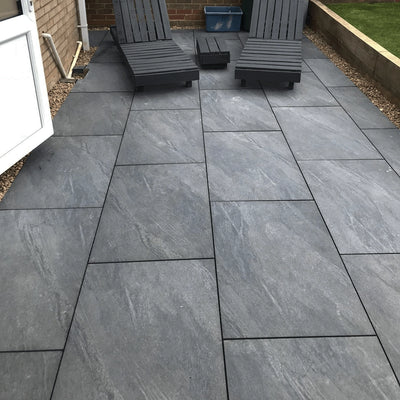
Slabs laid in a straight grid — all joints aligned horizontally and vertically. The simplest possible pattern. It creates a clean, formal, contemporary look but requires more precision because any misalignment is immediately visible against the straight grid lines.
│ ││ ││ │
└──────┘└──────┘└──────┘
┌──────┐┌──────┐┌──────┐
│ ││ ││ │
└──────┘└──────┘└──────┘
All joints aligned — perfectly square grid
Why it works: The geometric precision suits ultra-modern and minimalist designs. Particularly effective with large-format porcelain slabs where the tight joints and consistent colour create an almost seamless surface.
Warning: Stack bond is unforgiving. If your sub-base isn't perfectly level or your joints aren't perfectly consistent, the straight lines expose every error. Use with sawn/porcelain slabs (not riven — the irregular edges fight the grid).
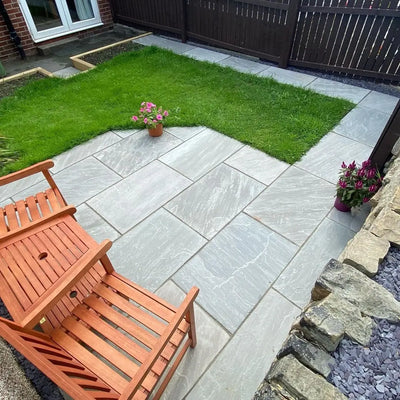
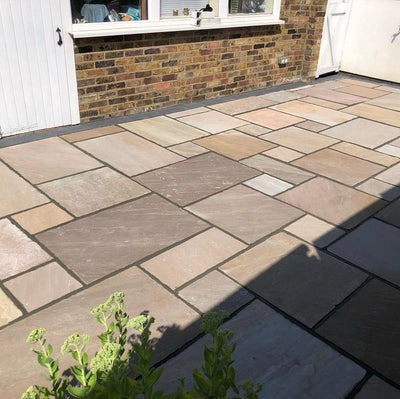
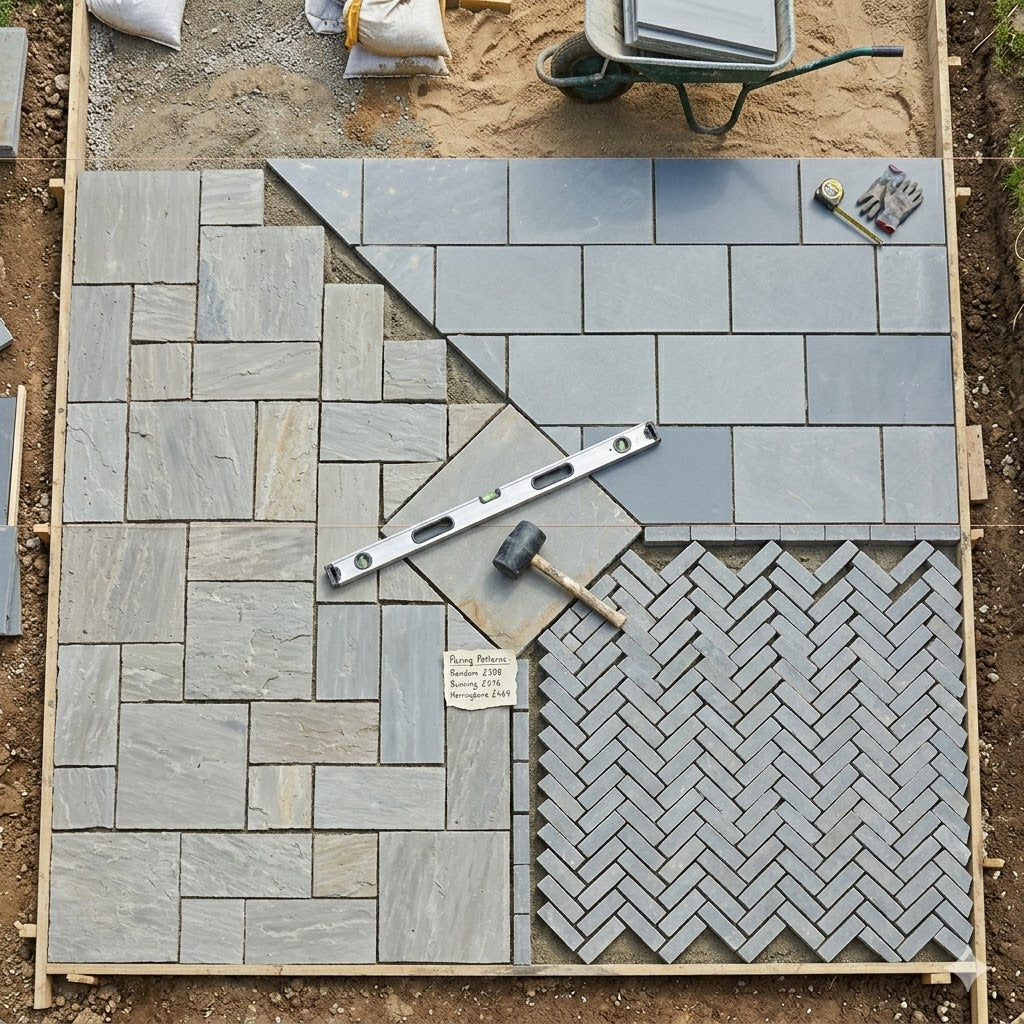
Multiple slab sizes (typically 4 sizes: 900×600, 600×600, 600×290, 290×290) laid in a seemingly random pattern. It's not actually random — it follows a repeating layout that avoids long continuous joints. This is the traditional British sandstone patio pattern and the most popular layout for sandstone patio packs.
│ ││ ││ │
└──────────┘│ │└──────────┘
┌────┐┌────┘└────┘┌──────────┐
│ │┌──────────┐│ │
└────┘│ │└──────────┘
Mixed sizes in a repeating pattern
Why it works: The mix of sizes creates visual interest and movement across the surface. Combined with the natural colour variation of sandstone, it produces a richly textured patio that feels organic and established — like it's always been there.
Key rule: Never let a joint line run continuously across more than two slabs. This is called "breaking the joint" and it's what prevents the random pattern from looking like a grid with gaps.
Slabs laid at 45° or 90° to each other in interlocking V-shapes. Herringbone is traditionally associated with brick driveways and block paving, but it works beautifully with rectangular paving slabs — particularly setts (200×100mm) and smaller format slabs. It's the strongest pattern structurally because the interlocking prevents lateral movement.
╲╱ ╲╱ ╲╱
╱╲ ╱╲ ╱╲
╱ ╲╱ ╲╱ ╲
45° herringbone — slabs interlock in V-shapes
Why it works: Visually dynamic and structurally robust. Herringbone adds energy and movement to a patio and is the strongest pattern for areas that take heavy foot traffic or vehicle loads (setts on driveways). The pattern naturally draws the eye in a zigzag, adding interest to even a single-colour surface.
Warning: Herringbone produces significant waste at the edges (every edge slab needs cutting at 45°). Budget 15–20% extra for cuts. It's also the most time-consuming pattern to lay accurately.
Pairs of slabs laid alternately horizontal and vertical, creating a woven texture. Works best with rectangular slabs where the long edge is exactly twice the short edge (e.g. 600×300, 200×100 setts). The alternating pairs create a checkerboard of directional texture.
│ ││ │ ═══ ═══
└───┘└───┘
═══ ═══ ┌───┐┌───┐
═══ ═══ │ ││ │
└───┘└───┘
Alternating pairs — horizontal then vertical
Why it works: Traditional, formal, and elegant. Basketweave has a heritage feel that suits period properties, formal gardens, and entrance paths. The woven texture adds visual interest without the complexity of herringbone.
Similar to running bond, but each row is offset by one-third instead of one-half. This creates a more dynamic, cascading effect that feels less rigid than standard running bond. The joints form a gentle diagonal flow across the patio.
└──────────┘└──────────┘└──────────┘
┌──────────┐┌──────────┐┌────────
└──────────┘└──────────┘└────────
┌──────────┐┌──────────┐┌─────
└──────────┘└──────────┘└─────
Each row offset by 33% — creates diagonal flow
Why it works: Slightly more interesting than running bond, still very easy to lay. The diagonal flow adds a subtle sense of movement without the complexity of herringbone. Works well with both sawn and riven slabs.
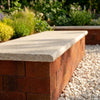
Not a full-patio pattern but a border treatment: a single row of slabs or setts laid lengthwise around the perimeter, with a different pattern (running bond, stack bond) filling the centre. The border "frames" the patio and creates a clean, defined edge.
║┌──────┐┌──────┐┌────║
║│ ││ ││ ║
║└──────┘└──────┘└────║
║ ┌──────┐┌──────┐┌─║
║ │ ││ ││ ║
║ └──────┘└──────┘└─║
═══════════════════════
Border course framing a running bond interior
Why it works: The border adds a sense of completeness and formality. It works with any interior pattern and is particularly effective when the border is a different material or colour — porcelain edging planks around sandstone, or sandstone setts around porcelain.
A regular stack bond (grid) rotated 45° so the slabs sit as diamonds rather than squares. This makes a small space feel larger because the eye follows the diagonal lines corner-to-corner (the longest dimension) rather than wall-to-wall.
◇◇◇◇
◇◇◇◇◇
◇◇◇◇◇◇
◇◇◇◇◇
◇◇◇◇
Grid rotated 45° — all slabs sit as diamonds
Why it works: The diagonal orientation is a powerful visual trick in small gardens — it draws the eye across the longest dimension of the space. Particularly effective with 600×600 porcelain where the uniform colour and precise edges suit the geometric pattern.
Warning: Every edge slab needs cutting at 45°, which generates significant waste. Budget 15–20% extra and plan your cuts carefully.
Which pattern for which situation?
First patio, DIY: Running bond (Pattern 1). Easiest to lay, most forgiving, looks professional with minimal skill.
Modern extension with bifolds: Stack bond (Pattern 2) in porcelain. Clean, contemporary, seamless indoor-outdoor transition.
Traditional cottage garden: Random pattern (Pattern 3) with a sandstone patio pack. The classic British patio layout.
Driveway or heavy-traffic path: Herringbone (Pattern 4) with setts. Strongest pattern structurally.
Small garden — make it feel bigger: Diagonal stack bond (Pattern 8) or diagonal running bond. The 45° lines stretch the visual dimensions.
Add a finished look to any patio: Soldier course border (Pattern 7). Works with any interior pattern and any material combination.
Always dry-lay first. Whatever pattern you choose, lay out the slabs dry (without mortar) in your proposed pattern before committing. This lets you check the layout, balance the colour variation, and identify where cuts will be needed — without the pressure of setting mortar. Read our full laying guide for the complete installation process.
Choose your slabs
All sizes and formats in stock — 600×600, 900×600, 1200×600, patio packs, setts, and edging planks.
Browse All Paving Order Samples