











8 Questions to Ask Any Paving Supplier Before You Order
Before ordering paving slabs from any supplier, ask about the total delivered price (including VAT and delivery), whether the product is physically in stock, actual delivery timeframes, split pallet charges, return policies, and what happens if slabs arrive damaged. These eight questions reveal the true cost and experience before you commit.
Most paving suppliers show you a great headline price and hope you don't dig deeper. The real cost, the real lead time, and the real experience only become clear after you've paid — by which point it's too late. Ask these eight questions before you order from anyone, including us, and you'll avoid the problems that fill paving supplier review pages.
Does the price include VAT and delivery?
Always check whether the displayed price includes VAT (20%) and delivery. Some paving suppliers show ex-VAT prices that jump 20% at checkout. Others advertise "free delivery" but add postcode surcharges for certain regions, or charge extra for tail-lift service.
A paving slab listed at £18/m² ex-VAT is actually £21.60/m² once VAT is added. Add a £50–80 delivery charge and the "bargain" price suddenly isn't. The only way to compare suppliers accurately is to compare the total cost at checkout — after VAT, delivery, and all surcharges are applied — for the same quantity to the same postcode.
All prices displayed include VAT. Delivery is free to all UK mainland addresses with no minimum order. No postcode surcharges, no congestion zone fees, no tail-lift premiums. The price on the product page is the price you pay at checkout.
Prices shown "from £X +VAT" or "delivery calculated at checkout" or "free delivery on orders over £1,000." These all mean the final cost will be higher than the advertised price.
Is the product actually in stock right now?
Ask whether the paving is physically held in a UK warehouse or ordered from a manufacturer after you pay. "In stock" on a website doesn't always mean the product is in a warehouse ready to ship. Some suppliers list products as available but order them from overseas or from a manufacturer's warehouse after receiving your payment.
This matters because stock-held products ship in 1–3 days. Products ordered from manufacturers after payment can take 2–6 weeks — and if you've booked a landscaper, those weeks cost real money in wasted labour charges and project delays.
The supplier holds stock in their own UK warehouse. Product pages show real-time stock levels (e.g. "8 in stock"). Orders are dispatched within 24 hours. Delivery arrives in 2–5 working days.
"Ships in 5–7 working days" (they're ordering it after you pay). "Delivery dates are estimated" without a firm dispatch window. No stock quantity shown on the product page.
Are there split pallet charges?
A split pallet charge is an extra fee some suppliers add when you order less than a full pallet. If a full pallet covers 22m² and you need 15m², the supplier may charge £30–80 extra to break the pallet. This fee is often not visible until checkout.
Split pallet charges penalise buyers whose patio doesn't happen to match the exact coverage of a full pallet — which is most people. A 20m² patio needs 22m² of paving (with 10% waste), but if the full pallet covers 18.9m², you need two packs and might be charged extra for the second partial pack.
No split pallet charges. Buy the quantity you need — full pallet, half pallet, individual packs — same price per m² regardless. No small-order surcharges.
"Split pallet charge: £X per order" appearing at checkout. Or worse — the charge exists but isn't mentioned until the order confirmation email.
What's the actual delivery timeframe?
Check the difference between dispatch time and delivery time. "Dispatched within 24 hours" plus "2–5 working days delivery" means you'll receive the paving within a week. "Dispatched within 5–7 working days" plus delivery time could mean 2–3 weeks.
Delivery delays are the single most common complaint on paving supplier review pages. Across every major supplier, 1-star reviews disproportionately mention late delivery, missed delivery windows, and poor communication about delays. Ask for a specific delivery window — not just a vague "5–7 days" — and get confirmation in writing before booking a landscaper.
Clear dispatch commitment (e.g. "dispatched within 24 hours"). Specific delivery window (e.g. "2–5 working days"). Proactive communication — the supplier contacts you with a delivery date, you don't have to chase them.
"Delivery dates are estimated and not guaranteed." Multiple reviews mentioning late deliveries, missed dates, or having to chase for updates. No tracking information provided.
What happens if slabs arrive damaged?
Paving slabs are heavy and fragile. Breakages in transit happen with every supplier — the question is how they handle it. Ask what the process is for reporting damage, how quickly replacements are sent, and whether you'll be charged for a second delivery.
A reasonable breakage rate is 2–5% of slabs. That's why we recommend ordering 10% extra — it covers both cuts and breakages. But if an entire pallet arrives badly damaged (10%+ breakage), the supplier should replace the damaged slabs at no cost to you, including free re-delivery.
Clear damage reporting process (photo the damage, email within 48 hours). Free replacement slabs shipped promptly. No re-delivery charge for replacements. The supplier takes responsibility rather than blaming the courier.
"Damage must be reported within 24 hours or no claim." Supplier blames the courier and directs you to file a separate claim. Replacement delivery charged at full delivery rate.
Is the supplier a direct importer or a reseller?
A direct importer buys from the quarry or factory and sells to you — one margin in the price. A reseller buys from an importer or manufacturer and adds their own margin on top. The same Indian sandstone slab can cost 20–30% more from a reseller than from the importer who brought it into the UK.
This doesn't mean resellers are bad — they offer wider brand selection and the convenience of browsing multiple manufacturers in one place. But if you already know what material and colour you want, buying from a direct importer typically saves you significant money on the same product.
How to tell: ask the supplier where the stone comes from and whether they imported it themselves. Direct importers will name their source (quarry, region, country). Resellers will name the brand or manufacturer they buy from.
"We import directly from [source country] and hold stock at our UK warehouse." One supply chain, one margin, transparent pricing.
Vague sourcing information. Can't tell you where the stone was quarried. Multiple middlemen in the chain (quarry → exporter → importer → wholesaler → retailer → you).
Can you see the product before ordering?
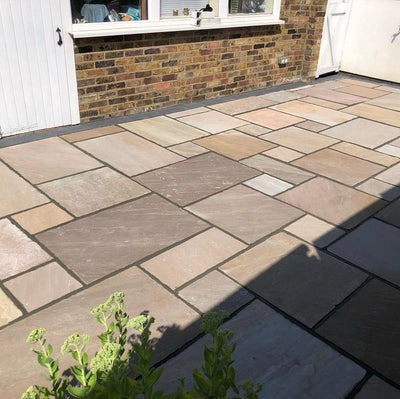
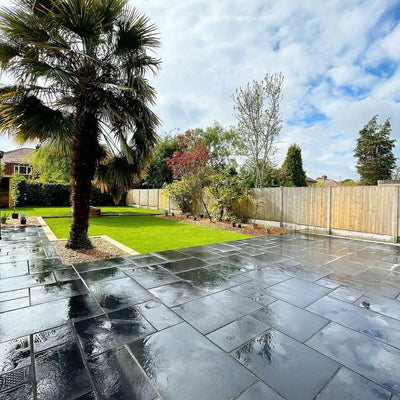
Paving looks different on screen than in person. Colours shift depending on the lighting, the moisture level, and the surrounding materials. Before committing to 20m² of paving, try to see at least a sample slab in your own garden — in both sun and shade, wet and dry.
Most reputable paving suppliers offer sample slabs — either free or for a small charge (typically £3–5 per sample). Some have physical yards or showrooms where you can see full pallets. If a supplier doesn't offer samples and doesn't have a showroom, you're ordering blind.
Sample slabs available for every product in the range. Physical yard or warehouse where you can see stock in person. Product photos show the paving in natural light, not studio-lit or colour-enhanced.
No sample service available. Product photos look heavily edited or shot in studio lighting that doesn't represent real outdoor colours. Reviews mention "colour was nothing like the website."
What do the negative reviews actually say?
Every paving supplier has negative reviews — the important thing is what the complaints are about. Read the 1-star and 2-star reviews and look for patterns. Isolated complaints happen to every business. Repeated complaints about the same issue (delivery delays, damage, refund problems) indicate a systemic problem.
The three most common complaints across UK paving suppliers are: late delivery (paving arriving days or weeks after the promised date), transit damage (broken or chipped slabs), and poor communication (having to chase for updates). A good supplier isn't one with zero complaints — it's one that resolves problems quickly and takes responsibility rather than deflecting.
Check Trustpilot and Google reviews for any supplier you're considering. Pay particular attention to how the company responds to negative reviews — do they apologise and fix the problem, or do they argue and deflect? The response tells you more about the company than the review itself.
Negative reviews are responded to promptly and constructively. The supplier acknowledges the problem, explains what went wrong, and describes how they fixed it. Overall rating is 4.0★ or above with a meaningful number of reviews (50+).
No response to negative reviews. Defensive or argumentative responses. Reviews mentioning the same problem repeatedly (especially delivery delays or refund difficulties). Very few reviews overall (under 20) — not enough data to judge.
The quick checklist
Before ordering paving from any supplier, confirm all eight:
☐ Price includes VAT and delivery — no extras at checkout
☐ Product is physically in stock at a UK warehouse
☐ No split pallet charges or small-order fees
☐ Specific dispatch and delivery timeframe confirmed
☐ Clear damage/breakage policy with free replacements
☐ You understand whether they're a direct importer or reseller
☐ Samples available so you can see the product in person
☐ Trustpilot/Google reviews checked — especially the negatives
Any supplier who ticks all eight is worth ordering from. Any supplier who avoids answering one or more of these questions is telling you something — and it's not good.
How we measure up
We're a direct importer. All prices include VAT and free UK delivery. No split pallet charges. Stock held at our Nottingham warehouse. Dispatched within 24 hours. Samples available for every product. Check us against the list above — and check every other supplier too.
Browse Paving Slabs Order SamplesFrequently asked questions
What should I look for when choosing a paving supplier?
Check whether prices include VAT and delivery, whether the product is physically in stock, the actual delivery timeframe, split pallet charges, damage/return policies, and whether they're a direct importer or reseller. Read Trustpilot and Google reviews — particularly the 1-star and 2-star reviews — to spot patterns in complaints before ordering.
Why are some paving suppliers so much more affordable than others?
The biggest factor is the supply chain. Direct importers buy from the quarry and sell to you — one margin. Resellers buy from importers or manufacturers and add a second margin. The same Indian sandstone paving slab can be 20–30% more expensive from a reseller than from the direct importer who brought it into the UK. Hidden fees (delivery charges, split pallet fees, postcode surcharges) also create significant price differences between suppliers who look similar on headline price.
Is it safe to buy paving online?
Yes — most major UK paving suppliers operate online and deliver nationwide. To buy safely, check the supplier has a physical UK address and phone number, read their Trustpilot or Google reviews (50+ reviews minimum), verify their return policy covers damaged goods, and order a sample before committing to a full order. Avoid suppliers with no reviews, no physical address, or prices that seem too good to be true.
What are split pallet charges?
Split pallet charges are extra fees some paving suppliers add when you order less than a full pallet. For example, if a full pallet covers 22m² and you need 15m², you may be charged £30–80 extra for the supplier to break the pallet and ship a partial quantity. Not all suppliers charge this — ask before ordering, and look for suppliers who allow any quantity without surcharges.
How long does paving delivery take in the UK?
Delivery time varies by supplier. Stock-held products from a UK warehouse typically arrive in 2–5 working days. Products ordered from manufacturers after payment can take 1–3 weeks. Always confirm whether the supplier dispatches from their own warehouse (faster) or orders from a third party after you pay (slower). Get a specific delivery date in writing before booking a landscaper.
What is the difference between a paving importer and a paving reseller?
A direct importer buys paving from the quarry or factory overseas, ships it to their UK warehouse, and sells directly to you. A reseller buys from importers or manufacturers already in the UK and adds their own margin. Direct importers typically offer lower prices because there are fewer middlemen in the supply chain. Resellers offer wider brand selection because they stock products from multiple sources.


,%20whether%20the%20product%20is%20physically%20in%20stock,%20actual%20delivery%20timeframes,%20spli...)