








From Quarry to Garden: How Your Paving Slab Gets to You
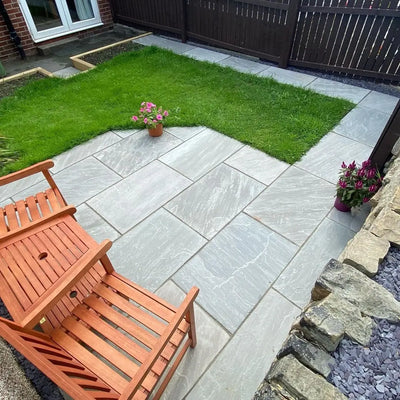
The Kandla Grey sandstone slab on your patio is somewhere between 145 and 170 million years old. It formed when dinosaurs roamed the earth, from layers of sand compressed under an ancient seabed in what is now Rajasthan, India. It survived continental drift, the formation of the Himalayas, and 150 million years of geological pressure. Then someone cut it out of a hillside, loaded it onto a ship, and sent it to Nottingham so you could eat breakfast on it. Here's how that journey works.
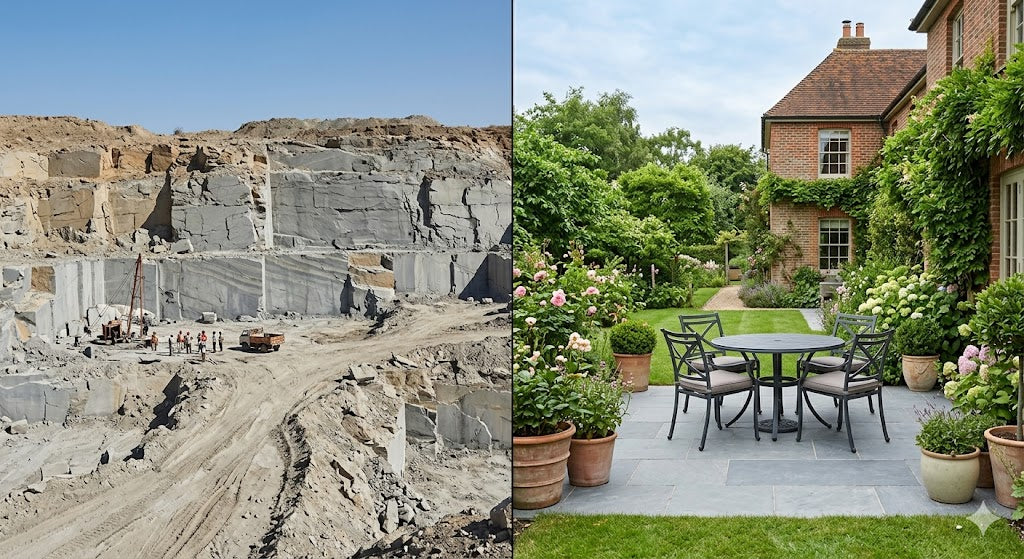
Indian sandstone is quarried in the Jodhpur and Kota districts of Rajasthan — a vast, arid region in northwest India where sedimentary rock formations sit close to the surface. The stone is extracted in large blocks using a combination of diamond wire cutting, wedging, and controlled splitting along the natural bedding planes.
Each colour comes from a different geological formation. Kandla Grey comes from quarries near the town of Kandla. Raj Green from the Rajnagar region. Fossil Mint from formations rich in ancient marine fossils. The colour isn't painted or treated — it's the natural mineral composition of the stone itself, formed over millions of years.
Once extracted, the raw blocks are transported to processing yards where they're cut to standard UK sizes (600×600, 900×600, patio packs), calibrated to consistent thickness (typically 22mm), and finished — either left naturally riven (split along the grain for a textured surface) or sawn and honed (cut and polished for a smooth, contemporary finish).
Before packing, every batch is inspected for thickness consistency (±1mm tolerance), colour range (ensuring the mix is representative of the colour family), structural integrity (no cracks, delamination, or weak spots), and dimensional accuracy (each slab within specification for its stated size).
Slabs that don't meet specification are rejected at source. This matters because quality control at the quarry end prevents problems arriving at your door — cracked slabs, wildly inconsistent thickness, or colours that don't match the product listing. The tighter the QC at source, the fewer issues on delivery.
Inspected slabs are packed onto wooden pallets, wrapped, and loaded into 20-foot or 40-foot shipping containers. Each container holds roughly 20–25 tonnes of paving — enough to cover 400–600m² of patio depending on the slab thickness and size.
Containers are shipped from Mundra Port on India's west coast to UK ports — typically Felixstowe or Tilbury. The sea crossing takes approximately 3–4 weeks. We schedule shipments regularly to maintain consistent stock levels, so by the time one container's stock starts running low, the next is already on the water.
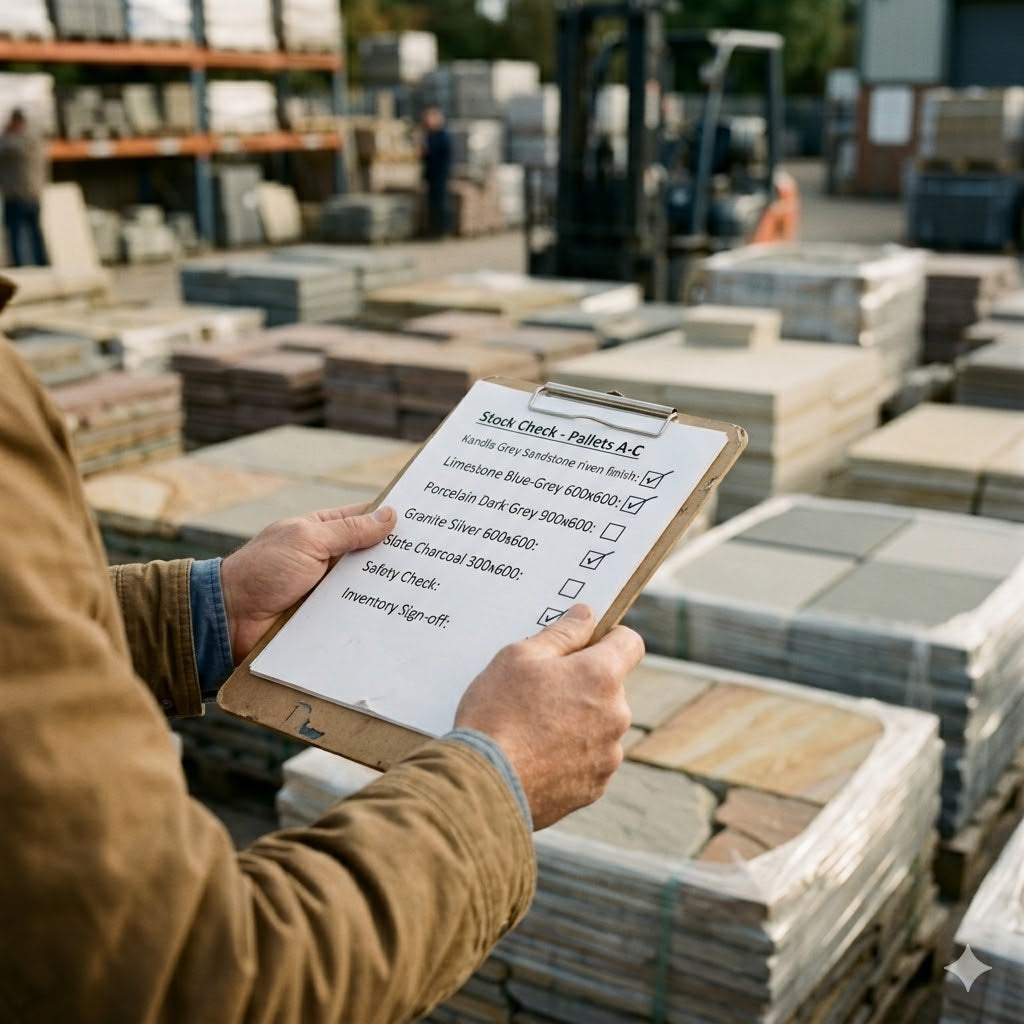
Containers arrive at our Nottingham warehouse where they're unloaded, inspected again (checking for transit damage), and stored on racking by product, colour, and size. At any given time, we hold 1,000+ pallets across our full range — sandstone, porcelain, limestone, granite, and slate.
This is the critical difference between a direct importer and a reseller. We physically hold the stock. When you order, your paving is already here — on a pallet, in a warehouse, ready to be loaded onto a lorry. We don't order it after you pay. We don't wait for a manufacturer to ship it. It's here. That's why we can dispatch within 24 hours and deliver in 2–5 working days.
You place an order on our website. The price includes VAT and free UK mainland delivery — nothing to add at checkout. Your order is picked from warehouse stock, loaded onto a pallet, and booked onto a haulier for delivery to your address.
We use tail-lift lorries for residential deliveries, which means the driver can lower your pallet to kerbside level without needing a forklift at your end. You'll receive a delivery notification with a date and time window so you know when to expect it.
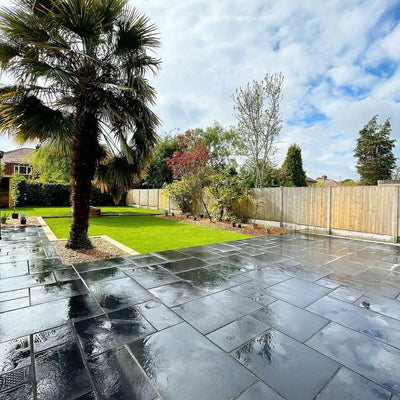
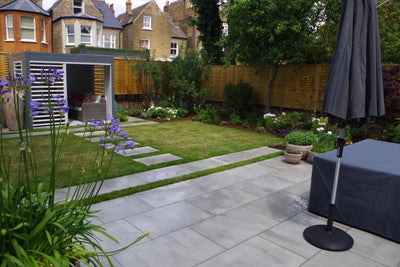
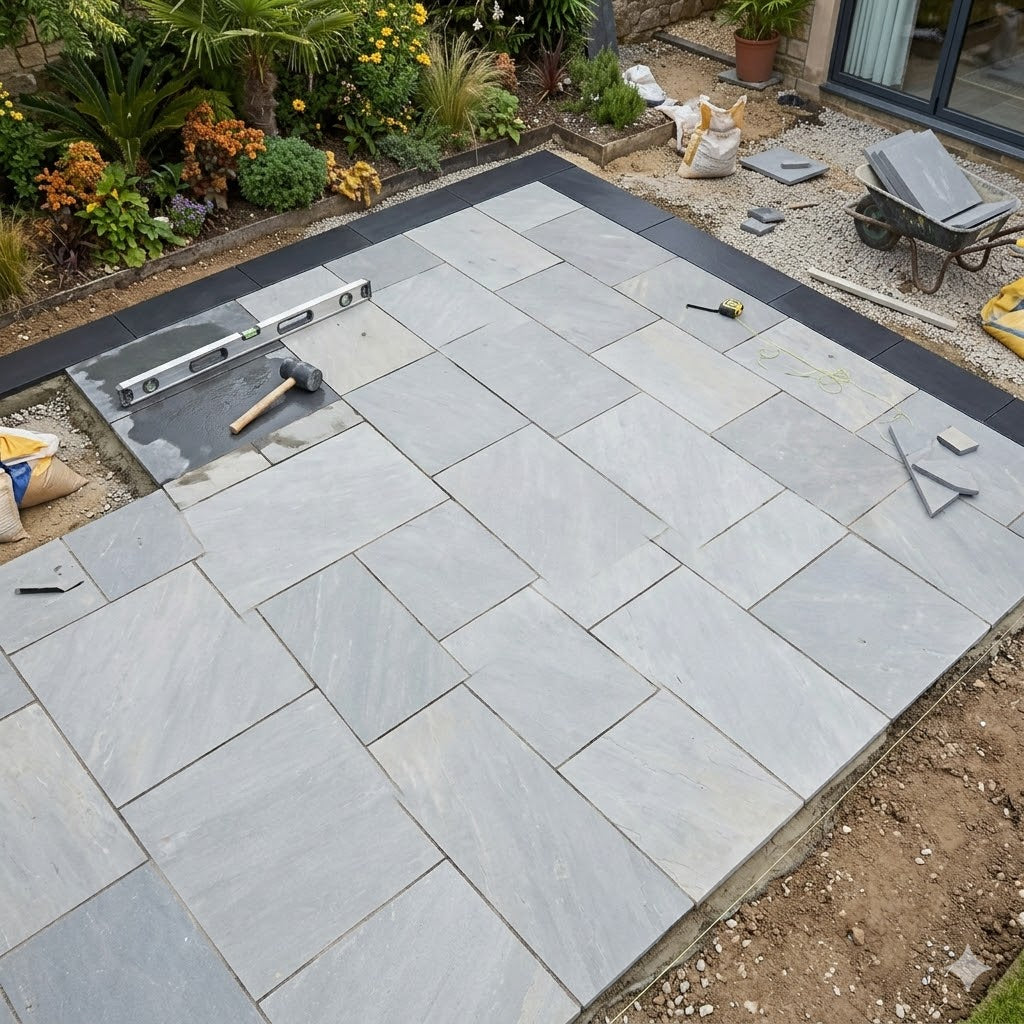
Your paving arrives. A stone that formed 150 million years ago, quarried from a hillside in Rajasthan, shipped across the Indian Ocean, stored in Nottingham, and delivered to your front drive — ready to become a patio that you'll use every summer for the next 30 years.
From quarry to garden: three stops. Quarry → our warehouse → you. That's the direct import model. And that's why the price is what it is.
Why this journey matters for price
The number of stops between the quarry and your garden directly affects the price you pay. Each stop adds a margin — because every business in the chain needs to make a profit.
Typical Supply Chain
Quarry sells to exporter (+15% margin)
Exporter sells to UK importer (+20% margin)
Importer sells to wholesaler (+15% margin)
Wholesaler sells to retailer (+20% margin)
Retailer sells to you (+25% margin)
5 margins stacked = higher price
Universal Paving
Quarry sells to us
We sell to you
1 margin = lower price
The same Kandla Grey sandstone slab that costs you £20–22/m² from us can cost £26–30/m² from a reseller buying through the typical chain. The stone is identical — it comes from the same quarries in Rajasthan. The difference is how many times it changed hands between the quarry and your garden.
This is why we say "direct import prices" rather than "discount prices." We're not discounting anything. We're not cutting quality. We're cutting out the middlemen. The saving comes from a shorter supply chain, not a lesser product. Read more about why homeowners and landscapers choose us.
What about porcelain?
Our porcelain paving follows a similar journey but starts in a factory rather than a quarry. Porcelain is manufactured — pressed from refined clay at extremely high temperatures to create a dense, non-porous slab. Our porcelain is produced in factories that specialise in outdoor-rated 20mm slabs with R11 anti-slip surfaces.
The supply chain advantage is the same: we buy direct from the manufacturer, ship to our Nottingham warehouse, and sell to you. One margin instead of three or four. Same product as the resellers sell, shorter chain, lower price.
What about limestone, granite, and slate?
Same model, different quarries. Our limestone comes from quarries in the Kota and Tandur regions of India. Our granite from South India, where some of the world's hardest granite formations sit close to the surface. Our slate from regions where fine-grained metamorphic rock splits cleanly along natural planes into the characteristic layered slabs.
Each material has its own geological story — limestone formed from compressed marine organisms, granite from cooled magma deep in the earth's crust, slate from layers of clay transformed by heat and pressure. But the supply chain story is the same for all of them: quarry → our warehouse → you.
Why we tell this story
Most paving websites don't talk about where the stone comes from or how it gets to you. They show a product photo, a price, and an "add to cart" button. We think you should know more than that.
When you know that your paving slab is 150 million years old, quarried by hand from a hillside in Rajasthan, inspected twice, shipped 5,000 miles, and held in stock at our warehouse ready for you — you understand why natural stone costs what it costs. And you understand why buying direct from the importer, rather than through three middlemen, makes a meaningful difference to the price you pay.
The stone is extraordinary. The supply chain should be simple. That's what we do.
See the stone for yourself
Order samples of any material and hold 150 million years of geological history in your hands.
Browse Paving Slabs Order Samples