






How Long Does a Patio Last? Lifespan by Material
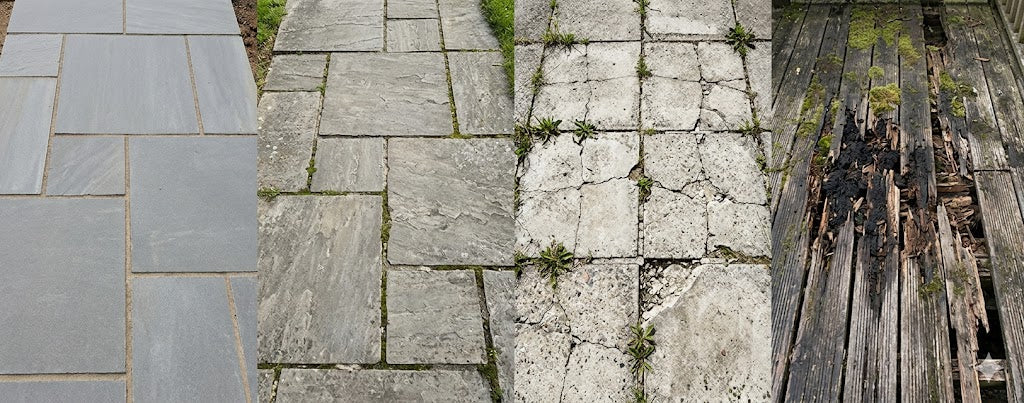
A well-installed natural stone patio lasts 20-50+ years. Porcelain lasts 30-50+ years. Concrete slabs last 10-15 years before surface deterioration. Timber decking lasts 10-20 years with regular maintenance. The material determines the upper limit, but the sub-base and installation quality determine whether you actually reach it. A premium slab on a poor sub-base fails faster than a budget slab on a proper foundation.
When you spend £1,000-3,000 on a patio, you want to know how long it'll last. The honest answer: the stone itself lasts effectively forever — it's millions of years old. What fails is the installation underneath. Here's how long each material lasts, what actually causes failure, and how to make sure your patio reaches its full lifespan.
Patio lifespan by material
| Material | Lifespan | Maintenance needed | What fails first |
|---|---|---|---|
| Indian sandstone | 20-50+ years | Annual clean, seal every 3-5 years | Mortar joints and pointing |
| Porcelain | 30-50+ years | None required | Mortar bed (if SBR skipped) |
| Granite | 50-100+ years | Virtually none | Nothing — outlasts everything |
| Limestone | 15-30 years | Seal recommended, annual clean | Surface erosion and staining |
| Slate | 20-40 years | Annual clean, seal optional | Delamination in severe frost |
| Concrete slabs | 10-15 years | Cleaning, re-pointing | Surface crumbling, fading, algae |
| Timber decking | 10-20 years | Oil 2x/year, replace boards | Rot, warping, structural failure |
| Composite decking | 15-25 years | Annual clean | Fading, scratching, structural frame |
What actually determines patio lifespan
The material is the headline number — but three factors beneath the surface determine whether your patio reaches 10 years or 50:
1. The sub-base (most important)
A properly compacted MOT Type 1 sub-base (100-150mm depth) is the single biggest factor in patio longevity. The sub-base prevents ground movement, distributes loads evenly, and provides free drainage beneath the mortar bed. Without it, even the best paving fails — slabs sink, joints crack, surfaces become uneven.
The sub-base itself lasts indefinitely. Once compacted, MOT Type 1 aggregate doesn't deteriorate, rot, shift, or compress further. It's the permanent foundation that everything else sits on. Read our complete sub-base guide.
Patios that skip the sub-base (laid directly on soil or sand) typically fail within 6-18 months. Read our guide on why laying on soil fails.
2. The mortar bed and joints
The mortar bed bonds the slabs to the sub-base. It's the component most likely to fail first — not the stone. Common mortar failures include:
Spot-bedding — using 5 blobs of mortar instead of a full bed. Unsupported areas of the slab flex under load and crack the mortar bond. Slabs rock and lift. Full mortar bed is essential for longevity.
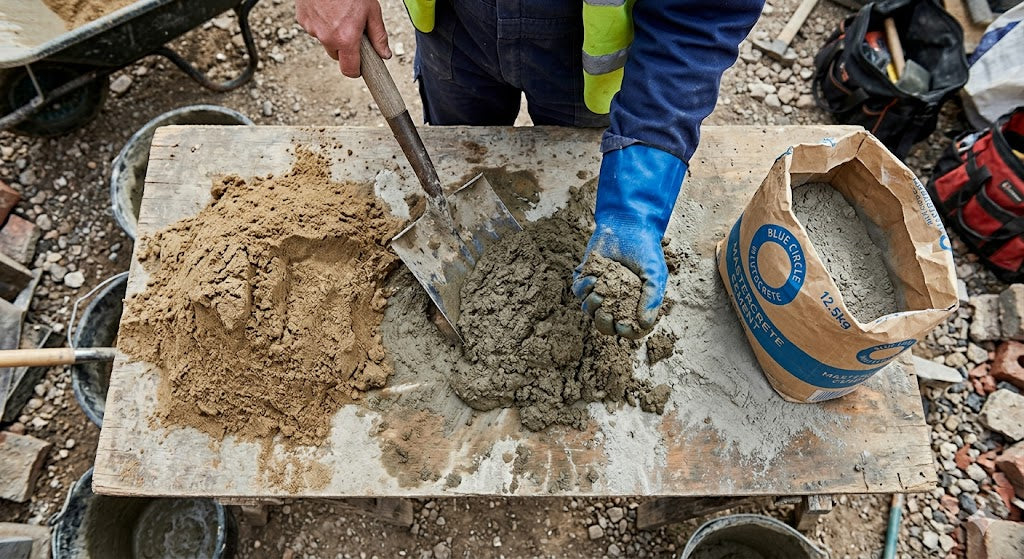
Wrong mix — too much cement creates brittle mortar that cracks with thermal movement. Too little produces weak mortar that crumbles. The correct ratio is 5:1 sharp sand to cement. Read our mortar mix guide.
Pointing failure — traditional sand-and-cement pointing cracks within 2-3 years and allows weed growth. Modern jointing compound lasts 10-15 years. Repointing is the most common patio maintenance task — using jointing compound instead of mortar delays it significantly.
3. Drainage
Water is the enemy of patio longevity. Standing water softens mortar, encourages frost damage (water in joints freezes and expands, cracking the mortar), promotes algae growth, and can cause damp in house walls. A correct 1:80 gradient away from the house prevents all of this. Read our patio drainage guide.
Lifespan detail by material
Indian sandstone: 20-50+ years
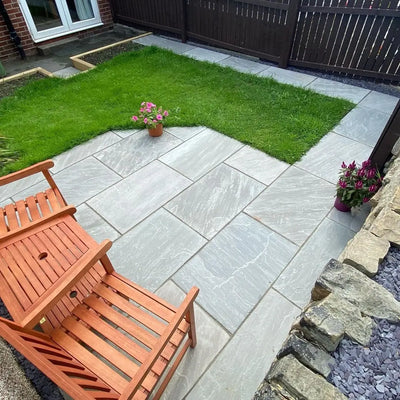
Indian sandstone is quarried from formations 145-170 million years old — the stone itself is effectively permanent. What limits its lifespan is weathering, frost damage, and staining — all manageable with basic maintenance.
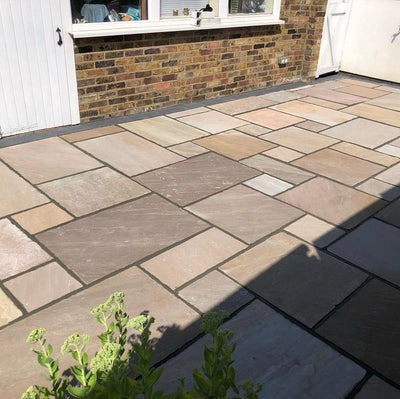
Colour change over time: sandstone develops a natural patina — colours soften slightly, shaded areas darken, sunny spots lighten. Most homeowners consider this an improvement, not deterioration. The stone doesn't fade in the way paint or concrete does — it weathers naturally like any geological surface.
Frost damage: sandstone absorbs moisture (3-6% porosity). In severe frost, trapped water can expand and cause surface spalling (flaking). Quality calibrated sandstone from reputable suppliers experiences this rarely — it's more common with lower-quality uncalibrated stone. Sealing reduces moisture absorption and virtually eliminates frost risk.
Maintenance to maximise lifespan: annual pressure wash (read our cleaning guide), seal every 3-5 years (read our sealing guide), repoint when joints deteriorate.
Porcelain: 30-50+ years
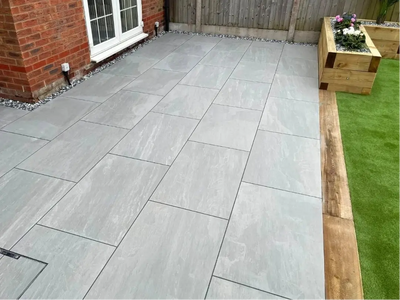
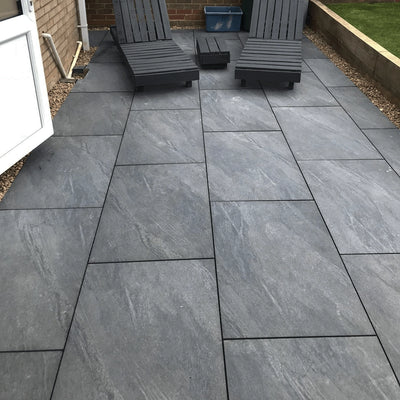
Porcelain is manufactured at 1,200°C+ to create an ultra-dense, non-porous material. The slab itself is virtually indestructible — it doesn't absorb moisture, doesn't fade, doesn't stain, and doesn't crack from frost. The limiting factor is the installation beneath it.
What fails first: if SBR primer was skipped during installation, the mortar bed debonds from the non-porous slab within 12-24 months. Slabs lift, rock, and crack. If SBR was applied correctly, the mortar bond lasts as long as any other paving installation — 20-40 years before repointing is needed.
Maintenance to maximise lifespan: none required. An annual hose-down keeps it looking new. Read our porcelain pros and cons for the full picture.
Granite: 50-100+ years
Granite is the hardest natural stone used in paving. It has negligible porosity, extreme compressive strength, and complete resistance to UV, chemicals, and biological growth. Granite cobblestones laid in Victorian-era streets are still in service 150+ years later. For residential patios and driveways, granite outlasts everything else — the sub-base and mortar will need attention long before the stone shows any wear.
Limestone: 15-30 years
Limestone is softer and more porous than sandstone, making it more susceptible to surface erosion, acid rain damage, and staining. In sheltered, well-maintained settings, limestone lasts 25-30 years. In exposed, high-traffic areas without sealing, surface deterioration becomes visible within 10-15 years. Sealing is strongly recommended for limestone to maximise lifespan.
Concrete slabs: 10-15 years
Pressed concrete paving slabs — the type sold at DIY stores — have a surface coating that fades, chips, and wears through with foot traffic and UV exposure. The aggregate core beneath is exposed, creating a rough, unattractive surface that traps dirt and grows algae. Most concrete patios look tired within 8-10 years and need replacing within 15. They're less expensive upfront but cost more per year of service than natural stone.
Timber decking: 10-20 years
Softwood decking (the most common type) requires oiling twice yearly, annual cleaning, and replacement of individual boards as they rot, warp, or split. The structural frame beneath typically lasts 15-20 years before needing replacement. Hardwood decking lasts longer but costs 3-4x more. Composite decking lasts 15-25 years but fades and scratches over time. Read our paving vs decking comparison.
Cost per year of service
The upfront cost doesn't tell the full story. When you factor in lifespan and maintenance, the annual cost of ownership changes the picture:
| Material (20m² DIY) | Total cost | Lifespan | Cost per year |
|---|---|---|---|
| Indian sandstone | ~£900 | 30 years | £30/year |
| Porcelain | ~£950 | 40 years | £24/year |
| Granite | ~£1,100 | 50+ years | £22/year |
| Concrete slabs | ~£600 | 12 years | £50/year |
| Timber decking | ~£800 + maintenance | 15 years | £53/year + oil |
Concrete looks cheapest upfront but costs the most per year because it needs replacing twice in the same period a sandstone patio lasts once. Granite is the most expensive upfront but the cheapest per year because it outlasts everything. Porcelain hits the sweet spot — moderate upfront cost, longest maintenance-free lifespan, lowest annual cost.
5 things that shorten patio lifespan
Reduces lifespan from 20+ years to 6-18 months. The single most damaging shortcut. Read why →
Creates unsupported areas that crack under load. Full mortar bed is essential. Read the laying guide →
Standing water softens mortar, causes frost damage, and promotes algae. Read the drainage guide →
Causes complete mortar debonding within 12-24 months. Read porcelain cons →
Algae, moss, and organic growth accelerate surface deterioration and create slip hazards. Even sandstone lasts 50+ years with annual cleaning. Read the cleaning guide →
Build a patio that lasts
Sandstone, porcelain, granite — all in stock with free UK delivery. Invest in the material, invest in the sub-base, and your patio will outlast the house.
Browse Paving Slabs Order SamplesFrequently asked questions
How long does an Indian sandstone patio last?
20-50+ years with proper installation and basic maintenance. The stone itself is 150 million years old — it doesn't deteriorate in a human timeframe. What limits lifespan is the mortar bed, pointing, and sub-base beneath it. Annual cleaning and optional sealing every 3-5 years keeps it looking its best for decades.
How long does porcelain paving last?
30-50+ years. Porcelain is non-porous, colourfast, frost-proof, and stain-proof — the material itself is virtually indestructible. The limiting factor is the mortar bond beneath, which depends on correct SBR priming during installation. With proper installation, porcelain has the longest maintenance-free lifespan of any paving material.
Is natural stone paving better than concrete?
For longevity and long-term value, yes. Indian sandstone lasts 20-50 years, concrete slabs 10-15 years. Over 30 years, a sandstone patio costs approximately £30/year; a concrete patio costs £50/year because you'll need to replace it at least once. Sandstone also looks better with age while concrete deteriorates visibly.
When should I replace my patio?
Replace when the sub-base has failed (widespread sinking or movement), when the slabs are cracked beyond repair (structural, not surface cracks), or when the surface has deteriorated to the point where cleaning no longer restores it (common with concrete after 10-15 years). If only the pointing has failed, repoint rather than replace — it's 90% cheaper.
Does sealing paving make it last longer?
Yes — for porous materials like sandstone and limestone. Sealing reduces moisture absorption, which prevents frost damage and staining. It doesn't affect the stone's structural integrity but preserves its appearance and reduces maintenance. Porcelain and granite don't need sealing because they're already non-porous. Read our sealing guide.