





Paving Slabs vs Decking: Which Is Better for Your Garden?
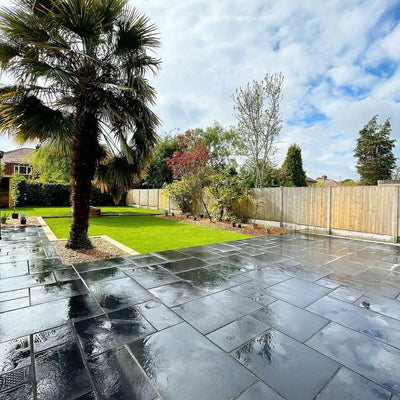
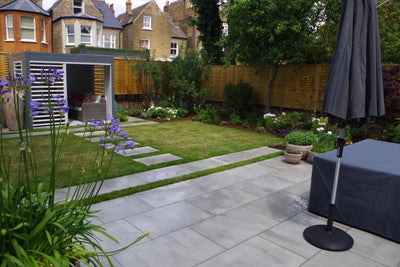
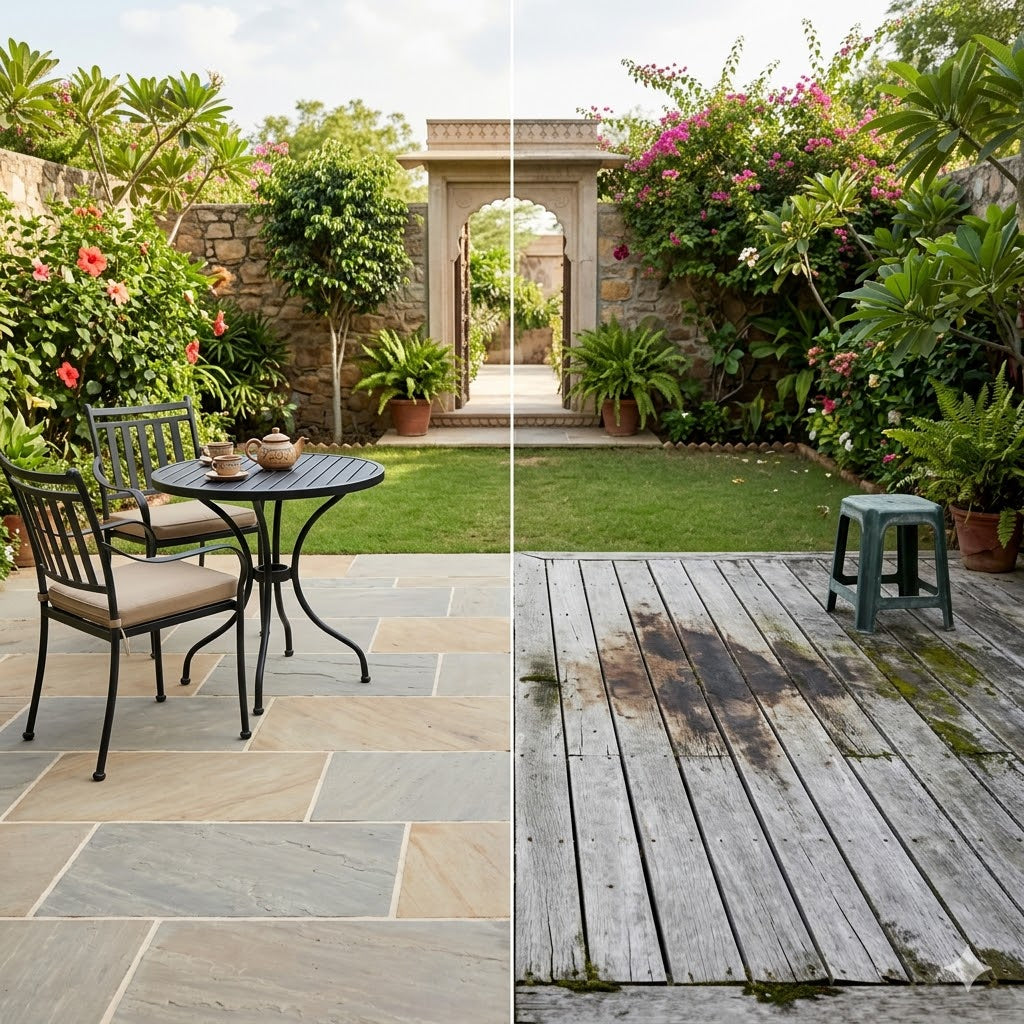
We sell paving, not decking — so you might expect this to be a one-sided argument. It isn't. Decking genuinely wins in certain situations, and we'll tell you which ones. But for most UK gardens, paving slabs are the better long-term investment, and the numbers back that up. Here's the honest comparison.
The quick comparison
| Paving Slabs | Timber Decking | |
|---|---|---|
| Lifespan | 25–50 years | 10–15 years (softwood), 25+ years (hardwood) |
| Material cost | £18–45/m² | £15–40/m² (softwood), £40–80/m² (hardwood) |
| Installation cost | £50–80/m² (professional) | £40–60/m² (professional) |
| Maintenance | Low to none (porcelain = none) | High — annual cleaning, oiling/staining, possible board replacement |
| Slip resistance | Good to excellent (R11 porcelain) | Poor when wet/mossy — the #1 complaint |
| Fire safety | Non-combustible | Combustible — BBQ risk, firepit restrictions |
| Weight capacity | Unlimited (on proper sub-base) | Limited by joist structure — hot tubs need reinforcement |
| Planning permission | Usually not needed (under 5m² near house) | May be needed if raised above 300mm |
| Flooding/drainage | Water drains through joints | Water runs off — can contribute to flooding |
| End of life | Stone can be relaid or reused | Rotten timber goes to landfill |
Cost: the 10-year reality
Decking often looks cheaper upfront, and it can be — softwood decking boards are available from £15/m². But the total cost of ownership over 10 years tells a different story.
Paving slabs (sandstone, 20m² patio): Materials £440 + installation £1,300 = £1,740 upfront. Ongoing cost over 10 years: one tub of sealer every 3 years (£40 × 3 = £120) + annual cleaning (your time). Total 10-year cost: approximately £1,860.
Softwood decking (20m² deck): Materials £400 + installation £1,000 = £1,400 upfront. Ongoing cost over 10 years: annual cleaning + oiling (£60 materials × 10 = £600) + board replacements (£200 in years 7–10) + possible structural repairs (£300). Total 10-year cost: approximately £2,500.
Porcelain paving (20m², zero maintenance): Materials £600 + installation £1,400 = £2,000 upfront. Ongoing cost over 10 years: £0. Total 10-year cost: £2,000.
Paving costs more upfront but less over time. Decking costs less upfront but the annual maintenance adds up. Over 10 years, porcelain paving is actually the cheapest option because the maintenance cost is zero. Sandstone and softwood decking end up roughly similar — but the sandstone patio will still be there in year 25 when the decking needs replacing entirely.
Maintenance: the real difference
Paving slabs
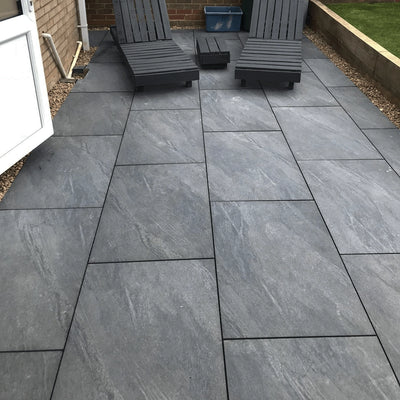
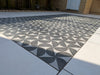
Natural stone paving needs a sweep and an annual wash. Optional sealing every 2–3 years if you want stain protection. Porcelain paving slabs need literally nothing — hose them down when they look dirty. That's it. No treatment, no oil, no sanding, no board replacement, no structural checks. Read our cleaning guide for details.
Timber decking
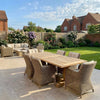
Decking needs annual cleaning (pressure washing or scrubbing with deck cleaner), annual oiling or staining, and periodic board replacement as individual boards warp, split, or rot. The substructure (joists and bearers) needs checking every few years for rot, especially at ground contact points. In shaded or damp gardens, moss and algae growth is a constant battle — and the slip hazard this creates is the single biggest complaint about decking in the UK.
The slip problem is real. Wet timber decking with even a thin film of algae is dangerously slippery. Every year, thousands of people injure themselves on slippery decks. Anti-slip strips and treatments help but need regular replacement. R11-rated non-slip porcelain paving provides tested, consistent grip in wet conditions without any ongoing treatment.
Durability: what lasts
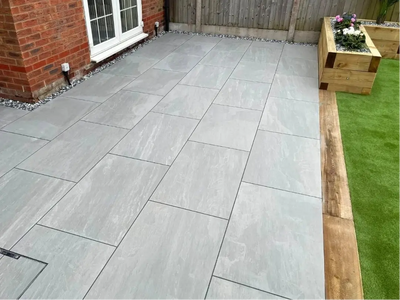
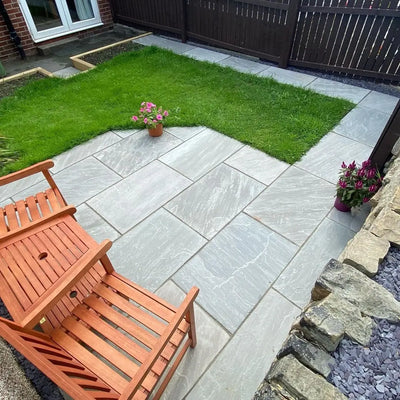
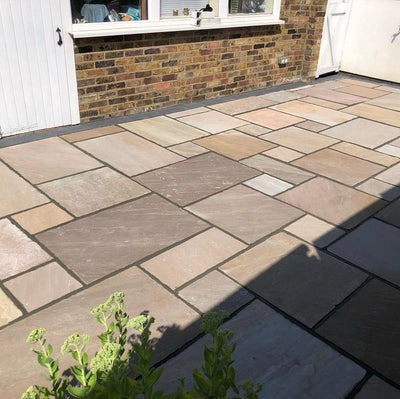
Paving slabs are effectively permanent. Indian sandstone is millions of years old — a few decades in your garden won't trouble it. Properly laid on a compacted sub-base with a full mortar bed, a stone or porcelain patio will outlast the house it sits next to. If a slab cracks (rare), you lift and replace that one slab without disturbing the rest.
Softwood decking (pine, treated timber) lasts 10–15 years before significant rot sets in, particularly at joist connections and ground contact points. Hardwood decking (ipe, balau) lasts 25+ years but costs £40–80/m² — at which point the price advantage over paving disappears entirely.
Composite decking (plastic-timber mix) is marketed as "maintenance-free" and lasts 20–25 years, but it costs £30–60/m² for the boards alone and still needs a timber substructure that can rot. It also fades, scratches, and retains heat in summer (uncomfortable barefoot in direct sun).
When decking wins
We're being honest — there are situations where decking is the better choice:
Sloped garden that needs levelling
If your garden slopes steeply away from the house, a raised deck on posts is significantly cheaper than excavating, retaining, and building a level paved area. Decking can span a slope; paving can't.
→ Decking winsTemporary surface (rented property, short-term)
If you're renting or plan to move within 5 years, decking is easier to install, easier to remove, and doesn't require excavation or a permanent sub-base.
→ Decking winsYou specifically want the look and feel of wood
Nothing replicates the warmth of real timber underfoot. If the wooden aesthetic is what you want, paving can't provide that — though our wood-effect porcelain planks come close with none of the maintenance.
→ Decking wins (or wood-effect porcelain as a compromise)When paving wins
Long-term family home
You're staying 10+ years and want a surface that lasts without ongoing cost.
→ Paving slabsOutdoor dining and barbecue area
Oil, grease, food spills, hot embers — all disastrous on timber. Paving handles everything.
→ Porcelain paving (stain-proof, non-combustible)Families with young children or elderly relatives
Slip resistance matters. Wet decking is a known hazard; R11 porcelain is tested safe.
→ Non-slip porcelain pavingShaded or damp garden
Shade + damp = moss and algae. On decking, this means slippery surfaces. On paving, it's cosmetic and easily cleaned.
→ Indian sandstone or porcelainAdding property value
Estate agents consistently rank a quality patio higher than decking for kerb appeal and property value. Buyers see paving as permanent; they see decking as maintenance.
→ Paving slabsThe bottom line
Decking makes sense for sloped gardens, temporary installations, and people who genuinely love the look and feel of wood. For everything else — long-term durability, low maintenance, slip safety, fire safety, property value — paving slabs are the stronger choice.
And if you want the best of both worlds — the warmth of a wood aesthetic with the durability of paving — wood-effect porcelain planks give you the look without any of the maintenance, rot, or slip risk.
Browse paving slabs
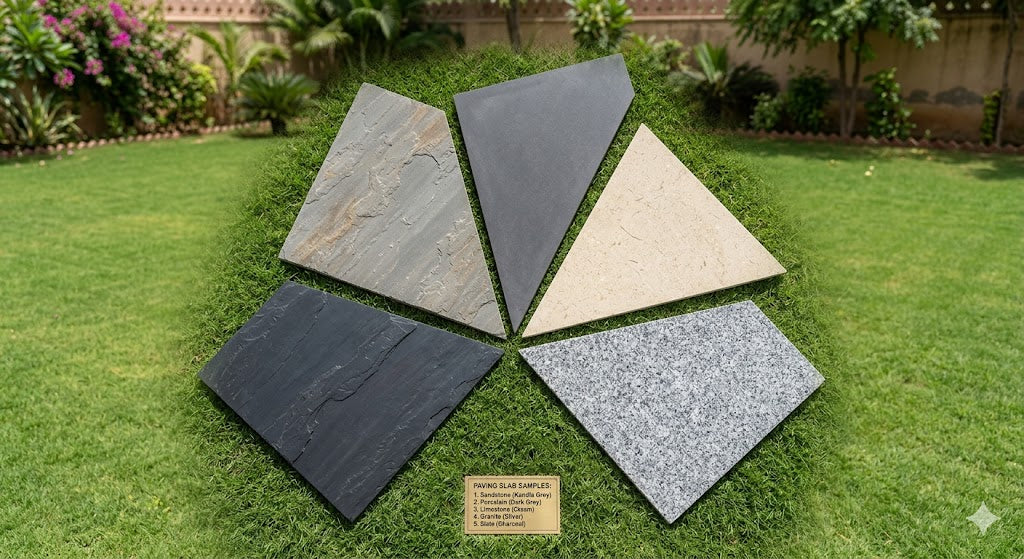
Five materials, all in stock. Free UK delivery, no hidden fees.
Compare All Paving Slabs Order Free SamplesFrequently asked questions
Is a patio cheaper than decking?
Upfront, softwood decking can be slightly cheaper. Over 10 years, paving is cheaper because the maintenance cost is minimal (and zero for porcelain). A sandstone patio and softwood deck cost roughly the same over 10 years — but the patio lasts 25+ years while the deck needs replacing at 10–15.
Does a patio add more value than a deck?
Generally yes. Estate agents report that a well-built stone or porcelain patio adds more perceived value than timber decking because buyers see it as permanent and low-maintenance. Decking is sometimes viewed as a maintenance burden by prospective buyers.
Is decking slippery?
Wet timber decking with any moss or algae growth is very slippery — it's the #1 complaint from decking owners. Anti-slip strips help but wear out and need replacing. R11 porcelain paving provides tested, consistent grip in all wet conditions without ongoing treatment.
Can I replace decking with paving?
Yes — it's one of the most common garden renovation projects. Remove the decking and substructure, excavate to the correct depth, lay a MOT Type 1 sub-base, and install paving on a mortar bed. The result is a permanent, low-maintenance surface that won't need replacing. Read our paving installation guide for the full process.