









Eco-Friendly Paving: Why Natural Stone Is the Greener Choice
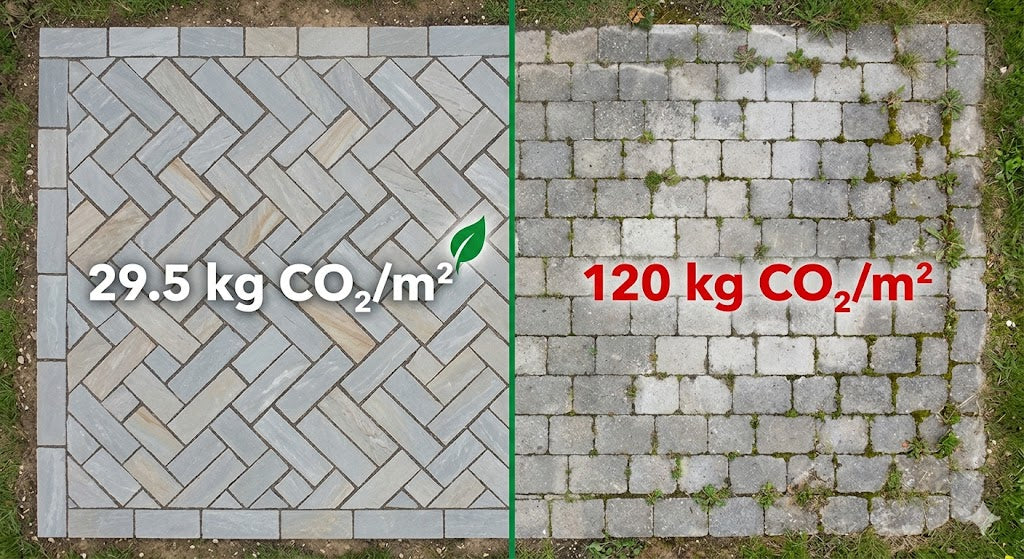
Natural stone paving (sandstone, granite, limestone) has a global warming potential (GWP) of 29-33 kg CO₂-equivalent per m² — compared to 77-120 kg CO₂/m² for concrete paving and 135 kg CO₂/m² for clay block paving. That means concrete slabs produce roughly 4x more carbon per m² than natural stone slabs. When you add that natural stone lasts 2-5x longer than concrete, the lifetime carbon footprint is even more dramatic. Choosing natural stone isn't just an aesthetic decision — it's an environmental one.
Most people choose natural stone because it looks better than concrete. Fair enough — it does. But there's a second reason that rarely gets discussed: natural stone is one of the lowest-carbon building materials available. It's quarried from the earth, cut to size, and shipped. No kilns. No chemical processes. No energy-intensive manufacturing. The stone already exists — it just needs cutting. Concrete, by contrast, is manufactured from scratch using cement (one of the world's highest-carbon industrial processes), aggregate, pigment, and significant energy. Here's what the numbers actually show.
The carbon footprint of paving — the numbers
Global Warming Potential (GWP) measures the total greenhouse gas emissions per m² of paving — from raw material extraction through manufacturing, finishing, and transport. Lower is better.
| Material | GWP (kg CO₂-eq/m²) | vs natural stone slab |
|---|---|---|
| Natural stone sett | 29.5 | Lowest |
| Natural stone slab | 33.1 | Baseline |
| Asphalt (tarmac) | 74.8 | 2.3x higher |
| Concrete sett (block paving) | 77.6 | 2.3x higher |
| Concrete slab | 120.0 | 3.6x higher |
| Clay paver | 134.9 | 4.1x higher |
The numbers are striking. A concrete patio slab produces 3.6x more carbon per m² than a natural stone slab. Concrete block paving (setts) produces 2.6x more than natural stone setts. Clay pavers — often marketed as a premium, traditional product — have the highest carbon footprint of all at 4.1x higher than natural stone.
The greenest paving product available? Natural stone cobbles and setts — 29.5 kg CO₂/m², the lowest of any paving material tested. The smaller format means less cutting waste per m², and the 40-50mm thickness delivers the durability that driveways, paths, and borders demand. Granite setts last 50-100+ years without a single replacement. That's a one-time carbon cost for a lifetime of use.
Cobbles and setts: the greenest paving you can buy
If reducing your environmental impact is a genuine priority, natural stone setts and cobbles deserve special attention. They sit at the very bottom of the GWP chart — and their practical advantages amplify the environmental benefit:
Lowest production carbon. At 29.5 kg CO₂/m², natural stone setts produce less carbon per m² than any other paving format. The compact size means each piece requires less cutting energy than a full 900×600 slab.
Longest lifespan. Granite setts are the hardest natural stone available — 50-100+ years on domestic driveways with zero deterioration. Victorian granite cobblestone streets are still in daily use 150+ years later. One installation. Zero replacement cycles. Zero repeat carbon costs.
Versatile format. Setts aren't just for driveways. Use them as driveway edging, patio borders, garden paths, material transition strips, and mowing strips. A single row of setts bordering your patio costs approximately £72-80 in materials and adds both definition and the lowest-carbon paving element available.
Block paving alternative. Concrete block paving (77.6 kg CO₂/m²) is the standard choice for UK driveways. Natural stone setts (29.5 kg CO₂/m²) do the same job at 62% lower carbon, with 3-5x longer lifespan, and without the fading, weed invasion, and sinking that concrete blocks suffer. Read our full comparison.
| Product | GWP | Lifespan | From |
|---|---|---|---|
| Sandstone setts 200×100mm | 29.5 kg CO₂/m² | 20-40 years | £40/m² |
| Sandstone cobbles 100×100mm | 29.5 kg CO₂/m² | 20-40 years | £43.22/m² |
| Granite setts | 29.5 kg CO₂/m² | 50-100+ years | £40-55/m² |
| Concrete block paving | 77.6 kg CO₂/m² | 15-20 years | £15-25/m² |
Read our complete cobbles and setts guide for sizes, laying patterns, and installation method.
Why natural stone is so much lower
The difference comes down to manufacturing. Or rather, the absence of it:
Natural stone: cut, not manufactured
Natural stone already exists. It formed millions of years ago through geological processes. Quarrying involves extracting blocks from the earth, cutting them to size with diamond saws, calibrating to a consistent thickness, and shipping. The energy input is mechanical — sawing and transport. There's no chemical transformation, no kiln firing, no cement production.
The primary carbon cost is transport — moving stone from quarry to port to warehouse to your garden. But even including international shipping from India to the UK, the total GWP is 29-33 kg CO₂/m². The stone itself costs the planet almost nothing.
Concrete: manufactured from scratch
Concrete paving requires mining aggregate, manufacturing cement (a process that involves heating limestone to 1,450°C in a kiln — one of the most energy-intensive industrial processes on earth), mixing, pressing, curing, pigmenting, and transporting the finished product. Cement production alone accounts for approximately 8% of global CO₂ emissions.
Every concrete slab is made from raw materials transformed through extreme heat and chemical processes. Every natural stone slab is made from existing geological material cut to shape. The environmental arithmetic is straightforward.
Clay pavers: the hidden carbon leader
Clay pavers might look traditional and "natural" but they require firing in kilns at 1,000-1,200°C — similar to brick manufacturing. The energy required to fire each clay paver is enormous relative to its size. At 134.9 kg CO₂/m², clay pavers have the worst environmental profile of any common paving material.
The lifespan multiplier
Carbon footprint per m² is only half the story. The other half is how long the material lasts — because when it fails, it needs replacing, doubling or tripling the lifetime carbon cost.
| Material | GWP per m² | Lifespan | Replacements in 60 years | Lifetime CO₂ (60 years, 20m²) |
|---|---|---|---|---|
| Granite setts | 29.5 | 60+ years | 0 | 590 kg |
| Sandstone slabs | 33.1 | 30-50 years | 0-1 | 662-1,324 kg |
| Concrete slabs | 120.0 | 10-15 years | 3-5 | 9,600-14,400 kg |
| Concrete block paving | 77.6 | 15-20 years | 2-3 | 4,656-6,208 kg |
Over 60 years, a 20m² granite sett driveway produces 590 kg of CO₂. The same area in concrete slabs — replaced every 12-15 years — produces 9,600-14,400 kg. That's 16-24x more carbon across the life of the property. The environmental case isn't marginal — it's overwhelming.
What makes natural stone sustainable
Natural stone is quarried as blocks and cut with diamond saws. The process is mechanical, not chemical. No cement kilns. No 1,450°C firing. No chemical bonding agents in the manufacturing process. The energy used is diesel for quarry machinery and electricity for cutting — a fraction of the energy required to manufacture concrete or fire clay.
Quarry offcuts from sandstone and granite production are crushed and reused as aggregate, roadstone, and construction fill. Very little material goes to landfill. The stone that can't be cut into paving slabs becomes the sub-base aggregate for other projects. In contrast, concrete manufacturing produces significant process waste and uses virgin raw materials for every batch.
A granite sett driveway laid today won't need replacing in your lifetime — or your children's. That means zero replacement materials, zero demolition waste, zero transport for replacement deliveries. Concrete paving, by contrast, enters a cycle: install → deteriorate → demolish → dispose → re-manufacture → re-install. Each cycle doubles the total carbon.
If a natural stone patio is eventually removed (garden redesign, property demolition), the stone can be cleaned and relaid elsewhere. Reclaimed sandstone and granite are valuable — there's an active market for salvaged natural stone. Concrete paving has minimal salvage value and typically goes to landfill or aggregate crushing.
The shipping question
The most common objection: "But your stone is shipped from India — doesn't that cancel out the carbon benefit?"
No. Maritime shipping is the most carbon-efficient freight method on earth. A container ship carrying 20,000 tonnes of stone across 8,000 miles produces less CO₂ per m² of paving than a lorry driving 200 miles from a UK concrete factory to a builders merchant. The GWP figures above (29-33 kg CO₂/m² for natural stone) already include international shipping — and they're still 3-4x lower than locally manufactured concrete.
The reason: container ships move enormous volumes with extraordinary fuel efficiency. Manufacturing concrete — heating limestone to 1,450°C in a kiln — uses more energy per m² of product than shipping stone halfway around the world.
Natural stone vs porcelain — the environmental nuance
Porcelain paving is manufactured — vitrified clay fired at 1,200°C+ in industrial kilns. Its carbon footprint sits between natural stone and concrete, typically around 50-70 kg CO₂/m² depending on manufacturing efficiency and transport distance.
However, porcelain's exceptional longevity (30-50+ years with zero maintenance) means its lifetime carbon footprint compares favourably to concrete — one porcelain patio replaces 2-3 concrete patios over the same period. It's not as green as natural stone, but it's significantly greener than concrete over a full lifecycle.
For the lowest possible environmental impact: natural sandstone or granite. For the best balance of low maintenance AND lower carbon than concrete: porcelain. For the highest carbon footprint: concrete or clay pavers.
Eco-friendly paving — the practical choices
| Priority | Best choice | Why |
|---|---|---|
| Lowest carbon — driveways | Granite setts | 29.5 kg CO₂/m², 50-100+ year lifespan, zero replacement |
| Lowest carbon — borders & paths | Sandstone setts & cobbles | 29.5 kg CO₂/m², warm natural character, multiple uses |
| Lowest carbon — patios | Indian sandstone slabs | 33.1 kg CO₂/m², 30-50 year lifespan, natural and beautiful |
| Low carbon + zero maintenance | Porcelain paving | ~50-70 kg CO₂/m², 30-50 year lifespan, no replacement cycles |
| Permeable option | Natural stone setts on sand bed | Allows water drainage between joints, reduces surface runoff |
Making your patio project greener
Beyond material choice, these decisions reduce the environmental impact of your patio project:
Choose natural stone over concrete. The single biggest environmental choice. Saves 75% of the carbon per m² before you consider lifespan.
Build it once, build it right. A proper sub-base ensures the patio lasts its full lifespan — no premature replacement, no wasted materials. Skipping the sub-base to save time creates waste when the patio fails in 12 months. Read our sub-base guide.
Buy direct. Fewer distribution steps means fewer lorry journeys. Buying from a direct importer rather than through a merchant network reduces transport emissions — your stone makes fewer road trips between warehouse, wholesaler, merchant, and your house.
Keep spare slabs. Spares from the original order mean future repairs use existing materials rather than triggering a new manufacturing and delivery cycle. Store 3-5 spare slabs for future use.
Reuse where possible. If you're removing an existing natural stone patio, the stone can be cleaned and relaid in a new pattern, used as stepping stones, or sold to a reclaimed stone dealer. Don't skip natural stone — it has value beyond its first use.
Choose the greener surface
Natural stone setts from £40/m² — the lowest carbon paving available. Sandstone slabs from £20/m². Granite setts from £40/m². All direct from source, delivered free, built to last decades.
Browse Cobbles & Setts Browse Sandstone SlabsFrequently asked questions
Is natural stone paving eco-friendly?
Yes — natural stone has the lowest carbon footprint of any common paving material. At 29-33 kg CO₂/m², it produces 75% less carbon than concrete slabs (120 kg CO₂/m²) and 78% less than clay pavers (135 kg CO₂/m²). The stone is quarried and cut, not manufactured — no kiln firing, no cement production, no chemical processes.
Is concrete paving bad for the environment?
Concrete paving has a significantly higher carbon footprint than natural stone — 120 kg CO₂/m² for concrete slabs vs 33 kg CO₂/m² for natural stone slabs. The main driver is cement production, which requires heating limestone to 1,450°C. When you add that concrete patios need replacing every 10-15 years (multiplying the carbon cost), the lifetime environmental impact is 16-24x higher than granite over 60 years.
Doesn't shipping stone from India cancel out the benefit?
No. Maritime shipping is extraordinarily fuel-efficient — a container ship carrying thousands of tonnes produces less CO₂ per m² of paving than a lorry driving 200 miles from a UK factory. The GWP figures (29-33 kg CO₂/m²) already include international shipping from India to the UK. Even after shipping 8,000 miles by sea, natural stone produces 3-4x less carbon than locally manufactured concrete.
Is porcelain paving eco-friendly?
Porcelain sits between natural stone and concrete environmentally — approximately 50-70 kg CO₂/m². It requires kiln firing at 1,200°C (higher carbon than quarrying stone, lower than cement production). However, porcelain's 30-50 year lifespan means one installation replaces 2-3 concrete patios over the same period, making its lifetime footprint significantly lower than concrete.
What is the most sustainable driveway material?
Granite setts — lowest GWP (29.5 kg CO₂/m²), longest lifespan (50-100+ years), and zero replacement cycles. A granite sett driveway is a one-time environmental cost that lasts indefinitely. Block paving, tarmac, and concrete all require replacement within 15-20 years, multiplying their already-higher carbon footprint. Read our block paving vs natural stone comparison.
%20has%20a%20global%20warming%20potential%20(GWP)%20of%2029-33%20kg%20CO%E2%82%82-equivalent%20per%20m%C2%B2%20%E2%80%94%20compared%20to%2077-120%20kg%20CO%E2%82%82/m%C2%B2%20for%20concrete%20paving%20and%20135%20kg%20CO%E2%82%82/m...)