








What Colour Paving Goes with My House? A Guide by House Type
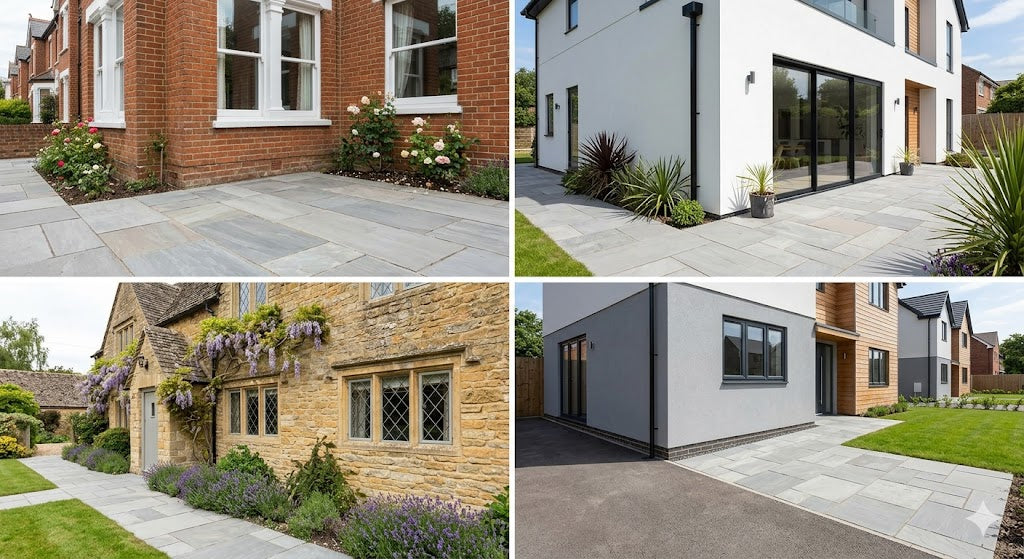
Red brick houses suit Kandla Grey (cool contrast) or Raj Green (warm complement). White render suits any paving — Anthracite Black for drama, Kandla Grey for subtlety. Grey render suits grey porcelain. Honey/cream stone houses suit Rippon Buff. Period properties suit riven sandstone in warm tones. Modern new-builds suit porcelain. The universal safe choice is Kandla Grey — it works with every house type in the UK.
Choosing paving colour from a website or brochure is difficult because you're seeing the stone in isolation — not next to your house, your fencing, and your planting. The colour that looks perfect on screen can clash badly once it's laid. This guide removes the guesswork by matching paving colours to the seven most common UK house types, with photo-tested combinations and the reasons why each works.
The principle
Two approaches work. One doesn't:
Complement — paving that shares the same warm or cool tone family as your house. Creates harmony. Feels cohesive. Example: Rippon Buff sandstone with a Cotswold stone house. Both warm, both golden — they belong together.
Contrast — paving that sits at the opposite end of the colour spectrum from your house. Creates definition. Feels intentional. Example: Anthracite Black porcelain against a white-rendered wall. Maximum contrast, maximum impact.
Clash — paving that falls close to your house colour but doesn't match it. Creates visual noise. Feels like a mistake. Example: orange-buff paving next to red brick — similar warmth, different hue, they fight each other.
The safest rule: either match the tone closely (complement) or go clearly different (contrast). Anything in between risks looking like you tried to match and failed.
Paving colour by house type
1. Red brick (Victorian, Edwardian, 1930s semis)
The UK's most common house type. Red brick is warm-toned with orange-brown undertones. Two approaches work:
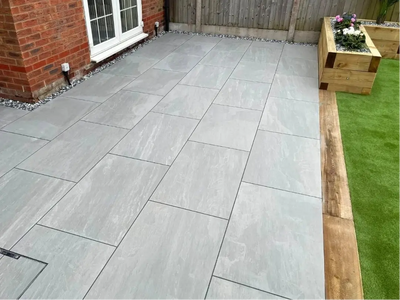
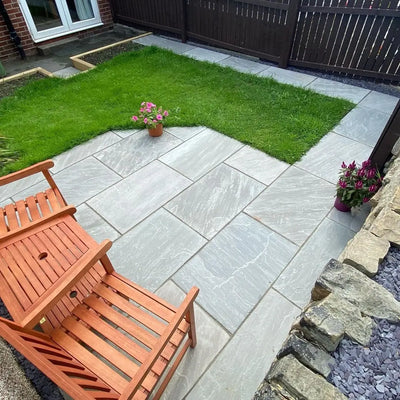
Cool silver-grey against warm red brick creates clean, deliberate contrast. The patio looks designed, not accidental. This is the UK's #1 paving combination for a reason — Kandla Grey is neutral enough to let the brick be the hero while providing a calm, grounding surface.
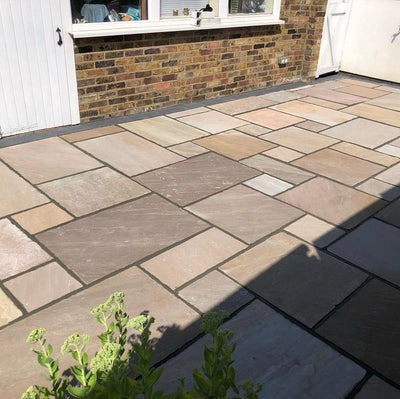
Raj Green's earthy brown and rust tones share the same warm palette as red brick without trying to match it. The green and purple accents add character that brick alone can't. This combination feels natural and established — as if the stone has been there as long as the house.
Buff tones next to red brick create colour tension — both warm, different hues, neither complements the other. The combination looks like an accidental mismatch rather than a design choice.
2. White or light render
White-rendered houses are the easiest to match — white is neutral, so almost any paving colour works. Your choice depends on the mood you want:
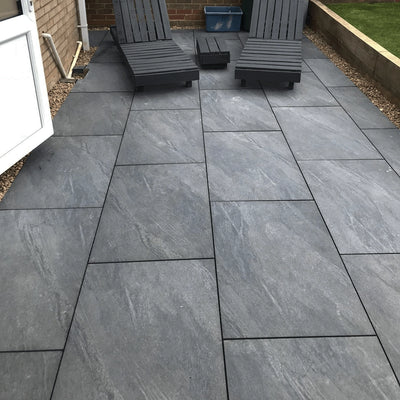
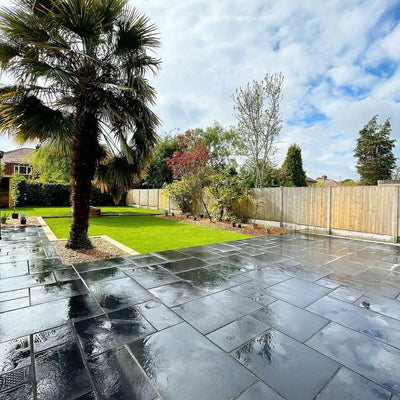
For drama: Anthracite Black porcelain — maximum contrast, architectural, bold. The white wall makes the dark paving look richer, and the dark paving makes the white wall look cleaner.
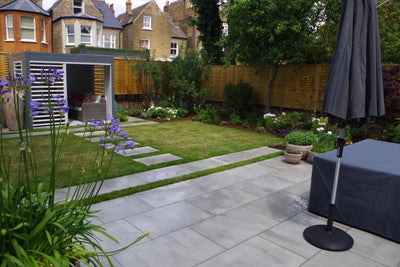
For subtlety: Kandla Grey sandstone or Kandla Grey porcelain — soft grey against white feels calm and sophisticated. Understated rather than statement.
For warmth: Fossil Mint sandstone — pale cream tones add warmth without clashing. The lightest sandstone against a white wall creates a bright, airy outdoor space.
3. Grey render (modern builds)
Grey-rendered houses suit grey paving — but the trick is matching the shade rather than creating grey-on-grey monotony:
Best match: Kandla Grey porcelain or Anthracite Grey porcelain — matches the modern material palette. Add contrast through green planting and dark edging planks to prevent flatness.
For variation: Kandla Grey sandstone — adds natural texture against smooth rendered walls. The stone's subtle colour variation breaks up the grey palette.
Avoid: dark grey paving against dark grey render without any relief. The entire property feels heavy and monochrome. Always introduce a contrasting element — light planting, pale edging, or a different-toned border.
4. Honey or cream stone (Cotswold, Bath, Yorkshire stone)
Stone-built houses in warm golden tones demand paving that respects their colour:
Rippon Buff is the golden-buff sandstone that matches Cotswold stone, Bath stone, and cream-coloured houses perfectly. Same warm tone family, similar geological character. The patio feels like a natural extension of the house.
Alternative: Fossil Mint — slightly lighter and cooler than Rippon Buff, with a cream-to-white base. Works with lighter stone houses where Rippon Buff might be too warm.
Avoid: cool grey paving. Kandla Grey against warm stone creates a temperature clash — the cool grey makes the warm house look orange, and the warm house makes the grey paving look cold.
5. Dark brick (blue engineering brick, charcoal)
Dark brick houses (common in industrial areas and some new-builds) need lighter paving to prevent the garden feeling dark and enclosed:
Best match: Fossil Mint sandstone or light porcelain — maximum brightness to offset the dark walls.
Alternative: Kandla Grey sandstone — mid-tone grey provides gentle contrast without being as stark as white against dark brick.
Avoid: dark porcelain. Anthracite Black paving against dark brick brickwork makes the entire outdoor space feel like a cave.
6. Timber-clad (garden rooms, cabins, rural properties)
Timber cladding — whether natural wood, composite, or painted — suits natural stone's organic character:
Natural timber: Kandla Grey sandstone or Raj Green sandstone — natural stone with natural timber creates an organic, grounded aesthetic.
Dark-painted timber: Fossil Mint or light porcelain — light paving provides contrast against dark cladding. Read our garden room paving guide for more.
Grey composite cladding: Kandla Grey porcelain — matches the modern manufactured feel of composite with a manufactured paving surface.
7. New-build estates (mixed materials)
New-builds often combine brick, render, and composite materials in neutral tones. The safest approach:
Best match: Kandla Grey porcelain — neutral grey, modern aesthetic, zero maintenance, matches the clean-lined architecture of most new estates.
For warmth: Kandla Grey sandstone — adds natural character to the typically uniform new-build aesthetic. The patio becomes the one element with genuine personality.
The safe choice — when in doubt
Kandla Grey works with everything. Red brick, white render, grey render, stone, timber — it's neutral enough to complement any house without clashing. If you're unsure, start with Kandla Grey samples. It's the UK's bestselling paving colour because it doesn't make mistakes.
How to check before committing
Never choose paving from a screen alone. Colours look different in your own garden, against your own house, in your own light:
1. Order samples. Our samples show real stone or porcelain in a hand-sized piece. Place them against your house wall.
2. Leave them outside for 3 days. Check in morning sun, afternoon shade, and after rain. Natural stone changes character dramatically between wet and dry.
3. View from distance. Place the sample at the far end of where your patio will be and walk back to the house. The colour you see at 5 metres is the colour you'll live with — close-up impressions are misleading.
4. Check against hard landscaping. Fencing, walls, planters, and any existing paving. The house isn't the only surface your patio sits next to.
See the colour in your own garden
Order samples of your shortlisted colours. Place them against your house, in your light, wet and dry. Then decide with confidence.
Order Samples Browse All PavingFrequently asked questions
What colour paving goes with red brick?
Kandla Grey (cool contrast) or Raj Green (warm complement) are the two best options. Kandla Grey creates clean separation between patio and house. Raj Green shares the warm palette without matching it. Avoid orange-buff tones — they clash with red brick.
What colour paving goes with a white house?
Almost anything works with white. Anthracite Black porcelain for bold contrast. Kandla Grey for understated harmony. Fossil Mint for an all-light, airy feel. White render is the most forgiving backdrop for any paving colour.
What colour paving is most popular in the UK?
Grey — specifically Kandla Grey — is the UK's most popular paving colour across both sandstone and porcelain. Its neutral silver-grey tone works with every house type and garden style. Raj Green is the second most popular, chosen for its natural warmth and character. Read our Kandla Grey guide.
Should paving match or contrast with my house?
Both work — as long as the choice is clear. Close complement (same colour family) creates harmony. Clear contrast (opposite tones) creates definition. What doesn't work is a near-match that looks like a failed attempt at matching. When in doubt, contrast is safer — it's harder to get wrong.
How do I test paving colour before buying?
Order samples and leave them outside against your house wall for 3 days. View in morning sun, afternoon shade, and after rain. Natural stone changes significantly between wet and dry — you need to see both before committing. View from 5 metres away for the truest impression of how the patio will look from indoors.
%20or%20Raj%20Green%20(warm%20complement).%20White%20render%20suits%20any%20paving%20%E2%80%94%20Anthracite%20Black%20for%20drama,%20Kandla%20Grey%20for%20subtlety.%20Grey%20render%20suits%20grey%20p...)