






Garden Room Base: What Paving to Put Around Your Garden Office
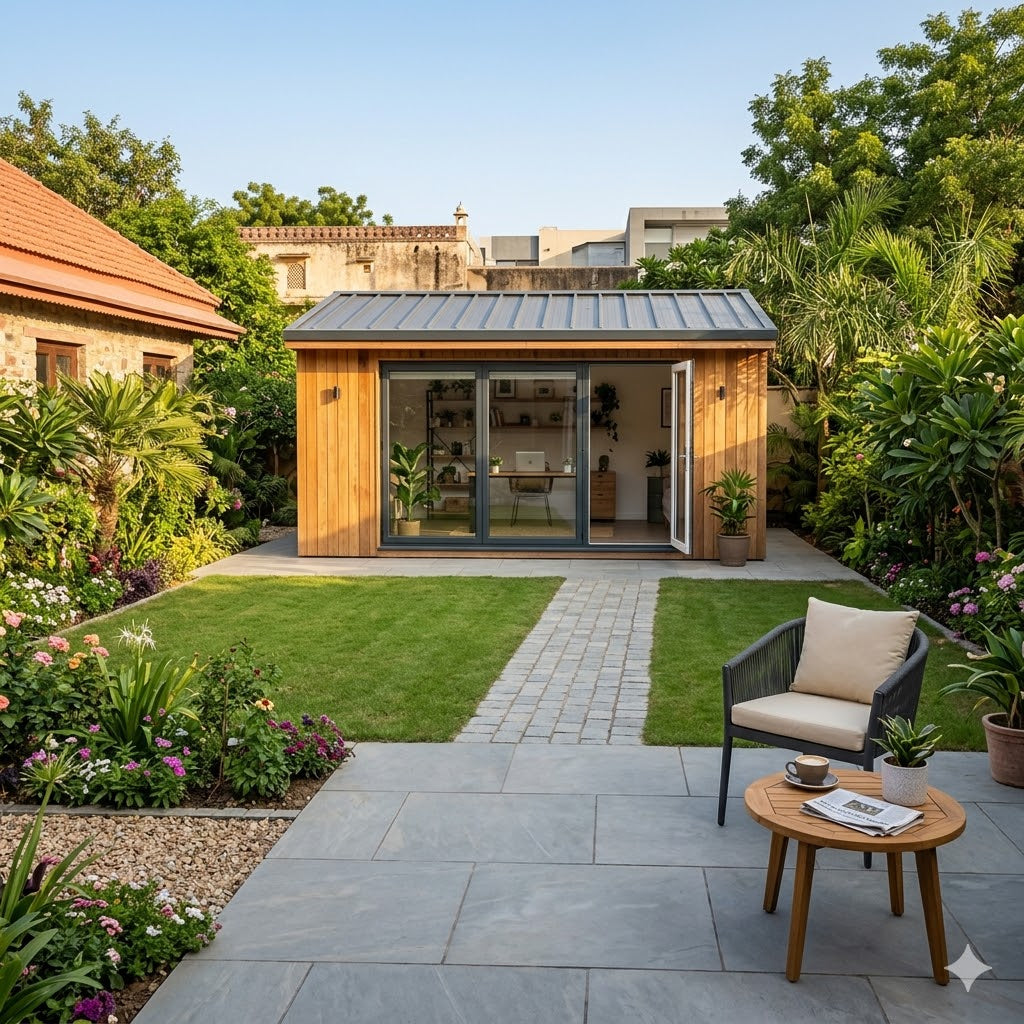
The paving around a garden room serves three purposes: a finished surround that prevents mud splash onto the cladding, an all-weather path from the house to the office door, and a small patio area outside the entrance for breaks and fresh air. Use porcelain for zero-maintenance daily use or riven sandstone for natural character. The surround should be at least 600mm wide on all sides, sloping away from the building at a 1:60 gradient.
Garden rooms exploded post-2020 and haven't slowed down. But most garden office guides focus on the building — insulation, electrics, planning permission — and treat the surround as an afterthought. A £15,000 garden office sitting on bare earth with a muddy path to the back door looks wrong, gets muddy in winter, and splashes dirt onto the cladding every time it rains. The right paving finishes the project and turns a garden building into a garden room.
Three things the paving needs to do
Rain hitting bare earth next to a garden room splashes mud onto the lower cladding and windows. Within one winter, the base of the building looks permanently dirty. A paved surround (minimum 600mm wide on all sides) eliminates this — rain hits the hard surface and runs away via the drainage gradient rather than bouncing dirt upward.
You walk to your garden office every working day — 220+ times a year. In January rain. In November frost. In the dark at 7am. A muddy grass track doesn't cut it. A paved path from the back door to the office door makes the daily commute clean, safe, and civilised. One row of 900×600 slabs is enough — read our path ideas for layouts.
A 2m × 2m paved area outside the garden room door gives you somewhere to sit with a coffee, take a phone call in fresh air, or eat lunch outside. Without it, you step out of the office onto grass — which is wet for 8 months of the year in the UK. A small paved pad makes the garden room feel like a complete workspace, not just a box at the bottom of the garden.
Best materials for garden room surrounds
Porcelain — the daily-commute choice
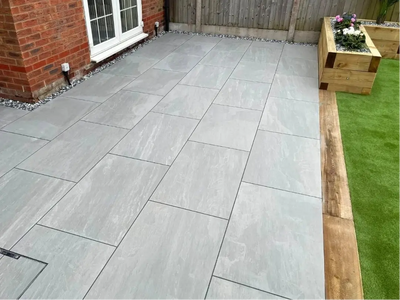
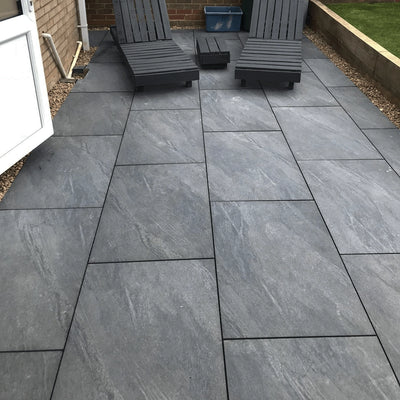
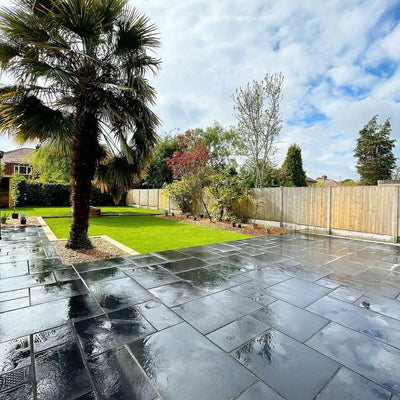
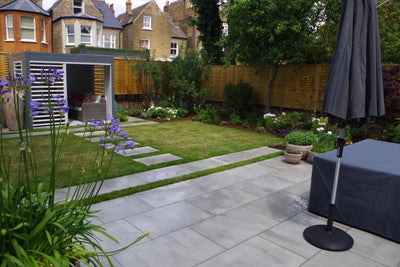
Porcelain paving is the practical winner for garden room surrounds. You'll walk on this surface 400+ times a year (there and back), in all weather, all seasons. Porcelain needs zero maintenance — no annual cleaning, no sealing, no algae treatment. The non-porous surface doesn't absorb rainwater, so it dries faster after rain and stays cleaner than natural stone in the permanently damp strip next to a building.
Best choices: Kandla Grey porcelain 900×600 matches most garden rooms. For dark-clad offices, light porcelain provides attractive contrast.
Sandstone — the character choice
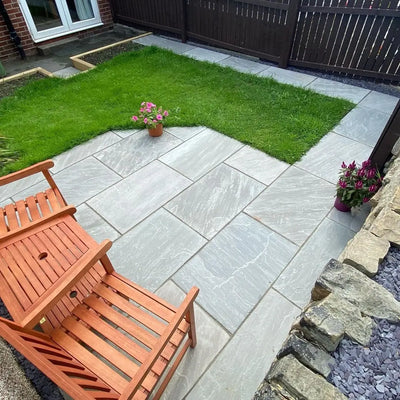
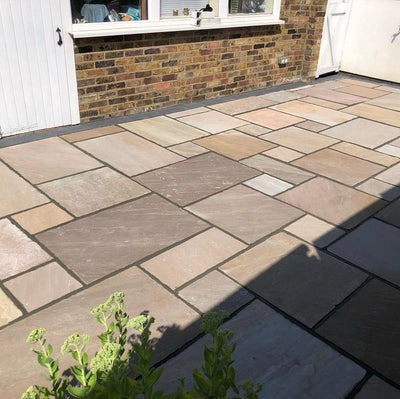
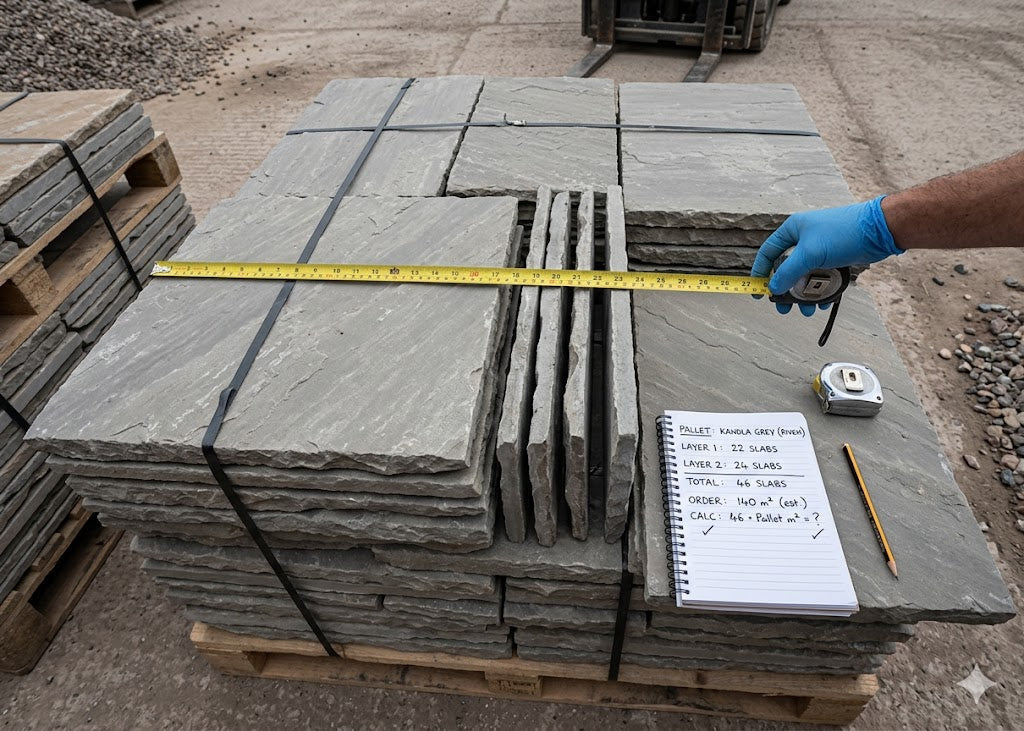
Riven sandstone gives the surround natural warmth and character that suits timber-clad garden rooms. The textured surface provides excellent grip in wet conditions — important for a path you walk daily in winter. Sandstone requires annual cleaning around a garden room because the building creates sheltered, damp conditions where algae thrives on the shaded side.
Best choices: Kandla Grey sandstone 900×600 for a neutral surround, Fossil Mint to brighten a north-facing office wall.
Gravel — the budget option
Decorative gravel over weed membrane is the quickest and least expensive surround option. It provides drainage, prevents mud splash, and needs minimal preparation. The downside: gravel isn't comfortable to walk on daily in office shoes, it migrates into the building (tracked in on shoes), and it needs raking periodically. For the path itself, combine gravel with paving slab stepping stones for a clean walking route through the gravel surround.
Layout: what goes where
| Element | Specification | Why |
|---|---|---|
| Building surround | 600mm minimum width, all sides | Prevents mud splash, allows access for maintenance |
| Path to house | 900mm wide, full-length | Daily all-weather commute route |
| Entrance patio | 2m × 2m minimum at office door | Break-out space, coffee, phone calls |
| Step (if needed) | Bullnose coping on step front | Safe, finished transition from ground to office floor level |
| Drainage gradient | 1:60 away from building on all sides | Prevents water pooling against the base — causes damp and rot |
The step detail
Most garden rooms sit 100-200mm above ground level on adjustable feet or a concrete base. This height difference needs a step — and the step needs a safe, finished edge.
Porcelain bullnose copings are the professional choice for garden room steps. The rounded nose edge prevents tripping, provides a comfortable step-up, and the R11-rated surface ensures grip in wet weather. Match the bullnose colour to the surround paving for a seamless look.
If the garden room is more than 200mm above ground, you may need two steps. Each step should be 150-180mm high — comfortable for daily use without being too steep.
Drainage — more critical than on a normal patio
Garden rooms are permanent structures with roofs that shed rainwater. That water hits the paved surround and needs to go somewhere — fast. Without proper drainage:
Water pools against the building base — causing damp, timber rot, and potential structural issues in the garden room's foundation.
The surround stays wet longer — because it's sheltered by the building on one side, reducing airflow and evaporation. Algae thrives in these conditions.
Solutions: slope the surround AWAY from the building at 1:60 gradient (slightly steeper than a standard patio). If the garden room has gutters, connect downpipes to a soakaway or drainage channel — don't let them discharge directly onto the paved surround. Read our drainage guide.
How much does garden room paving cost?
A typical garden room surround includes three elements:
| Element | Approx. area | Porcelain cost | Sandstone cost |
|---|---|---|---|
| Surround (600mm wide, 4m × 3m room) | ~8m² | ~£152-170 | ~£160-185 |
| Path (10m long × 900mm wide) | ~9m² | ~£171-190 | ~£180-207 |
| Entrance patio (2m × 2m) | ~4m² | ~£76-84 | ~£80-92 |
| Bullnose step coping | ~1.2m | ~£30-50 | — |
| Total paving materials | ~21m² | ~£430-494 | ~£420-484 |
Add sub-base materials (£150-200), mortar and jointing compound (£80-120), and skip hire (£200-280) for a total DIY cost of approximately £860-1,100. All paving prices include VAT and free UK delivery.
For exact figures, use our patio cost calculator.
Matching your garden room to your paving
Timber-clad garden rooms: Kandla Grey sandstone or Rippon Buff sandstone — natural stone complements natural timber. The warm tones work together organically.
Dark-clad garden rooms (charcoal, black): Light porcelain or Fossil Mint sandstone — light paving creates contrast and prevents the office area feeling dark and heavy.
Grey composite-clad rooms: Kandla Grey porcelain — matches the modern material palette. Same grey tone, same clean aesthetic, zero maintenance on both building and surround.
Match your main patio: if you already have a paved patio, extend the same material to the garden room surround and path. Visual continuity across the garden makes everything feel intentional and connected.
Finish your garden room properly
Porcelain, sandstone, bullnose steps — all in stock with free UK delivery. Order samples to match your garden room cladding.
Browse All Paving Order SamplesFrequently asked questions
What paving should I put around a garden room?
Porcelain for zero maintenance on a surface you'll walk on 400+ times a year. Riven sandstone for natural character that suits timber-clad buildings. Both need a minimum 600mm surround width with a 1:60 drainage gradient away from the building.
Do I need paving around a garden office?
Not legally — but practically, yes. Without a hard surround, rain splashes mud onto the building base, the walk to the office becomes muddy in winter, and the ground next to the building stays permanently damp. A paved surround solves all three problems and typically costs £400-500 in materials.
How do I step into a raised garden room?
Most garden rooms sit 100-200mm above ground. Use a porcelain bullnose coping as the step edge — the rounded nose is safe, comfortable, and matches the surround paving. For heights above 200mm, build two steps at 150-180mm each.
Should the paving slope away from the garden room?
Yes — always. A 1:60 gradient (approximately 17mm per metre) away from the building on all sides. This prevents rainwater pooling against the base, which causes damp and timber rot. Read our drainage guide for gradient calculation.