





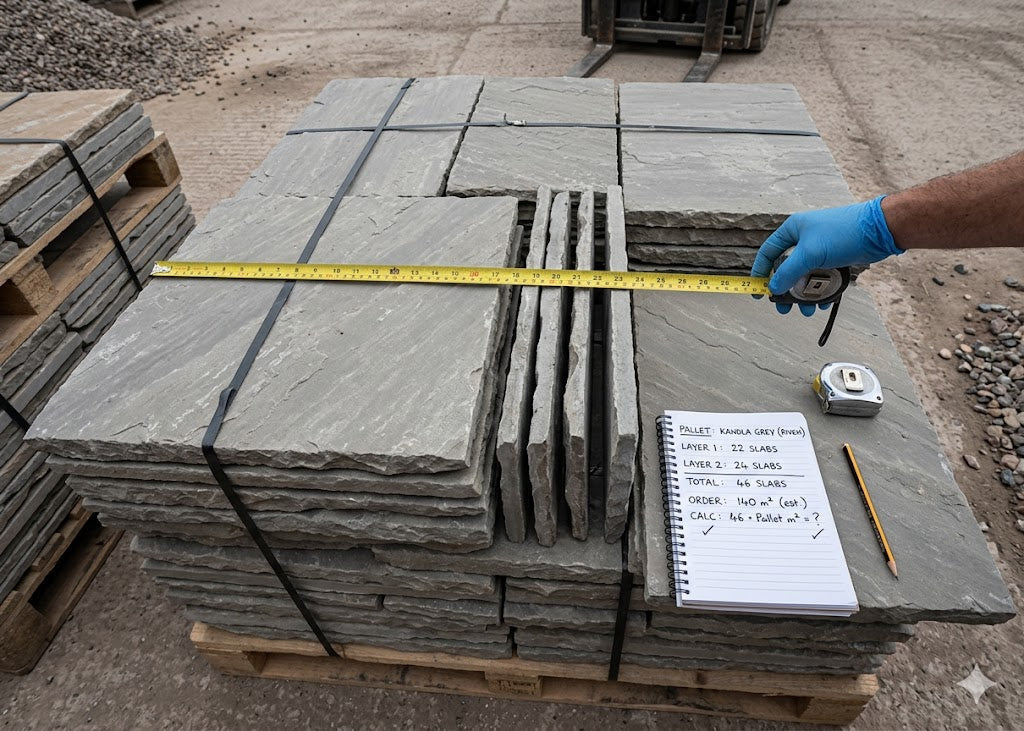
How to Calculate How Much Paving You Need (Without Over-Ordering)
Measure your patio length × width in metres to get the area in m². Add 10% for cuts and wastage. Then divide by the coverage per slab: 900×600mm = 0.54m² per slab, 600×600mm = 0.36m² per slab, 1200×600mm = 0.72m² per slab. A 20m² patio needs 22m² of paving (20 + 10%) = 41 slabs at 900×600mm or 61 slabs at 600×600mm. Our website shows price per m² — multiply your area (including wastage) by the per-m² price for the total cost.
Calculating paving quantities isn't complicated — but getting it wrong is expensive. Under-order and your project stops while you wait for a top-up delivery (which may be a different batch with slightly different colour). Over-order by 20% and you've paid for stone that sits in your garden forever. The sweet spot is 10% extra — enough to cover cuts and the occasional broken slab, without excessive waste. Here's exactly how to calculate it.
The formula
Three steps. That's it.
Measure the length and width of your planned patio in metres. Multiply them together.
Example: 5m long × 4m wide = 20m²
For L-shaped or irregular patios, split the area into rectangles, calculate each one separately, and add them together.
Every patio requires cuts at edges, around drain covers, and at boundary walls. Some slabs break during handling. The industry standard allowance is 10%.
Example: 20m² × 1.10 = 22m²
For complex shapes (curves, angles, many obstacles), add 15% instead of 10%. For simple rectangles with minimal cutting, 10% is sufficient.
Divide your total area (including wastage) by the coverage per slab.
Example (900×600mm slabs): 22m² ÷ 0.54m² per slab = 41 slabs
Example (600×600mm slabs): 22m² ÷ 0.36m² per slab = 61 slabs
Coverage per slab — the conversion table
| Slab size | m² per slab | Slabs per m² | Slabs for 10m² | Slabs for 20m² |
|---|---|---|---|---|
| 600×600mm | 0.36 | 2.78 | 31 slabs | 61 slabs |
| 900×600mm | 0.54 | 1.85 | 21 slabs | 41 slabs |
| 1200×600mm | 0.72 | 1.39 | 16 slabs | 31 slabs |
| 800×800mm | 0.64 | 1.56 | 18 slabs | 35 slabs |
| 600×300mm | 0.18 | 5.56 | 61 slabs | 123 slabs |
| Setts 200×100mm | 0.02 | 50 | 550 setts | 1,100 setts |
| Cobbles 100×100mm | 0.01 | ~85 | 935 cobbles | 1,870 cobbles |
Slab counts include 10% wastage. These are "order this many" numbers, not exact-fit numbers.
Patio packs — different calculation
Patio packs are pre-calculated bundles of mixed sizes designed to cover a specific area. You don't calculate individual slabs — you calculate how many packs you need:
Step 1: Check the pack coverage (stated on the product page — typically 15-20m² per pack).
Step 2: Divide your total area (including 10% wastage) by the pack coverage.
Example: 22m² needed ÷ 15.37m² per pack = 1.43 packs → order 2 packs (you can't buy partial packs).
Patio packs often leave you with spare slabs from the second pack. Keep them — they're useful for future repairs, garden path stepping stones, or extending the patio later. Spare slabs from the same batch are invaluable because they guarantee an exact colour match.
Quick reference — common patio sizes
| Patio size | Area | Order (inc 10%) | 900×600 slabs | Approx. cost (sandstone) |
|---|---|---|---|---|
| Small (3×2m) | 6m² | 6.6m² | 13 slabs | ~£132-143 |
| Medium (4×3m) | 12m² | 13.2m² | 25 slabs | ~£264-286 |
| Standard (5×4m) | 20m² | 22m² | 41 slabs | ~£440-476 |
| Large (6×5m) | 30m² | 33m² | 62 slabs | ~£660-714 |
| Extra large (8×5m) | 40m² | 44m² | 82 slabs | ~£880-952 |
Sandstone prices based on Kandla Grey 900×600 from £20-21.64/m². For exact pricing on any product, check the product page or use our cost calculator.
How to measure irregular shapes
L-shaped patios
Split into two rectangles. Measure each separately. Add them together.
Example: Main section 5m × 4m = 20m². Side extension 3m × 2m = 6m². Total = 26m². Add 10% = 28.6m².
Curved patios
Measure the bounding rectangle (the smallest rectangle that would contain the entire curved area). Calculate that area and add 15% instead of 10% — curves create more off-cuts and waste than straight edges.
Patios with obstacles
If your patio wraps around a drain cover, manhole, or tree, measure the full rectangle and don't subtract the obstacle area. The slabs around the obstacle need cutting, which creates waste that offsets the "saved" area. The 10% allowance covers this.
Calculating sundry materials
Paving slabs aren't the only material you need. Here's how to calculate the rest:
| Material | How to calculate | Example (20m² patio) |
|---|---|---|
| MOT Type 1 sub-base | Area × 0.15m depth × 1.8 (tonnes per m³) | 20 × 0.15 × 1.8 = ~5.4 tonnes |
| Sharp sand (mortar bed) | Area × 0.025m depth × 1.6 | 20 × 0.025 × 1.6 = ~0.8 tonnes |
| Cement | 1 bag per 5 bags of sand (5:1 ratio) | 4-5 bags (25kg) |
| Jointing compound | 1 tub per 10-15m² (porcelain) or 8-12m² (sandstone) | 2 tubs |
| SBR primer (porcelain only) | 1 litre per 8-10m² | 2-3 litres |
Read our mortar mix guide for exact ratios and our jointing compound guide for coverage rates.
Why 10% extra — not 5% or 20%
5% is too little. A simple rectangular patio with no obstacles and straight cuts in one direction might only waste 3-4%. But one mistake — a dropped slab, a bad cut, an unexpected drain cover — and you're short. Re-ordering a single slab means a separate delivery, potential batch colour variation, and project delay.
20% is too much. On a 20m² patio, 20% extra means 4m² of spare stone (£80-90 in sandstone) sitting in your garden. Unless you plan to extend the patio or build a path, that's wasted money.
10% is the sweet spot. It covers 2-3 cutting errors, 1-2 broken slabs, and the natural waste from edge cuts. Any spare slabs after the project are useful for stepping stones, replacing a cracked slab years later, or extending the patio. And a few spare slabs from the original batch are invaluable for future repairs — guaranteed colour match.
Know your numbers? Start browsing.
All prices shown per m² including VAT and free UK delivery. Multiply by your area for the total.
Browse All Paving Order Samples FirstFrequently asked questions
How many paving slabs do I need for a 10m² patio?
At 900×600mm (most popular size): 21 slabs (including 10% wastage). At 600×600mm: 31 slabs. At 1200×600mm: 16 slabs. Always add 10% to the exact-fit number to cover cuts, breakages, and spare for future repairs.
How do I convert slab price to total cost?
Our prices are shown per m². Multiply the per-m² price by your total area (including 10% wastage). Example: Kandla Grey sandstone at £21.64/m² × 22m² (for a 20m² patio + 10%) = £475.08 total. Use our cost calculator for instant totals.
Should I order extra for porcelain?
Yes — 10% minimum, and keep the spares. Porcelain replacement slabs must come from the same production batch to guarantee colour match. Different batches can have subtle colour variations visible on a laid patio. With sandstone, batch variation matters less because every slab already varies naturally.
How do I measure for edging setts?
Measure the total linear metres of border you need. For 200×100mm setts in a single soldier course, you need 5 setts per linear metre. For 100×100mm cobbles, 10 per linear metre. Example: 18 linear metres of border × 5 setts per metre = 90 setts + 10% = 99 setts.