






How to Clean Porcelain Paving: The Low-Effort Method That Keeps It Perfect
Porcelain paving needs minimal cleaning — an annual wash with clean water and a soft brush removes surface dirt and prevents algae forming in the joints. For tougher marks (grout haze, tyre marks, paint splashes), use a pH-neutral paving cleaner or diluted household degreaser. Unlike sandstone, porcelain tolerates pressure washers at full power and won't stain from cleaning products. The entire process takes 30 minutes for a 20m² patio.
Porcelain is the lowest-maintenance paving material on the market. But "low maintenance" doesn't mean "no maintenance forever." Left for five years without a wash, even porcelain develops a grey film of atmospheric dirt, and algae colonises the jointing compound between slabs. Neither damages the porcelain itself — but the patio stops looking pristine. Thirty minutes once a year prevents this entirely. Here's how.
The annual clean — 30 minutes, once a year
This is all most porcelain patios need. Do it in spring before BBQ season starts:
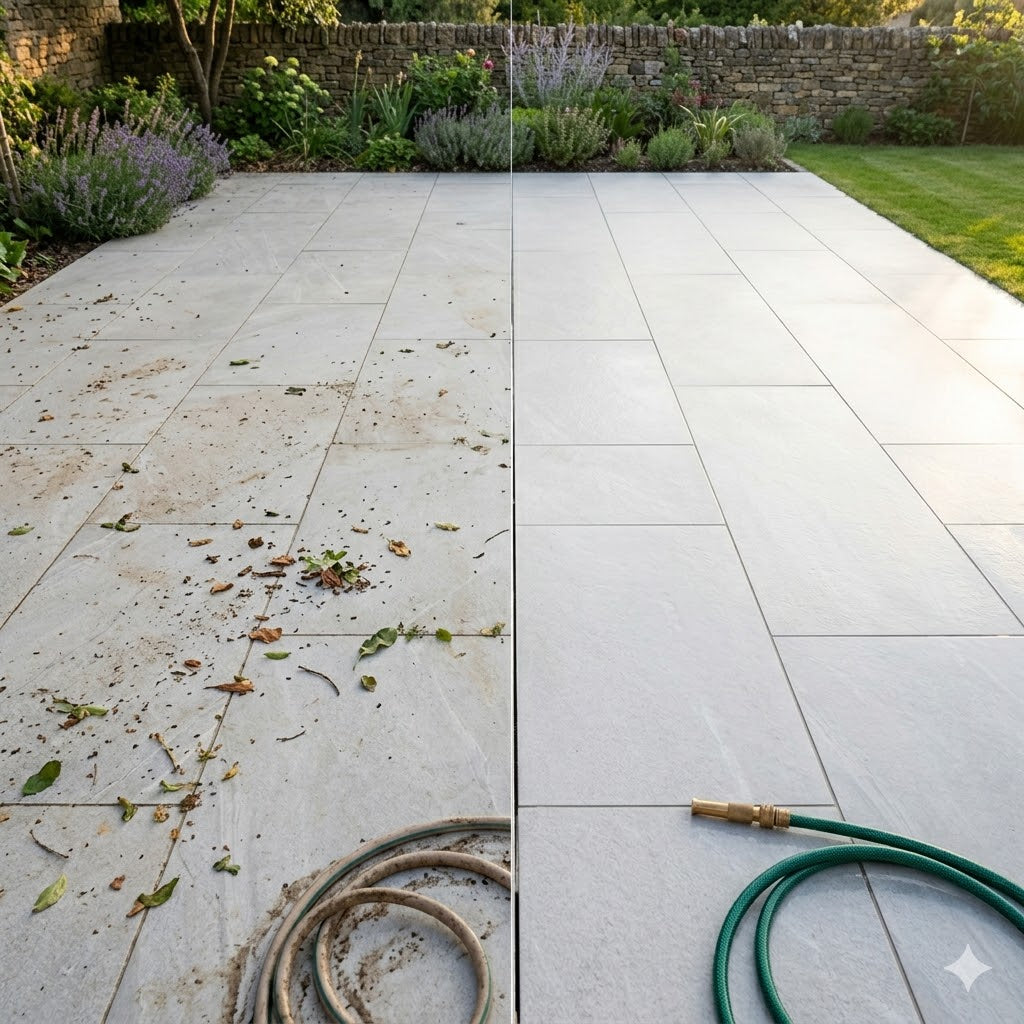
Remove loose leaves, debris, and dirt with a stiff outdoor broom. Pay attention to corners, edges, and the joints between slabs where organic material collects. This step alone makes a noticeable difference — most of what makes a porcelain patio look dirty is surface debris, not staining.
Hose down the entire surface with clean water. For light dirt, this is enough. For atmospheric grime that's built up over winter, add a squirt of washing-up liquid to a bucket of warm water and mop or brush across the surface before hosing off. The non-porous surface means dirt sits on top — it doesn't penetrate — so water lifts it off easily.
Run a stiff brush along the joints between slabs. Algae and moss grow in the jointing compound — not on the porcelain surface. The joints are the one area that needs attention. A stiff bristle brush dislodges any green growth before it establishes. If the joints have heavy moss, apply a diluted algae treatment (follow product instructions) and brush out after 15 minutes.
Final hose-down to rinse away any remaining soap or loosened dirt. The porcelain surface dries quickly because it's non-porous — no water absorption, no damp patches lingering for hours. Your patio looks factory-new. Total time: 20-30 minutes.
Using a pressure washer on porcelain
Unlike sandstone (where high pressure can damage the surface), porcelain handles pressure washers without restriction:
| Setting | Porcelain | Sandstone |
|---|---|---|
| Pressure | Up to 2,500 PSI — safe | Max 1,500 PSI — higher damages surface |
| Nozzle | Any — fan or rotary | Wide fan only — rotary gouges |
| Distance | 15-30cm from surface | 30cm minimum |
| Surface damage risk | None | Yes — can erode soft stone |
One caution: while pressure washers can't damage porcelain slabs, they CAN blast out jointing compound from between the slabs if directed into the joints at close range and high pressure. Angle the nozzle at 30-45° to the joint line rather than directly into it. If the compound does loosen, re-point with Ultrascape Porcelpoint.
How to remove specific stains
Porcelain's non-porous surface means stains sit on top rather than penetrating. Most wipe off with a cloth. For stubborn marks:
| Stain type | How to remove | Difficulty |
|---|---|---|
| Food and drink (wine, coffee, sauce) | Damp cloth immediately, or warm soapy water if dried | Easy |
| BBQ grease | Kitchen degreaser spray, leave 5 minutes, wipe and rinse | Easy |
| Grout haze (post-installation) | Porcelain grout haze remover (available from tile suppliers). Apply, scrub with nylon pad, rinse | Moderate |
| Rust marks (from furniture) | Oxalic acid-based rust remover — safe on porcelain (NOT safe on sandstone or limestone) | Moderate |
| Paint splashes | Scrape wet paint immediately. Dried paint: acetone (nail polish remover) on a cloth, rub gently | Moderate |
| Tyre marks | WD-40 or kitchen degreaser, leave 10 minutes, scrub with stiff brush, rinse | Moderate |
| Algae on joints | Diluted algae killer, leave 15 minutes, stiff brush along joints, rinse | Easy |
| White salt deposits (efflorescence) | Dry brush to remove crystals, then rinse. Usually stops after first year as mortar cures | Easy |
Grout haze — the post-installation problem
The most common porcelain cleaning issue isn't from use — it's from installation. Grout haze is a thin film of dried jointing compound left on the slab surface after pointing. If the excess compound wasn't cleaned off within 15-20 minutes of application, it dries and bonds to the surface as a cloudy, milky film.
Grout haze doesn't mean the porcelain is stained — the haze sits ON the surface, not IN it. A dedicated grout haze remover (available from tile suppliers or builders merchants) dissolves the residue without damaging the porcelain. Apply, leave for the specified time, scrub with a nylon pad (not wire), and rinse thoroughly.
Prevention is easier than cure: during installation, clean excess jointing compound off the slab surface within 15 minutes of application, working in small sections. Read our jointing compound guide for the full application method.
3 mistakes that damage porcelain
Porcelain is nearly indestructible — but these three mistakes can cause permanent damage:
Wire brushes and metal scrapers leave fine scratches in the porcelain glaze that trap dirt and become visible over time. The scratches are permanent — porcelain can't be resurfaced like wood or stone. Always use nylon brushes, plastic scrapers, or soft bristle brooms. The porcelain surface is hard enough to resist most cleaning tools — but metal is harder.
Scouring powders and abrasive cleaners contain grit that scratches the porcelain surface — the same principle as sandpaper. Use liquid cleaners only. Standard washing-up liquid, pH-neutral paving cleaner, or diluted degreaser — all safe. Anything with "scouring" or "abrasive" on the label — avoid.
Cast iron planters, steel-legged furniture without caps, and heavy metal barbecues dragged across porcelain can scratch the glaze. Always lift heavy objects rather than sliding them. Fit rubber or felt caps to metal furniture legs. This isn't a cleaning mistake — it's a use mistake — but the damage shows up when you clean and the scratches become visible.
Porcelain vs sandstone — cleaning comparison
| Cleaning factor | Porcelain | Sandstone |
|---|---|---|
| Annual cleaning time (20m²) | 30 minutes | 2-3 hours |
| Pressure washer safe? | Yes — any setting | Careful — max 1,500 PSI |
| Acid cleaners safe? | Yes | Caution — can discolour |
| Sealing needed? | Never | Recommended every 3-5 years |
| Stain risk | None — non-porous | Yes — porous, absorbs stains |
| Algae risk | Joints only — surface resists | Surface and joints — porous |
Read our complete sandstone cleaning guide for the more demanding natural stone method.
Seasonal cleaning schedule
For patios that see heavy use (BBQs, dining, children, pets):
Spring (March-April): Full annual clean — sweep, wash, brush joints, rinse. Remove winter debris and any algae that grew in the damp months. This is the only essential clean.
Summer (as needed): Wipe food and drink spills promptly. A quick hose-down after barbecues prevents grease building up. No formal cleaning session needed.
Autumn (October-November): Clear fallen leaves regularly — wet leaves left for weeks can stain jointing compound (not the porcelain, but the joints). A 10-minute sweep every fortnight prevents this.
Winter: Nothing. Porcelain handles frost, ice, rain, and snow without any intervention. Don't use salt for de-icing — it can damage jointing compound. If the patio is slippery with ice, sprinkle sharp sand for grip and sweep it up once the ice melts.
The patio that cleans itself (almost)
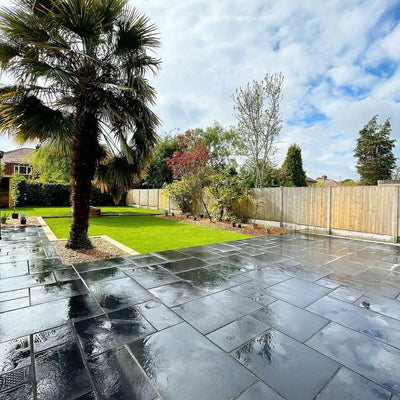
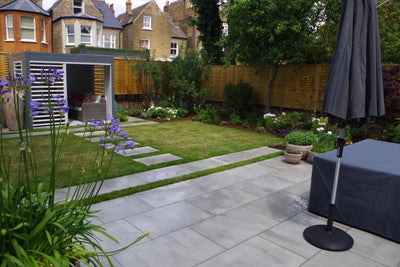
Porcelain paving — stain-proof, frost-proof, 30 minutes of cleaning per year. All prices include VAT and free UK delivery.
Browse Porcelain Paving Order SamplesFrequently asked questions
Does porcelain paving need cleaning?
Technically no — porcelain won't deteriorate without cleaning. But an annual wash (30 minutes) prevents atmospheric dirt building up and keeps the surface looking factory-new. The joints between slabs benefit from an annual brush to prevent algae establishing. It's optional maintenance, not essential — but it makes a visible difference.
Can I pressure wash porcelain paving?
Yes — porcelain handles pressure washers up to 2,500 PSI without surface damage. Any nozzle type is safe. The only caution: angle the nozzle away from joints to avoid blasting out the jointing compound. Porcelain is significantly more pressure-washer-friendly than sandstone, which requires lower pressure and a wider nozzle to avoid erosion.
How do I remove grout haze from porcelain?
Use a dedicated grout haze remover (available from tile suppliers). Apply to the affected area, leave for the specified time, scrub with a nylon pad (not wire brush), and rinse thoroughly. Grout haze is dried jointing compound residue sitting on the surface — it's not a stain. Prevention: clean excess compound off within 15 minutes during installation.
What cleaning products are safe for porcelain paving?
Most cleaning products are safe on porcelain — it's far more chemical-resistant than natural stone. Safe: washing-up liquid, pH-neutral paving cleaner, household degreaser, grout haze remover, algae killer, acetone (for paint). Avoid: abrasive scouring powders and wire brushes (scratch the glaze). Unlike sandstone and limestone, acid-based cleaners won't damage porcelain.
Why are my porcelain paving joints going green?
Algae grows in the jointing compound between slabs — not on the porcelain surface itself. The compound is slightly porous, and in shaded, damp conditions, algae colonises it over 2-3 years. Brush the joints with a stiff bristle brush annually and apply diluted algae treatment if needed. The porcelain slab surfaces remain algae-free because of their non-porous finish.