






Block Paving vs Natural Stone Setts: Which Is Worth Your Money?
Block paving is manufactured concrete pressed into moulds — it costs £15-25/m² and lasts 15-20 years before fading and surface deterioration. Natural stone setts are quarried granite or sandstone — they cost £40-55/m² and last 50-100+ years (granite) or 20-40 years (sandstone). Block paving is cheaper upfront but needs replacing 2-3 times in the period a granite sett driveway lasts once. Over 30 years, granite setts cost approximately £1.10/m²/year vs block paving at £1.50-2.50/m²/year.
This is a comparison most paving websites won't make — because block paving companies don't sell natural stone, and natural stone suppliers don't acknowledge block paving exists. We sell natural stone setts, so we have a bias. But we'll give block paving a fair hearing, because for some projects it genuinely is the better choice. Here's the honest comparison.
What's the actual difference?
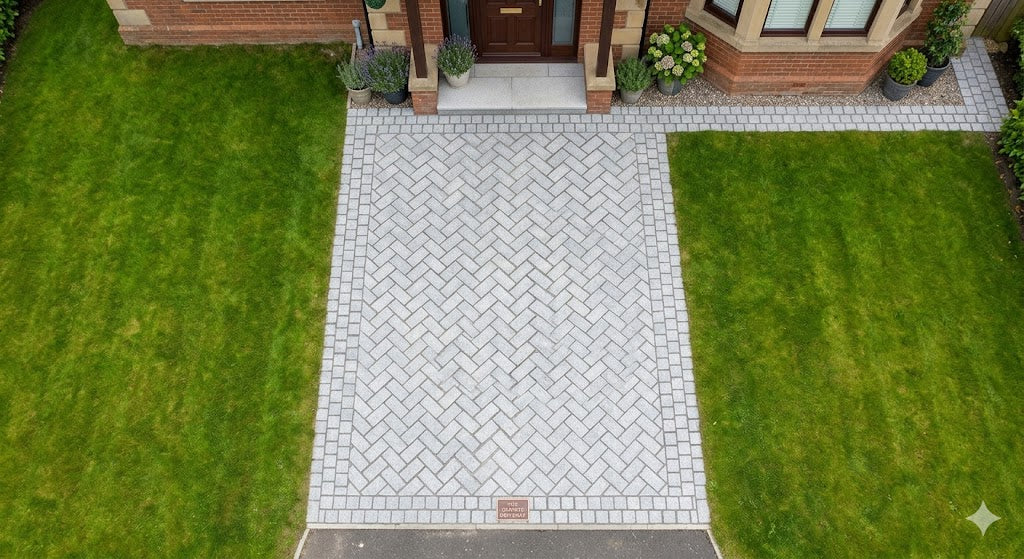
Block paving and natural stone setts look similar from a distance — small rectangular units laid in patterns. But they're fundamentally different products:
Block paving is manufactured concrete. Sand, cement, aggregate, and pigment are pressed into moulds under high pressure and vibration. The colour is added during manufacturing — it's a surface coating or pigment mixed into the concrete. The surface is uniform, consistent, and identical across every block.
Natural stone setts are quarried from geological formations millions of years old. Granite setts are cut from igneous rock (cooled magma). Sandstone setts are cut from sedimentary rock (compressed sand). The colour runs all the way through the stone — it's geological, not applied. Every sett has unique natural variation.
Side-by-side comparison
| Feature | Block paving | Granite setts | Sandstone setts |
|---|---|---|---|
| Material | Manufactured concrete | Quarried igneous rock | Quarried sedimentary rock |
| Price per m² | £15-25 | £40-55 | £40-43 |
| Lifespan | 15-20 years | 50-100+ years | 20-40 years |
| Colour fade | Fades within 5-10 years | Never fades — colour is geological | Develops natural patina |
| Surface wear | Coating wears through, exposing aggregate | Same material all the way through | Same material all the way through |
| Weed growth | Common — sand-filled joints wash out | Minimal — mortar/compound joints | Minimal — mortar/compound joints |
| Sinking/movement | Common — sand bed shifts over time | Rare — mortar bed is rigid | Rare — mortar bed is rigid |
| Oil stain resistance | Absorbs oil permanently | Very low porosity — resists oil | Moderate — sealing helps |
| Character | Uniform, manufactured | Natural, unique variation | Natural, warm variation |
| Installation | Sand bed — faster, simpler | Mortar bed — slower, stronger | Mortar bed — slower, stronger |
The real cost comparison — over time
Block paving wins on upfront cost. But driveways aren't one-time purchases — they need replacing eventually. Here's what happens over 30 years:
| Scenario (20m² driveway, 30 years) | Block paving | Granite setts |
|---|---|---|
| Initial installation | £1,200-1,500 | £1,600-2,400 |
| Maintenance (joint refilling, weed treatment) | £50-100/year × 30 = £1,500-3,000 | £0-20/year × 30 = £0-600 |
| Replacement at year 15-20 | £1,200-1,500 (second installation) | £0 (still going strong) |
| 30-year total | £3,900-6,000 | £1,600-3,000 |
| Cost per year | £130-200/year | £53-100/year |
Block paving's lower upfront cost is deceptive. Annual maintenance (re-sanding joints, weed treatment, occasional block replacement) and a full re-lay at year 15-20 push the lifetime cost above granite setts — which need virtually nothing beyond the initial installation.
The 5 problems with block paving that nobody mentions
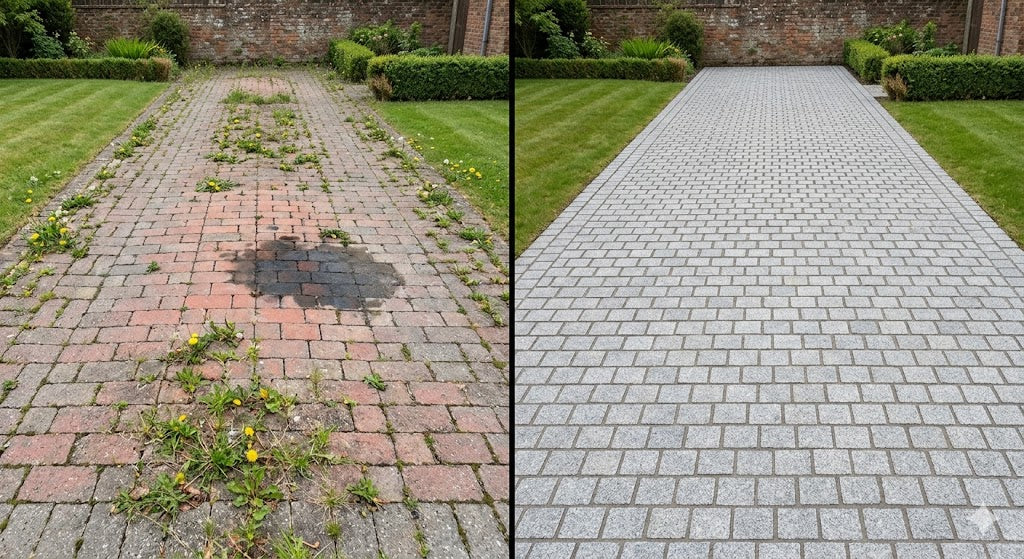
Block paving colour is either a surface coating or pigment mixed into concrete. Both fade under UV exposure. Within 5-10 years, the rich charcoal or red you chose has softened to a washed-out grey or pink. Natural stone doesn't fade because the colour is geological — it's the mineral composition of the rock itself, not an applied pigment.
Block paving joints are filled with kiln-dried sand — it washes out over time, creating gaps where weeds colonise aggressively. Within 3-5 years, most block-paved driveways have visible weed growth between blocks. Refilling with sand is a recurring maintenance task. Natural stone setts use mortar or jointing compound — solid joints that resist weed growth for 10-15 years.
Block paving sits on a sand bed — not mortar. Sand shifts, settles unevenly, and washes out from underneath. Over time, individual blocks sink, creating trip hazards and puddles. Lifting and re-laying sunken blocks is a recurring maintenance task. Stone setts on a mortar bed create a rigid surface that doesn't shift.
The concrete surface of block paving wears through under tyre friction and foot traffic, exposing the rough aggregate core underneath. This creates an uneven, rough texture that traps dirt and looks tired. Stone setts are the same material all the way through — wear simply reveals more of the same stone.
Concrete block paving absorbs engine oil and vehicle fluid permanently. The stains darken with time and can't be removed without specialist chemicals — and even then, the treated area often looks different from the surrounding surface. Granite setts have negligible porosity and resist oil penetration.
When block paving IS the better choice
We sell natural stone setts, so we're biased. But here are the genuine scenarios where block paving makes more sense:
If you need a fresh driveway for kerb appeal before a sale but won't be living there long enough to experience the deterioration, block paving gives you a clean surface at the lowest upfront cost. The fading and wear won't be your problem.
At £15-25/m² vs £40-55/m², block paving is roughly half the material cost of natural stone setts. If the budget genuinely can't stretch to stone, block paving is a legitimate surface — it works, it looks acceptable, and it's better than cracked concrete or bare gravel.
Block paving on a sand bed is simpler to lay than setts on a mortar bed. No mortar mixing, no SBR priming, no pointing. For a competent DIYer, a block-paved driveway is a 2-3 day project. Setts on mortar take 3-5 days and require more skill.
The verdict
If you're staying in your home long-term — natural stone setts are the better investment. Higher upfront cost, dramatically lower lifetime cost, and a surface that looks better with age instead of worse. Granite setts are the strongest; sandstone setts offer the warmest character.
If you need a surface now at the lowest possible cost — block paving is honest, functional, and widely available. Accept that it will need maintenance and eventual replacement, and it serves its purpose well for 15-20 years.
We sell natural stone setts for driveways — browse the full [driveway paving range](https://universalpaving.co.uk/collections/driveway-slabs), or go straight to [granite](https://universalpaving.co.uk/collections/granite-slate-cobbles-setts) from £40/m² and [sandstone](https://universalpaving.co.uk/collections/sandstone-cobbles-and-setts) from £40/m², both delivered free. We don't sell block paving. Take that bias into account — but check the 30-year cost comparison and decide for yourself.
See the difference in person
Order granite or sandstone sett samples and compare them to block paving from your local builders merchant. The difference in weight, texture, and character tells the story better than any website.
Browse Granite Setts Browse Sandstone SettsFrequently asked questions
Is natural stone better than block paving?
For longevity and lifetime value, yes. Granite setts last 50-100+ years vs block paving's 15-20 years. Natural stone doesn't fade, the colour runs all the way through, and mortar joints resist weeds far better than sand-filled block paving joints. Block paving wins only on upfront cost and ease of DIY installation.
Why is block paving cheaper than natural stone?
Block paving is manufactured concrete — mass-produced in factories from inexpensive raw materials. Natural stone is quarried, cut, and finished individually from geological formations. The manufacturing process is cheaper but produces a less durable, less attractive product that deteriorates faster. The price reflects the raw material and process, not the long-term value.
Does block paving last as long as natural stone?
No. Block paving lasts 15-20 years before visible fading, surface wear, and joint failure require replacement. Granite setts last 50-100+ years. Sandstone setts last 20-40 years. A granite sett driveway laid today will still be in service when block paving has been replaced 3-5 times.
Can I replace block paving with natural stone setts?
Yes — and it's a popular upgrade. Remove the block paving and sand bed, check the existing sub-base (it may need deepening from 100mm to 200mm for vehicular use), lay a mortar bed, and install the setts. The upgrade transforms the driveway's appearance and adds decades to its lifespan. Read our setts installation guide.