








Best Paving for Driveways: What Actually Survives Daily Traffic
The best driveway paving is granite setts — 50mm thick, the hardest natural stone available, and a lifespan of 50-100+ years under daily vehicle traffic. Sandstone setts (40-50mm) are a warmer alternative that handles domestic driveways comfortably. Standard paving slabs (20-22mm) are NOT suitable for driveways — they crack under vehicle weight. Concrete block paving works but deteriorates after 15-20 years. For a driveway that never needs replacing, natural stone setts are the only serious option.
A driveway isn't a patio. Your patio handles foot traffic — 70-90kg per person, spread across a shoe sole. Your driveway handles 1,500-2,000kg of vehicle, concentrated through four tyre contact patches of roughly 150cm² each. That's a completely different engineering requirement. The material, thickness, sub-base depth, and laying method all need to be built for vehicular loading — not pedestrian use. Most "driveway paving" advice online ignores this distinction. Here's what actually works — and if you want to see the driveway-rated options we stock, browse our full driveway paving collection.
Why thickness matters
The single most important factor for driveway paving is thickness. A thin slab flexes under vehicle weight, and natural stone doesn't flex — it snaps. Here's the minimum thickness by use:
| Use | Minimum thickness | Suitable products |
|---|---|---|
| Pedestrian only (patios, paths) | 20-22mm | Standard sandstone slabs, porcelain slabs |
| Occasional light vehicle | 40mm minimum | Sandstone setts (40-50mm), thick cobbles |
| Daily vehicle traffic (domestic driveway) | 50mm recommended | Granite setts (50mm), sandstone setts (50mm) |
| Heavy vehicle / commercial | 60mm+ | Granite setts, engineering brick |
Standard paving slabs (20-22mm) will crack on driveways. This includes all standard sandstone slabs and porcelain paving slabs in our range. They're designed for pedestrian patios, not vehicle loading. If you lay 20mm slabs on a driveway, expect cracking within the first year — regardless of how good your sub-base is. For driveways, you need setts.
Driveway materials compared
Granite setts — the best driveway paving
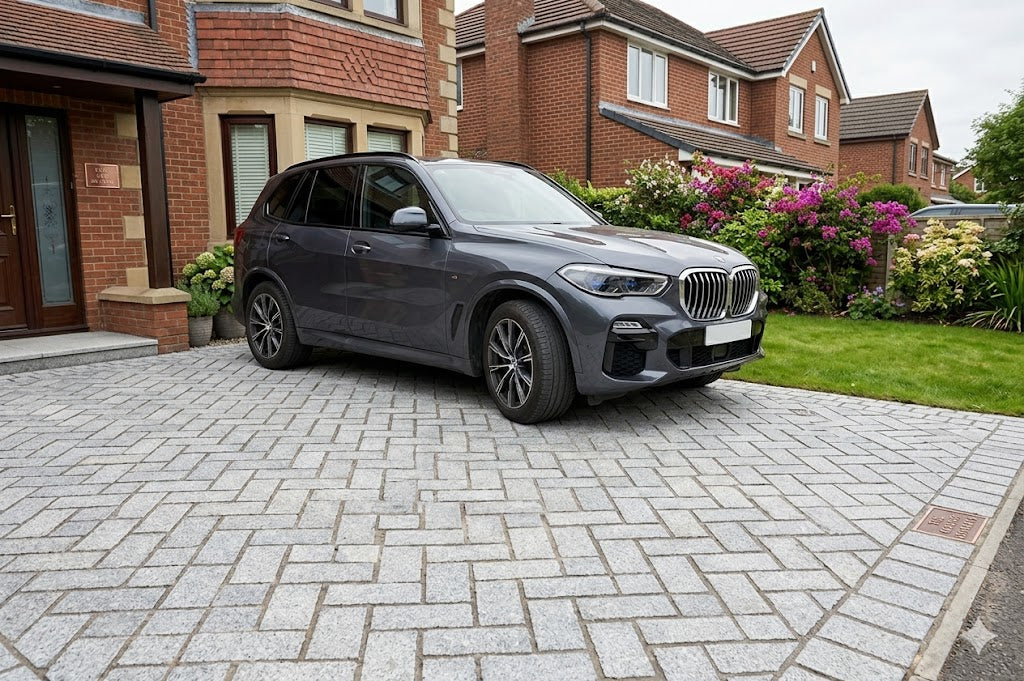
Granite is the hardest natural stone commercially available. At 50mm thick, granite setts handle daily car traffic, delivery vans, and even occasional heavy vehicles without stress. Victorian granite sett streets in London, Edinburgh, and Manchester are still in daily use 150+ years after installation — carrying buses and lorries, not just family cars.
| Granite setts | Details |
|---|---|
| Thickness | 50mm |
| Size | 200×100mm (standard sett format) |
| Colour | Silver Grey |
| Lifespan | 50-100+ years |
| Maintenance | None — occasional re-pointing if joints erode |
| Price | From £40/m² |
| Carbon footprint | 29.5 kg CO₂/m² — lowest of any paving material |
Best pattern for driveways: herringbone. The interlocking 45° pattern distributes vehicle weight across multiple setts simultaneously, preventing individual setts from shifting under braking and turning forces. A running bond (brickwork) pattern also works but is slightly less resistant to lateral forces from steering.
Sandstone setts — the character alternative
Sandstone setts at 40-50mm thickness handle domestic car traffic comfortably. They're softer than granite so they'll show wear sooner — but "sooner" still means 20-40 years on a residential driveway. The natural colour variation (Kandla Grey or Raj Green) adds warmth and geological character that granite's uniform grey can't match.
Choose sandstone setts over granite if: you want warmer colour tones, you prefer natural variation over consistency, and your driveway carries domestic cars only (not heavy vehicles). Sandstone setts in Raj Green complement red brick houses beautifully — the browns and greens in the stone echo the warm tones of the brickwork.
Concrete block paving — the common choice
Concrete block paving is the most widely installed UK driveway surface. It's affordable, widely available, and comes in dozens of colours and patterns. But it has significant drawbacks compared to natural stone:
Concrete blocks fade in UV sunlight, losing their original colour within 5-7 years. Weeds colonise the sand-filled joints aggressively — requiring annual weedkiller or re-sanding. The blocks themselves shift and sink as the sand bedding erodes, creating uneven surfaces that pool water. After 15-20 years, most concrete block driveways need ripping out and replacing. Read our full block paving vs setts comparison.
Tarmac and resin-bound — the budget options
Tarmac: cheapest driveway surface. Functional but aesthetically limited. Fades from black to grey within 3-5 years, softens in extreme heat, and needs resurfacing every 15-20 years. No character, no kerb appeal, no property value benefit.
Resin-bound: aggregate stones bonded with resin. Permeable, smooth, attractive when new. But resin degrades with UV exposure, and once the surface layer fails, repair isn't possible — the entire driveway needs re-laying. 10-15 year lifespan with a replacement cost similar to natural stone setts.
30-year cost comparison
For a typical 40m² domestic driveway:
| Material | Install cost (40m²) | Replacements in 30 years | 30-year total cost |
|---|---|---|---|
| Granite setts | £4,800-6,400 | 0 | £4,800-6,400 |
| Sandstone setts | £4,000-5,600 | 0 | £4,000-5,600 |
| Concrete block paving | £3,200-4,800 | 1-2 | £6,400-14,400 |
| Tarmac | £2,000-3,200 | 1-2 | £4,000-9,600 |
| Resin-bound | £3,600-5,200 | 2 | £10,800-15,600 |
Granite setts cost more to install than tarmac or block paving — but they never need replacing. Over 30 years, granite setts are cheaper than concrete block paving and resin-bound because you pay once instead of paying two or three times.
Driveway sub-base requirements
A driveway sub-base needs to be deeper and more heavily compacted than a patio sub-base because of the vehicle loading:
| Layer | Patio (pedestrian) | Driveway (vehicles) |
|---|---|---|
| MOT Type 1 sub-base | 150mm | 200-250mm |
| Mortar bed | 30-40mm | 40-50mm |
| Total excavation depth | 200mm | 300-350mm |
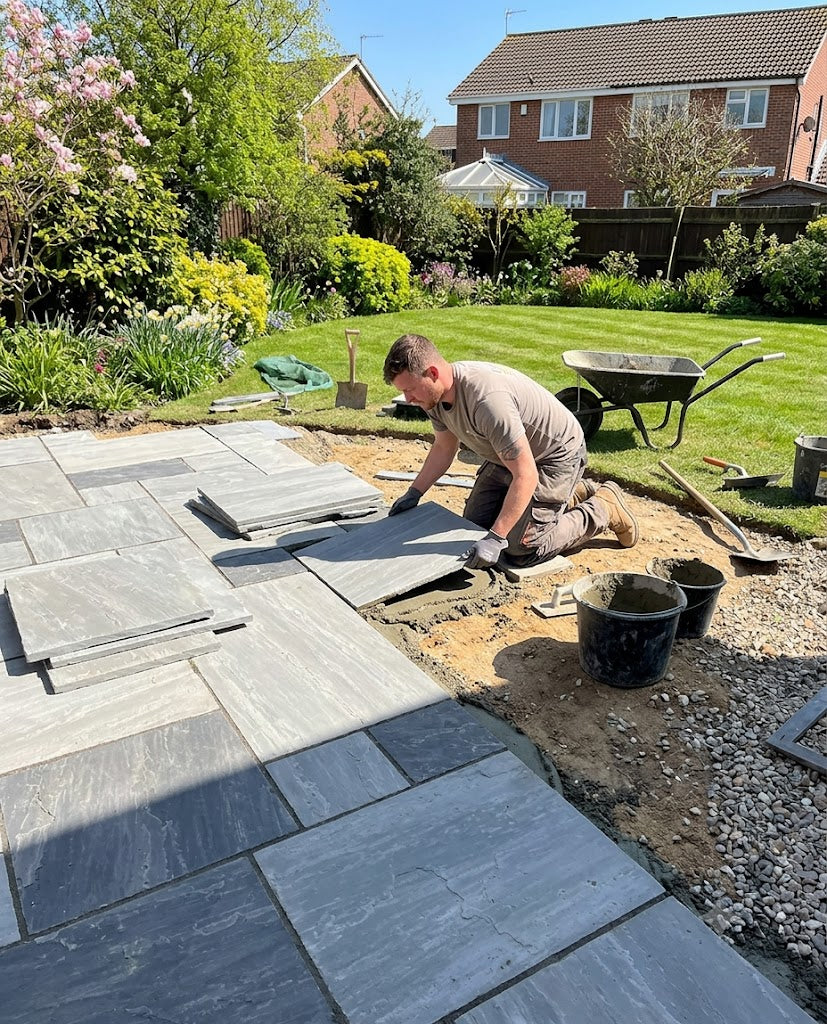
The sub-base is where most driveway failures start. A driveway laid on 100mm of aggregate will sink under vehicle weight within the first winter. 200-250mm of compacted MOT Type 1 — laid in two 100-125mm layers, each separately compacted with a wacker plate — provides the stable foundation a driveway needs.
Driveway edging
Every sett driveway needs a solid edge restraint to prevent the setts migrating outward under vehicle turning forces. Options include:
Granite setts set on edge: use the same setts laid vertically as a perimeter border — 50mm wide, 100mm deep. Creates a seamless, matching edge.
Concrete kerbing: functional, affordable, hidden beneath the driveway surface. The practical choice when appearance doesn't matter at the edge.
Contrasting setts: use a different colour or material as the border row — for example, Raj Green sandstone setts bordering a Silver Grey granite driveway. Adds definition and design intention. Read our driveway edging guide for more ideas.
Eco advantage
Natural stone setts have the lowest carbon footprint of any driveway material at 29.5 kg CO₂/m² — compared to 77.6 for concrete blocks, 74.8 for tarmac, and 134.9 for clay pavers. When you factor in that granite setts never need replacing (zero repeat carbon cost), the lifetime environmental impact is 16-24x lower than concrete block paving. Read our eco-friendly paving guide for the full GWP data.
The last driveway you'll ever lay
Granite setts from £40/m². Sandstone setts from £40/m². Both handle daily vehicle traffic for decades. Free UK delivery on every order.
Browse Granite Setts Browse Sandstone SettsFrequently asked questions
Can I use standard paving slabs on a driveway?
No. Standard paving slabs (20-22mm thick) are designed for pedestrian patios. They will crack under vehicle weight — even a family car. Driveways need 40-50mm thick setts or purpose-made driveway blocks. If you want the look of larger format paving on a driveway, use setts for the driving area and standard slabs for adjacent paths or borders. You can see our driveway-rated options in the driveway paving collection.
How long do granite setts last on a driveway?
50-100+ years. Granite is the hardest commercially available natural stone. Victorian granite sett streets in UK cities are still in daily use after 150+ years, carrying bus and lorry traffic far heavier than domestic cars. A properly laid granite sett driveway will outlast the house it serves.
Are granite setts better than block paving for driveways?
Yes — in every measurable way except initial cost. Granite setts last 3-5x longer (50-100 years vs 15-20 years), don't fade in sunlight, resist weed growth better, and cost less over 30 years when replacement costs are included. Block paving's only advantage is lower upfront cost. Read our full comparison.
How much does a granite sett driveway cost?
Materials for a 40m² driveway: approximately £1,600-2,200 (granite setts at £40-55/m²). Professionally installed with proper sub-base: £4,800-6,400 total. This is a one-time cost — no replacement, no resurfacing, no significant maintenance for 50-100+ years.
What pattern should I lay driveway setts in?
Herringbone (45°) is the strongest pattern for driveways. The interlocking angles distribute vehicle weight across multiple setts and resist the lateral forces from braking and turning. Running bond (brickwork) also works for domestic driveways. Avoid stack bond (grid pattern) on driveways — it doesn't interlock and setts can shift under vehicle forces.
%20are%20a%20warmer...)