






Which Paving Size? 900×600 vs 600×600 vs 1200×600 Compared
900×600mm is the best all-round paving size for most UK patios — large enough to look modern and spacious, light enough for two people to handle, and the most popular format with the widest product range. Choose 600×600mm for small patios, tight budgets, or solo DIY projects. Choose 1200×600mm for premium modern patios where you want minimal joints and maximum visual impact.
You've chosen your material and colour. Now you're staring at three sizes on the product page and wondering which one to order. It's a bigger decision than it looks — the size affects how many joints your patio has, how heavy each slab is to carry, how much cutting waste you'll generate, which laying patterns you can use, and ultimately how the finished surface looks and feels. Here's how to choose.
The 3 sizes at a glance
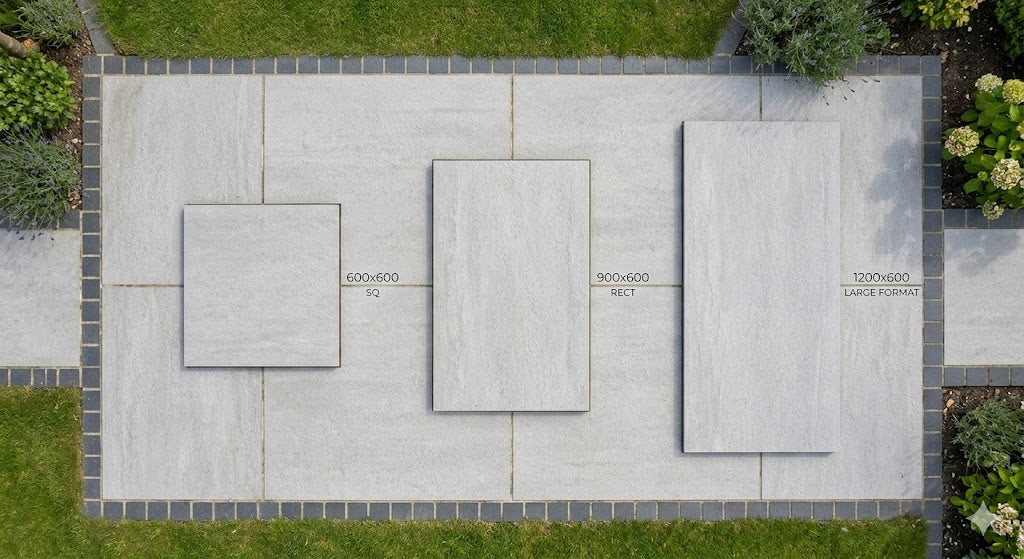
| Factor | 600×600mm | 900×600mm | 1200×600mm |
|---|---|---|---|
| Area per slab | 0.36m² | 0.54m² | 0.72m² |
| Slabs per m² | ~2.8 slabs | ~1.9 slabs | ~1.4 slabs |
| Weight per slab (porcelain 20mm) | ~16kg | ~24kg | ~32kg |
| Weight per slab (sandstone 22mm) | ~19kg | ~28kg | ~38kg |
| Joints per m² | Most joints | Moderate | Fewest joints |
| Visual effect | Traditional, busy | Modern, balanced | Premium, expansive |
| Best for | Small patios, budgets, DIY | Most patios — best all-rounder | Large modern patios |
600×600mm — the traditional square
At 16-19kg per slab, 600×600 is the only size one person can comfortably carry and position. This makes it the DIY-friendly format — you can lay a patio solo without a second pair of hands for every slab. It's also typically the cheapest per m² in both porcelain and sandstone.
With 2.8 slabs per m², a 600×600 patio has roughly 50% more joint lines than 900×600. This creates a busier visual grid that can make small patios look smaller. On a 20m² patio, the difference between 600×600 and 900×600 is approximately 18 metres of additional joint line — visible and significant.
Choose 600×600 if: you're laying solo, working with a tight budget, building a small patio (under 12m²), or prefer a traditional square grid pattern. Also a good choice for paths and stepping stone layouts where the square format fits naturally.
Products: Kandla Grey Porcelain 600×600 · Sandstone 600×600
900×600mm — the UK's most popular size
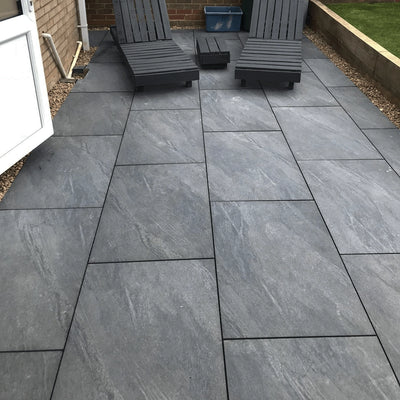
900×600 is the most popular paving size in the UK for good reason. The rectangular format creates a modern, spacious appearance with fewer joints than 600×600. At 24-28kg per slab, it's manageable for two people and still within reach for a strong solo DIYer. The widest range of colours and materials is available in this size.
The 900×600 format opens up laying patterns that 600×600 can't achieve. A running bond (brickwork pattern) with 900×600 slabs creates clean, directional lines that visually extend a patio — lay them lengthways to make a narrow garden feel wider, or lay them towards the house to draw the eye down the garden.
Choose 900×600 if: you want the best balance of modern appearance, practical handling, and product choice. This is the default for most UK patios between 12-40m². If you're unsure which size to choose, 900×600 is the safe answer.
Products: 900×600 Porcelain · Kandla Grey Porcelain 900×600 · Sandstone 900×600
1200×600mm — the large format
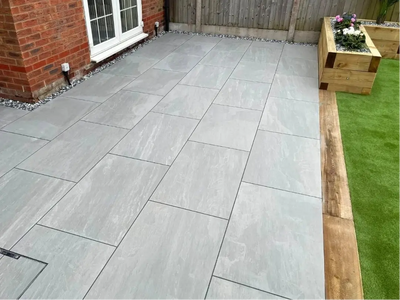
1200×600 slabs cover 0.72m² each — meaning just 1.4 slabs per m² and the fewest joints of any standard format. The result is a clean, expansive surface with minimal visual interruption. This is the format you see in architectural magazines and high-end garden designs. It suits large, open patios where the surface can breathe.
At 32-38kg per slab, 1200×600 requires two people for every single slab — no exceptions. The larger format also makes levelling more critical: any slight rocking is more visible on a bigger slab. Sub-base preparation must be precise. And at the patio edges, larger slabs generate more cutting waste — a half-slab offcut from a 1200mm slab is a bigger piece of wasted material than from a 600mm slab.
Choose 1200×600 if: you want a premium modern patio with minimal joints, you have a helper for lifting, and your patio area is at least 20m² (large format needs space to look right — on a small patio it looks like you couldn't fit enough slabs). Suits bifold door openings, contemporary extensions, and indoor-outdoor transitions where clean lines matter.
Products: Kandla Grey Porcelain 1200×600
What about patio packs (mixed sizes)?
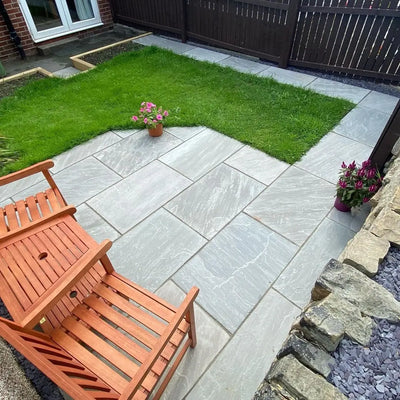
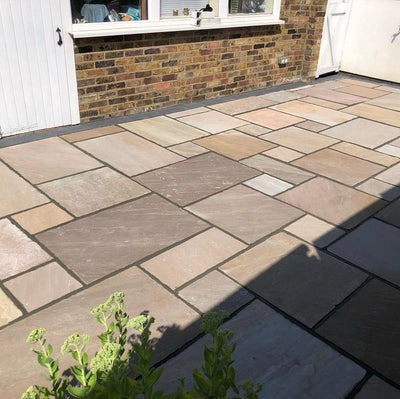
Patio packs contain a mix of sizes — typically 900×600, 600×600, 600×290, and 290×290 — designed to lay in a traditional random pattern. They're the classic choice for Indian sandstone patios and offer two advantages:
Visual variety. The mix of sizes creates a natural, traditional appearance that suits cottage gardens, period properties, and rustic settings. No repeating grid, no monotonous joints — just a varied, organic surface.
Less cutting waste. Because you have multiple sizes to choose from, you can fit smaller slabs into edge gaps that would otherwise need cutting from a larger slab. An experienced landscaper can often lay a patio pack with almost zero cuts.
Choose a patio pack if: you're laying sandstone (not porcelain) and want a traditional random pattern. Patio packs are the most popular format for Indian sandstone and the most cost-effective — full crate pricing keeps the per m² cost low. Read our calculation guide for how to work out coverage.
Size by garden type
| Garden type | Best size | Why |
|---|---|---|
| Small courtyard (under 12m²) | 600×600 | Proportional to space, less cutting waste in tight areas |
| Standard back garden (12-30m²) | 900×600 | The sweet spot — modern without overwhelming the space |
| Large open patio (30m²+) | 1200×600 | Fills the space with fewer joints, premium feel |
| Cottage garden / period property | Patio Pack | Traditional random pattern suits older properties |
| Modern extension with bifolds | 1200×600 or 900×600 | Clean lines that match indoor floor tiles |
| Garden path | 600×600 | Fits path width without cutting, square grid suits linear layouts |
| DIY first-timer (any size garden) | 600×600 or Patio Pack | Lightest slabs, most forgiving layout |
Laying patterns by size
600×600 — grid or stacked bond. Square slabs lay in a simple grid with aligned joints. Clean, symmetrical, traditional. You can also lay them diagonally (diamond pattern) for visual interest, but this increases cutting waste at the edges.
900×600 — running bond (brickwork). The most popular pattern for rectangular slabs. Each row is offset by half a slab length, creating a staggered brickwork effect. Visually extends the patio in the direction the slabs run. Also works as a stacked bond (aligned grid) for a more formal, contemporary look.
1200×600 — running bond or stacked bond. Same patterns as 900×600 but with even more impact. The longer slabs create stronger directional lines. Running bond with 1200×600 slabs looks architectural and expansive.
Patio pack — random pattern. The sizes are designed to interlock in a pre-set random layout — most manufacturers provide a laying pattern diagram. The result is a varied, traditional surface with no repeating grid.
Cutting waste — the hidden cost
Every patio has edges that need part-slabs. Larger slabs mean larger offcuts — and more wasted material per cut:
| Size | Recommended waste allowance | For a 20m² patio, order |
|---|---|---|
| 600×600 | 5-8% | 21-21.6m² |
| 900×600 | 8-10% | 21.6-22m² |
| 1200×600 | 10-15% | 22-23m² |
| Patio Pack | 3-5% | 20.6-21m² |
Patio packs have the lowest waste because you can fit smaller slabs into edge gaps. 1200×600 has the highest waste because every edge cut leaves a larger offcut. Factor this into your order — running short of slabs mid-project means waiting for another delivery while the mortar bed cures without you.
Always order 10% more than your patio area. This covers cuts, waste, and breakage during handling. Leftover slabs are worth keeping as spares for future repairs — matching a colour from a batch ordered years earlier is almost impossible.
Can I mix sizes on one patio?
Yes — but only within the same product range. Mixing 900×600 and 600×600 slabs from the same colour creates a varied, modern layout without a full patio pack. The key is ensuring both sizes are the same thickness (20mm porcelain or 22mm sandstone) and from the same colour batch to avoid shade variation.
Don't mix sizes from different materials — a 900×600 sandstone slab next to a 600×600 porcelain slab creates a thickness mismatch and a visual clash.
See the size in person
Visit our Nottingham showroom to see all three sizes laid as finished paving — or order samples to compare at home.
Browse Porcelain Browse SandstoneFrequently asked questions
What is the most popular paving slab size?
900×600mm is the UK's most popular paving size across both sandstone and porcelain. It balances modern appearance (fewer joints than 600×600) with practical handling (lighter than 1200×600). The widest range of colours and materials is available in 900×600.
Is 600×600 or 900×600 better?
For most patios over 12m², 900×600 is better — it creates a more spacious, modern look with fewer joints. For small patios under 12m², garden paths, or solo DIY projects where slab weight matters, 600×600 is the practical choice. Both sizes are available in the same colours and materials.
Are 1200×600 paving slabs worth it?
On large patios (30m²+), yes — the minimal joints and expansive surface look premium. On small patios, no — the slabs dominate the space and the cutting waste is disproportionately high. 1200×600 also requires two people for handling (32-38kg per slab) and more precise sub-base preparation.
How many paving slabs do I need per m²?
600×600: approximately 2.8 slabs per m². 900×600: approximately 1.9 slabs per m². 1200×600: approximately 1.4 slabs per m². Always add 10% to your total for cuts and waste. Use our calculation guide for exact quantities.
What size paving for a small garden?
600×600mm for patios under 12m² — the square format is proportional to smaller spaces and produces less cutting waste in tight areas. Alternatively, a sandstone patio pack with mixed sizes creates variety without overwhelming a small garden.