






How to Replace Decking with Paving: The Complete Swap Guide
To replace decking with paving: remove the timber boards and joists, dig out the sub-base area to 200mm depth, lay 150mm of compacted MOT Type 1 aggregate, apply a 30-40mm mortar bed, and lay your paving slabs. The total cost for a 20m² patio is approximately £900-1,200 DIY or £2,000-3,000 professionally installed. The project takes 3-5 days DIY or 2-3 days for a professional landscaper.
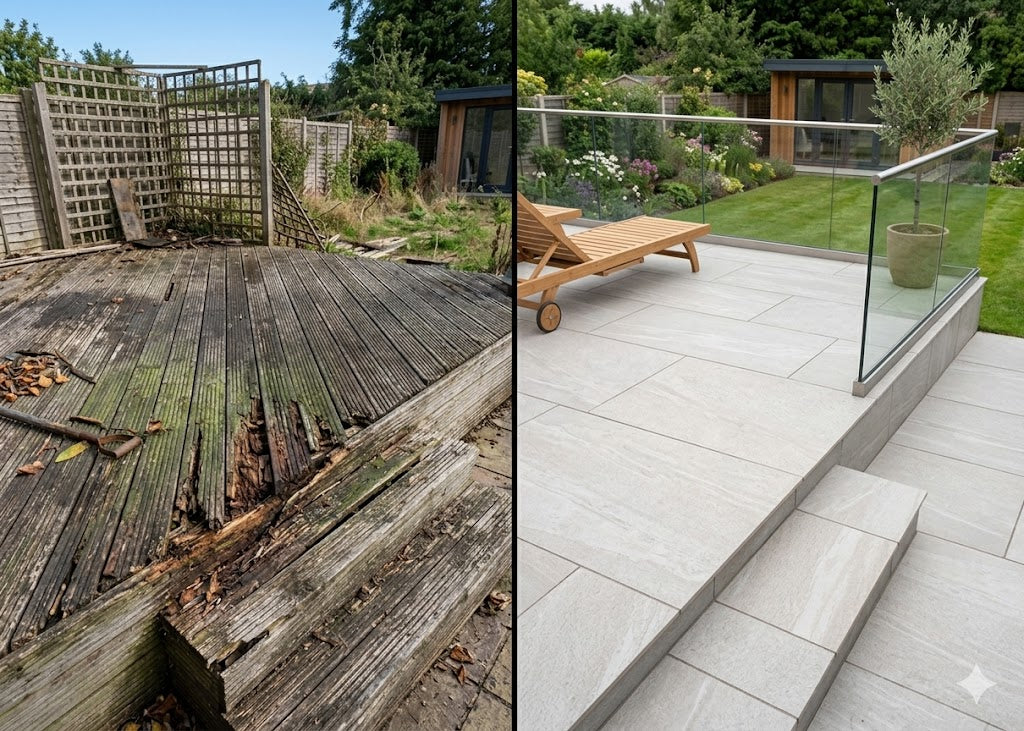
If you're reading this, you probably already know why you want to replace your decking. It's gone green. It's slippery when wet. The boards are splitting. The joists are rotting underneath. You've pressure-washed it three times this year and it still looks tired. Decking has a 10-15 year lifespan in the UK climate, and when it goes, it goes quickly. Paving — sandstone or porcelain — lasts 30-50+ years and gets better with age rather than worse. Here's how to make the swap.
Why people replace decking with paving
This isn't a theoretical comparison — these are the reasons real customers give us when they order paving to replace their old decks:
Timber decking develops a biofilm of algae in the UK's damp climate. This makes it dangerously slippery — especially for children, elderly family members, and dogs. Pressure washing removes the algae temporarily but it returns within weeks. Porcelain paving is R11 anti-slip rated even when soaking wet. Riven sandstone is naturally slip-resistant. Neither develops algae on the surface.
Timber decking joists rot from underneath where you can't see them. By the time the boards feel soft or bouncy, the structural framework is compromised. One heavy person in the wrong spot and the board goes through. Paving sits on a solid mortar bed over compacted aggregate — no hidden rot, no structural surprise, no collapse risk.
Timber decking needs annual pressure washing, staining or oiling every 2-3 years, and board replacement as individual pieces fail. Over 15 years, maintenance costs often exceed the original installation cost. Porcelain paving needs 30 minutes of hosing per year. Sandstone needs an annual wash. Neither needs painting, staining, or oiling — ever.
Softwood decking lasts 10-15 years in UK conditions. Hardwood lasts 15-25 years. Either way, you'll replace it at least twice in the life of your house. Sandstone lasts 30-50+ years. Porcelain lasts 30-50+ years. Granite lasts 50-100+ years. One installation, no replacement cycle.
Step-by-step: removing decking and laying paving
Unscrew or pry up the deck boards first. Most are screwed down — a cordless drill makes this quick. Stack the boards for skip disposal or offer them free on local marketplace groups (people use old deck boards for raised beds and compost bins). Once boards are removed, you'll see the joist framework underneath.
Remove the joists, bearers, and any concrete pads or posts they were sitting on. This is the hardest physical work in the project — joists are heavy and often partially buried. A reciprocating saw speeds up cutting joists into manageable lengths. Everything goes in the skip. Once the framework is out, you're left with bare ground at whatever level the original garden was.
Excavate the area to 200mm below your finished patio level. This depth allows for 150mm of sub-base aggregate plus 30-40mm of mortar bed plus 20-22mm slab thickness. Use string lines and a spirit level to establish the correct finished level — the patio surface should sit flush with or slightly below any adjacent door threshold, with a 1:80 fall away from the house for drainage. Read our drainage guide for the gradient method.
Fill with MOT Type 1 aggregate (crushed limestone) to 150mm depth. Compact with a hired wacker plate — at least 4-6 passes. The sub-base is the foundation of your patio. Skip it or skimp it and the paving will sink, rock, and crack within 12 months. This is the one step you cannot shortcut. Read our sub-base guide for the full method.
Mix a semi-dry mortar bed (5:1 sharp sand to cement for sandstone, 4:1 for porcelain) and lay to 30-40mm thickness. Butter the back of each slab with mortar (for porcelain, prime with SBR first), position, and tap down with a rubber mallet to your string line level. Leave 8-12mm joints between slabs. Work in sections — don't mix more mortar than you can use in 30 minutes. Read our mortar mix guide for exact ratios.
After 24-48 hours (once the mortar bed has set), fill the joints with brush-in jointing compound. Use Flowpoint for sandstone, Porcelpoint for porcelain. Sweep the compound into all joints, mist with water per the product instructions, and clean any residue off the slab surface within 15 minutes. Read our jointing compound guide for the full method.
The one mistake that ruins the project
Laying paving directly onto the old decking sub-frame or bare soil. Some people remove the deck boards, leave the joists in place, fill between them with gravel or sand, and lay paving on top. This fails within 12 months — the joists rot further, the fill settles unevenly, and the paving sinks, rocks, and cracks. There is no shortcut around a proper sub-base. Remove everything, dig to formation level, lay 150mm of compacted MOT Type 1. It takes an extra day of work but the patio lasts 30+ years instead of 12 months.
Cost comparison: decking vs paving
For a 20m² area — the typical back garden patio size:
| Cost element | Timber decking | Sandstone paving | Porcelain paving |
|---|---|---|---|
| Materials (20m²) | £600-1,200 | £400-560 | £390-500 |
| Sub-base + mortar + jointing | N/A (posts + joists) | £300-400 | £300-400 |
| Professional installation | £1,200-2,000 | £1,000-1,600 | £1,000-1,600 |
| Annual maintenance | £100-200/year | £0-30/year | £0/year |
| Lifespan | 10-15 years | 30-50 years | 30-50+ years |
| 30-year total cost | £5,400-9,600 | £1,700-2,560 | £1,690-2,500 |
Over 30 years, decking costs £5,400-9,600 (two replacements + annual maintenance). Paving costs £1,700-2,560 (one installation, minimal maintenance). Paving saves £3,700-7,000 over three decades — even before you factor in the hassle of living through two deck replacement projects.
Which paving for a decking replacement?
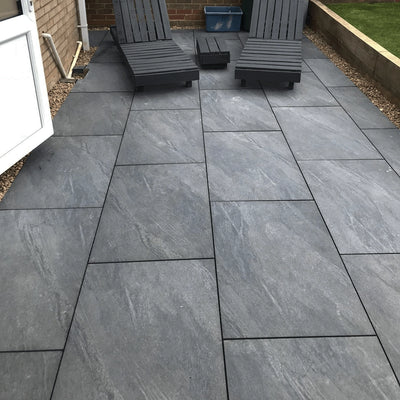
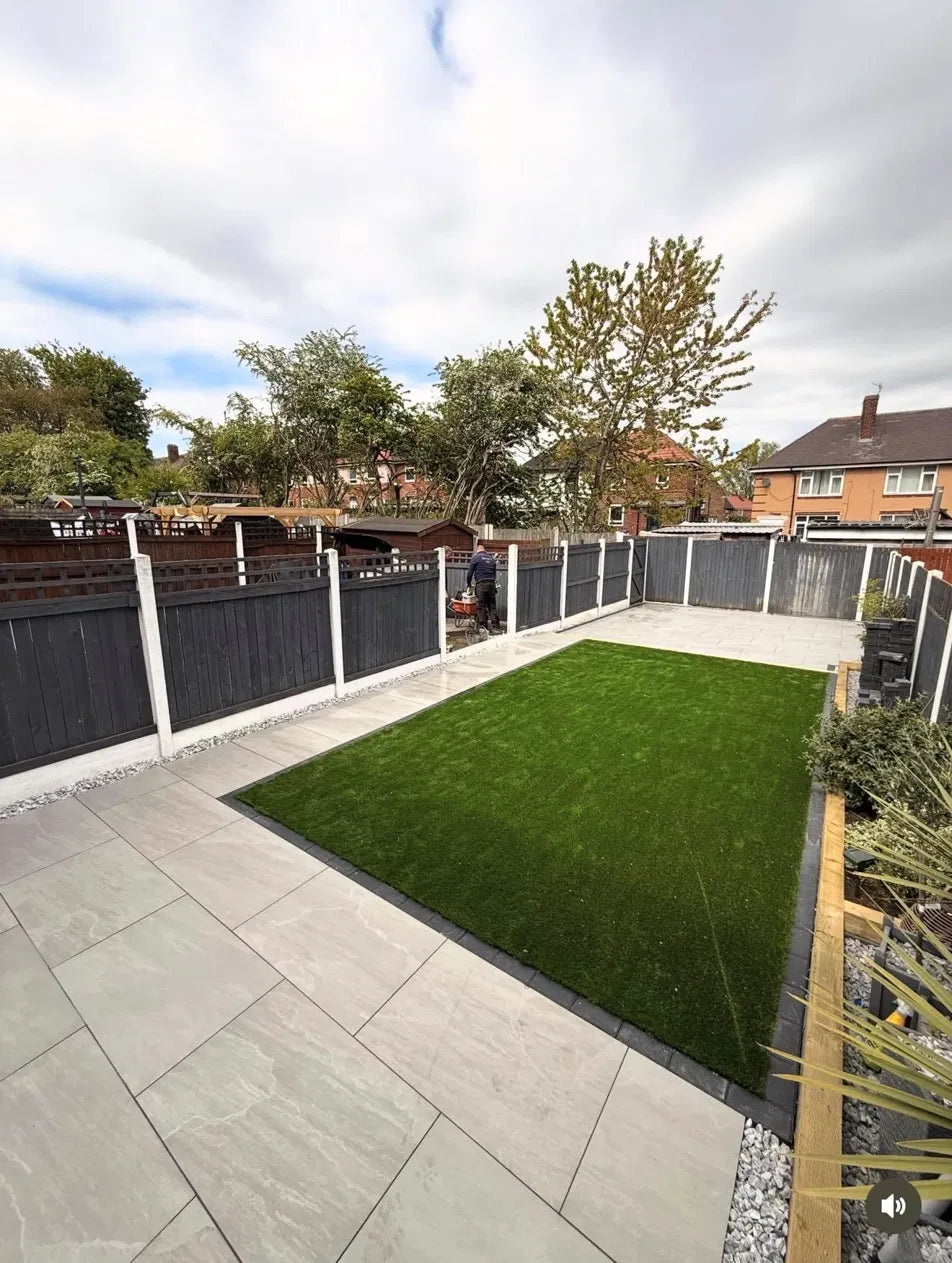
If you're replacing decking because of maintenance: Porcelain paving — zero maintenance, stain-proof, no annual cleaning needed. You hated maintaining decking, so choose the material that needs none.
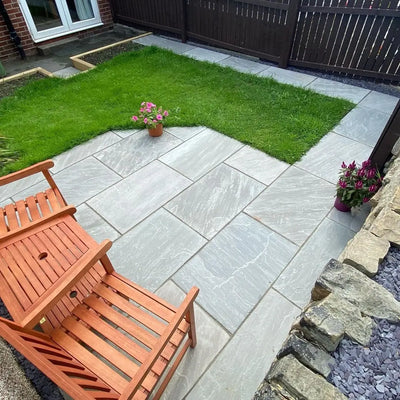
If you're replacing decking because it's slippery: Riven sandstone — the best natural grip of any paving material, even when soaking wet. Naturally slip-resistant without needing anti-slip coatings.
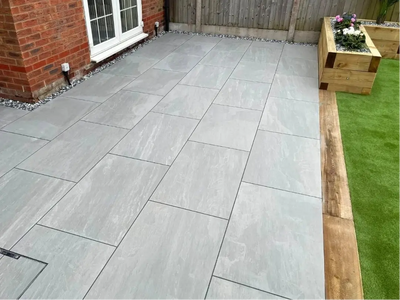
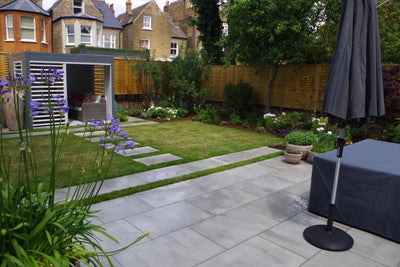
If you want the "indoor-outdoor flow" that decking was supposed to provide: Kandla Grey porcelain 900×600 — large format, clean lines, sits flush with bifold or sliding doors. The contemporary aesthetic decking promised but never delivered because it rotted.
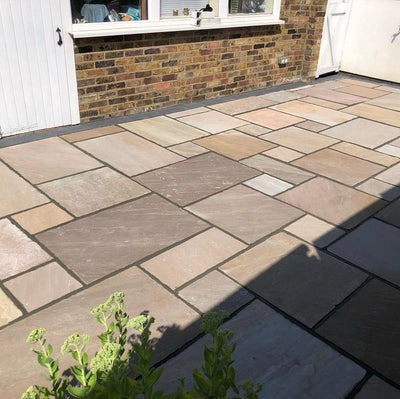
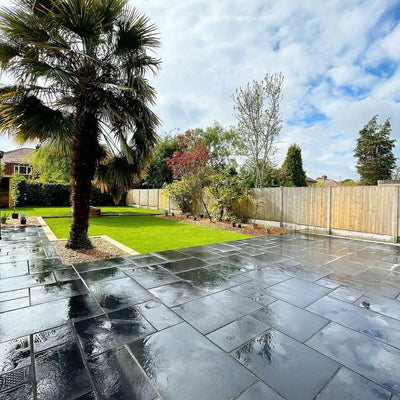
If you want natural warmth and character: Raj Green sandstone — warm, multi-tonal, ages beautifully. The natural alternative to timber's warmth without any of timber's problems.
Replace your decking for good
Sandstone from £20/m². Porcelain from £19/m². Both outlast timber decking by 20-30 years. Free delivery, no maintenance.
Browse Porcelain Browse SandstoneFrequently asked questions
Can I lay paving where decking was?
Yes — but you must remove all the decking structure (boards, joists, posts, pads) and build a proper sub-base from scratch. You cannot lay paving on top of the old joist framework or directly on the soil underneath. Remove everything, excavate to 200mm, lay compacted MOT Type 1, then mortar bed and paving.
How much does it cost to replace decking with paving?
For a 20m² area: approximately £900-1,200 total DIY (including decking removal, skip hire, sub-base, mortar, paving, and jointing). Professionally installed: £2,000-3,000 total. This is a one-time cost — paving lasts 30-50 years with minimal ongoing expense, whereas decking needs replacing every 10-15 years.
How long does it take to replace decking with paving?
3-5 days DIY for a 20m² area: day 1 removing decking and digging out, day 2 laying and compacting sub-base, days 3-4 laying slabs, day 5 pointing joints. A professional landscaper typically completes it in 2-3 days. The mortar bed needs 24-48 hours to cure before you can walk on the paving.
Is paving better than decking?
For the UK climate, yes. Paving lasts 3-5x longer, costs less over its lifetime, requires almost no maintenance, and doesn't become dangerously slippery when wet. The only advantage decking has is initial speed of installation (no sub-base digging) — but that speed savings disappears when you're replacing it for the second time 15 years later.
Can I DIY the decking-to-paving swap?
Yes. Decking removal is straightforward with basic tools. Sub-base preparation is physical labour but not technically difficult. Laying paving requires care with levels and mortar consistency but is achievable for a competent DIYer. The key skill is getting the sub-base right — read our sub-base guide and our laying guide before starting.