





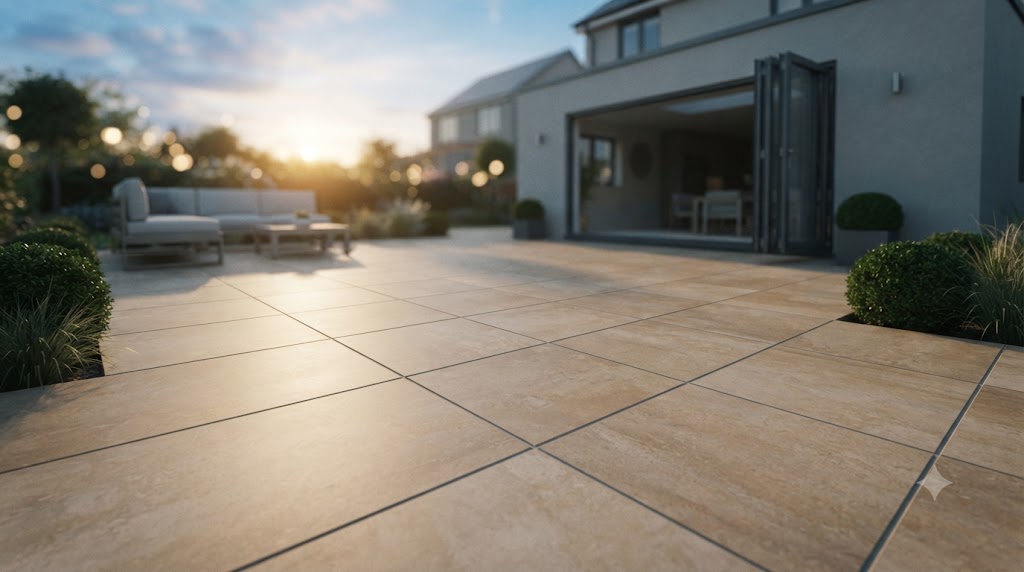
1200×600 Porcelain Paving: Is Large-Format Worth It?
Large-format 1200×600 porcelain is worth it if your patio is big enough to carry the scale and you want a premium, minimal-joint, contemporary finish. Fewer joints make a space feel larger and more expensive, and the format suits modern extensions and bi-fold openings perfectly. The trade-offs are real: the slabs are heavy (a two-person lift), less forgiving to lay, and cost a little more per m² than 900×600. For small or busy gardens, 900×600 is usually the smarter choice. Here's how to decide.
1200×600 is the size people choose when they want their patio to look designed rather than just paved. It's the format behind most of the sleek, magazine-style modern gardens you've probably saved to a moodboard. But bigger isn't automatically better — large-format porcelain asks more of your sub-base, your budget, and the people laying it. This guide is an honest look at when 1200×600 is genuinely worth it, and when you're better off with a standard size.
What "large format" actually means
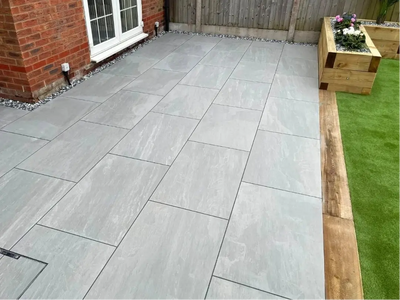
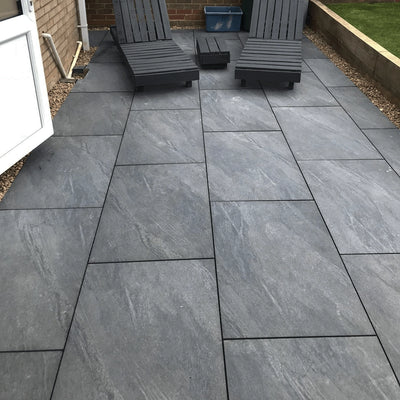
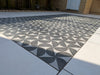
A 1200×600mm slab covers 0.72m² — a third more than a 900×600 (0.54m²) and more than twice a 600×600 (0.36m²). That larger footprint is the whole point: cover the same patio with fewer slabs, and you get fewer joint lines breaking up the surface. The result reads as cleaner, calmer, and more contemporary — the joints stop being a visual grid and become a subtle background detail.
On a typical patio, switching from 600×600 to 1200×600 roughly halves the number of visible joints. That's the single biggest reason people choose it: the minimal-joint look is what makes a patio feel high-end.
The case for 1200×600 — when it's worth it
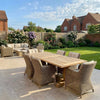
Large slabs need room to breathe. On a generous patio, terrace, or open entertaining area, 1200×600 looks expansive and intentional. The bigger the space, the better the format works — it's the natural choice for larger contemporary gardens and extensions.
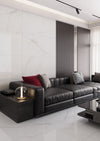
If your house is contemporary — render, bi-fold doors, clean lines — the fewer joints of large-format porcelain flow cleanly from inside to out. It's the format that makes an indoor-outdoor transition look seamless.
Large-format natural stone gets expensive fast. Large-format porcelain gives you the same expansive, high-end appearance with zero maintenance — and at a price that stays competitive per m².
The honest trade-offs — when to think twice
A single 20mm 1200×600 porcelain slab is substantial — this is genuinely a two-person handling job, never a solo one. If you're laying it yourself, you'll need a capable second pair of hands throughout, proper lifting technique, and clear coordination. For larger projects, this is a real reason many people bring in a professional installer.
Bigger slabs amplify every imperfection. Any bump in the sub-base, uneven bedding, or slight level variation shows more obviously under a 1200×600 slab than a small one, because there's more surface to reveal it. The sub-base preparation has to be spot-on, and a spirit level becomes your most-used tool. This is skilled work — comfortable for an experienced DIYer, but not the easiest place to start.
In a small courtyard or narrow space, large slabs can feel out of proportion — and you end up cutting more of them to fit, which wastes material and interrupts the clean look you paid for. For compact or busy-shaped gardens, 900×600 (or even 600×600) usually looks better and lays easier.
The rule of thumb: choose 900×600 as your default — it's the most popular size for good reason, balancing the modern look with manageable handling. Step up to 1200×600 when the space is large enough to carry it and you specifically want that premium, minimal-joint finish. Drop to 600×600 only for small gardens where larger formats feel out of scale.
Our 1200×600 porcelain range
Every large-format slab we stock is 20mm outdoor porcelain with an anti-slip textured surface, frost-proof and stain-proof — the choice between them is purely colour. Here's the large-format range:
| Colour | Tone | Best for |
|---|---|---|
| Indiana Multicolor | Multi-tonal, warm natural variation | Best-seller — character and warmth in a large format |
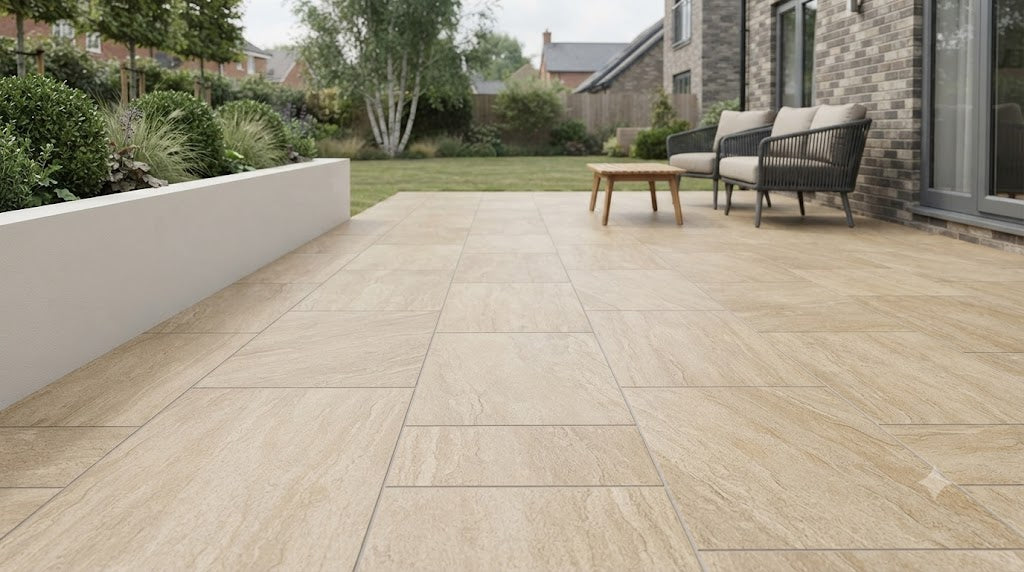
| Everest Beige | Soft beige and cream | Warm, brightening; modern and traditional gardens alike |
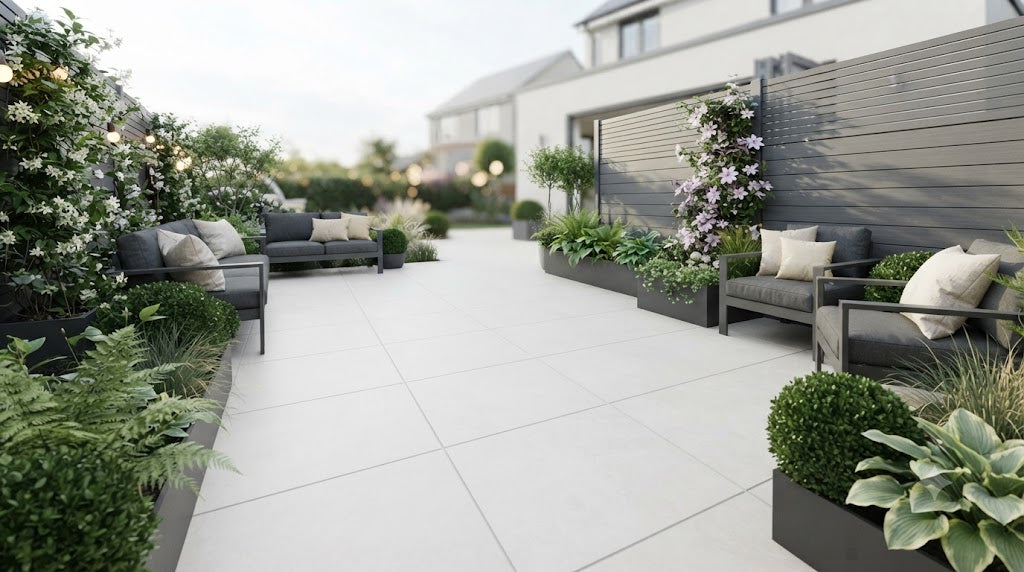
| Luna Off White | Pale off-white | Bright, contemporary; opens up and lightens a space |
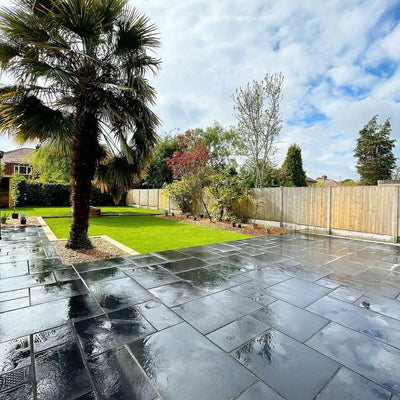
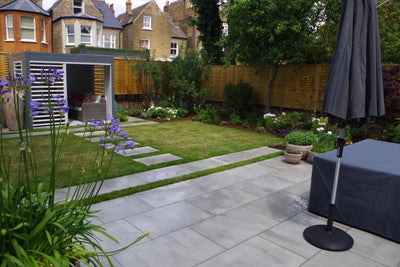
| Kandla Grey | Cool silver-grey with buff accents | The safe all-rounder; pairs with anthracite and render |
Large-format 1200×600 porcelain starts from around £22/m² including VAT, with free UK delivery. Because it's a light-reflecting decision as much as a colour one, the paler tones (Luna Off White, Everest Beige) brighten and open a space, while Kandla Grey and Indiana Multicolor bring more depth and warmth.
See it before you commit. Colour and finish never read accurately on a screen — and with large format, scale matters too. Order samples and view them in your own garden light, wet and dry, before ordering a full patio's worth.
Laying 1200×600 porcelain — what to know
Large-format porcelain follows the same method as all outdoor porcelain, but with less room for error:
Full mortar bed, not spot-bedding. Every slab needs complete mortar coverage underneath — voids under a large slab lead to cracking. SBR primer is essential on the back of each slab, because porcelain won't bond to mortar without it. The sub-base must be immaculate — 150mm of well-compacted MOT Type 1, dead level, because large slabs reveal every flaw. And it's a two-person job from start to finish. For the full method, see our porcelain laying guide and sub-base guide.
If you're not confident with levels and handling, large format is the format most worth hiring a professional for — the material cost is significant enough that a laying mistake is expensive to fix.
Browse large-format 1200×600 porcelain
Luna Off White, Everest Beige, Indiana Multicolor and Kandla Grey — all 20mm, anti-slip, frost-proof. Prices include VAT and free UK delivery.
Browse Large Format Order SamplesFrequently asked questions
Is 1200×600 porcelain better than 900×600?
Neither is universally better — it depends on your space. 1200×600 gives a more premium, minimal-joint finish and suits larger, contemporary patios, but the slabs are heavier and less forgiving to lay. 900×600 is the most popular size because it balances the modern look with easier handling. Choose 1200×600 for large open spaces where you want maximum impact; choose 900×600 as the safe all-round default.
How heavy is a 1200×600 porcelain slab?
A 20mm 1200×600 porcelain slab is heavy enough that it should always be handled by two people, never lifted solo. Use proper lifting technique and coordinate movements between both handlers. This weight is one of the main reasons larger projects are often laid by professionals rather than DIY.
How many 1200×600 slabs are in a square metre?
Each 1200×600 slab covers 0.72m², so you need roughly 1.4 slabs per m². For a 20m² patio that's about 28 slabs — always order 10% extra to allow for cuts and breakages.
Is large-format porcelain harder to lay?
Yes, somewhat. Large slabs amplify any imperfection in the sub-base or bedding, so the groundwork has to be precise and dead level. They also need a full mortar bed, SBR primer, and two people to handle. It's well within reach of an experienced DIYer, but it's not the easiest format to start with — and mistakes are more costly given the material price.
What's the best colour in large-format porcelain?
It depends on your garden's light and style. Pale tones like Luna Off White and Everest Beige brighten and open up a space, ideal for shaded or smaller-but-still-open areas. Kandla Grey is the safe contemporary all-rounder, and Indiana Multicolor (our best-seller in the format) brings warmth and natural variation. Order samples to judge them in your own light.