






Can You Lay Porcelain on Sand? Installation Methods Explained (UK Guide)
Short answer: No. Absolutely not.
Longer answer: You can physically place porcelain slabs on sand. They'll sit there looking perfectly fine. For about six months. Then they'll start rocking. Joints will crack. Slabs will lift at corners. Eventually, you'll be ripping the whole thing up and starting again—this time doing it properly, on a full mortar bed.
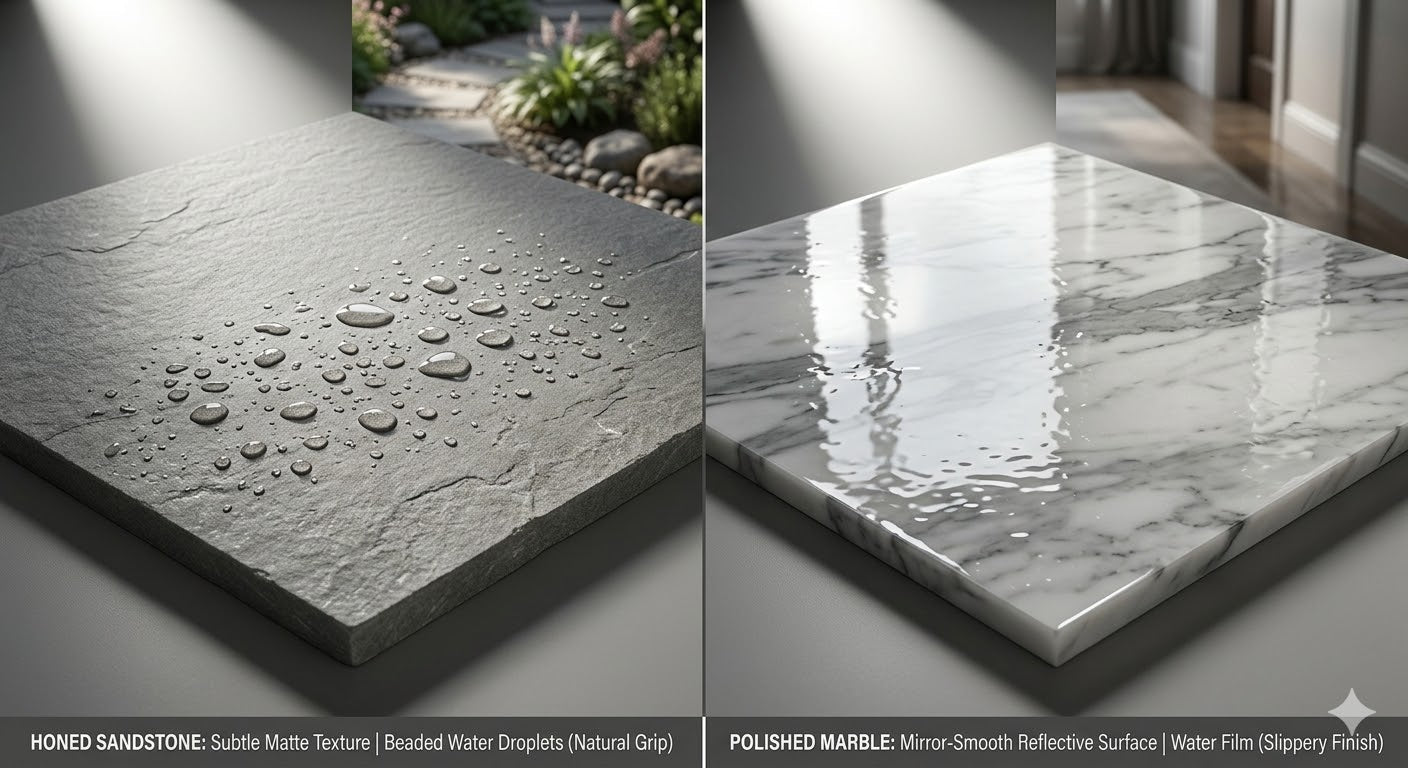
Here's why this question comes up so often: porcelain paving looks identical to natural stone paving. Natural stone CAN be laid on sand (though mortar is still better). So people assume the installation method is the same. It's not. Porcelain and sandstone might look similar, but they behave completely differently when it comes to bedding and bonding.
This isn't about suppliers trying to sell you extra materials. This is about fundamental material science—specifically, porosity, water absorption, and adhesion. Understanding why porcelain needs mortar (and priming) prevents costly installation failures.
At Universal Paving, we sell both porcelain and natural stone. We're honest about installation requirements because failed patios create warranty claims, bad reviews, and unhappy customers. Getting it right first time costs less than doing it twice.

Why People Think Porcelain Can Go on Sand
The confusion is understandable. Several factors create the "porcelain on sand" myth:
1. Natural Stone Precedent
Indian sandstone, limestone, even granite—these CAN be laid on a sand bed (though sharp sand and cement mix is better). The technique works because natural stone is porous. It absorbs moisture from the bedding layer, creating a bond as materials cure together.
Logic: "If sandstone works on sand, porcelain should too—they're both paving slabs."
Reality: Porcelain is vitrified (glass-like). Zero porosity. It won't absorb anything from sand, so no bond forms.
2. Indoor Tile Experience
People have laid ceramic tiles indoors using sand-and-cement screed. Some porcelain floor tiles go down the same way. This creates false confidence.
The difference: Indoor tiles are thin (8-10mm), bedded on solid concrete sub-floor, protected from weather, and use tile adhesive—not just sand. Outdoor porcelain is thicker (20mm), subjected to freeze-thaw cycles, and needs completely different installation standards.
3. "I Saw It on YouTube"
Plenty of DIY videos show people laying pavers on sand. Some are natural stone (where it's marginal), some are concrete pavers (which work differently), and some are just... wrong. YouTube doesn't have quality control.
4. Cost Cutting
Full mortar bed installation costs more—both in materials (sand, cement, primer) and labour (more time-consuming). Sand-only bedding is quicker and uses fewer materials. When budget is tight, the temptation to skip "unnecessary" steps is strong.
The problem: You're not saving money. You're delaying the inevitable replacement cost.

What Makes Porcelain Different: The Science
Understanding why porcelain needs different installation starts with understanding what porcelain actually is.
Porcelain Manufacturing
Porcelain paving is made from fine clay, minerals, and pigments pressed at extremely high pressure (400+ tons) then fired at 1,200-1,400°C. This vitrification process creates a dense, glass-like material.
Key characteristics:
- Water absorption: <0.5% (essentially zero)
- Density: 2,400 kg/m³ (very dense)
- Porosity: Virtually non-existent
- Surface: Sealed during firing
Natural Stone for Comparison
Indian sandstone is sedimentary rock formed from compressed sand over millions of years. It remains porous.
Key characteristics:
- Water absorption: 3-6% (significant)
- Density: 2,200-2,400 kg/m³ (varies)
- Porosity: Moderate to high
- Surface: Open pores, absorbent
Why This Matters for Bedding
Natural stone on sand/cement:
- Moisture from bedding mix contacts stone underside
- Stone absorbs moisture into pores
- Cement particles migrate into stone surface
- As bedding cures, stone and mortar interlock
- Bond forms through mechanical and chemical adhesion
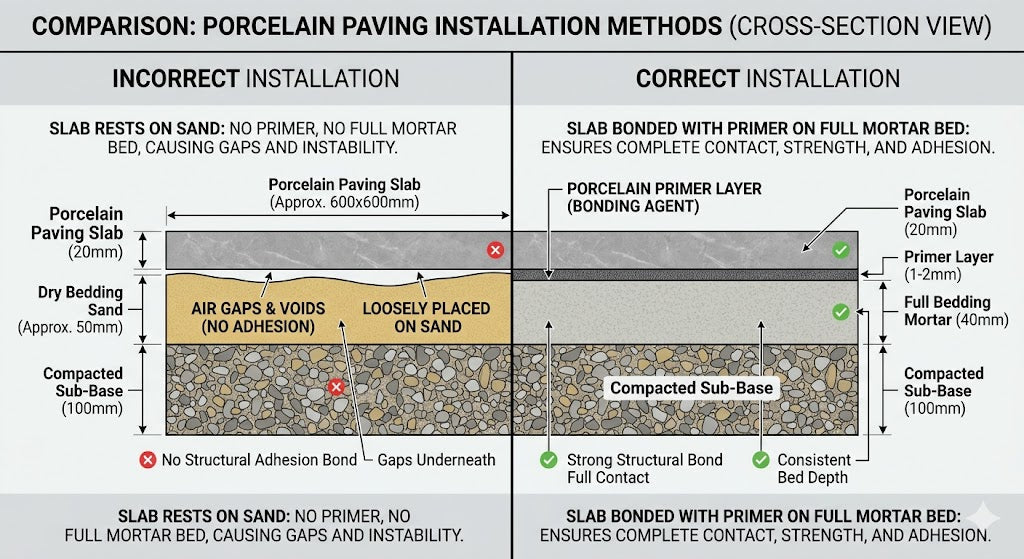
Porcelain on sand/cement (without primer):
- Moisture contacts porcelain underside
- Porcelain absorbs NOTHING (vitrified surface)
- No cement particle migration
- Bedding cures independently of porcelain
- No bond forms—just friction and weight
The result: Porcelain sits on the bed but isn't bonded to it. Any movement, thermal expansion, frost heave, or settlement causes slabs to shift.
The Correct Installation Method — In Short
Porcelain needs four things, and skipping any one of them causes failure:
- A compacted MOT Type 1 sub-base — 100-150mm, built up and compacted in layers rather than one thick pour.
- A full mortar bed — 40-50mm of 4:1 to 6:1 sharp sand to cement. Full coverage under every slab, never "dots and dabs".
- Slurry primer on the back of every slab — brushed across the entire underside and laid while still wet. This is what actually bonds porcelain to mortar.
- A porcelain-specific jointing compound — standard sand-cement grout won't bond properly to a vitrified edge.
Skipping primer is the single most common cause of porcelain paving failure, and it's entirely avoidable. For the complete step-by-step method — excavation depths, drainage falls, mixing, levelling, cutting and jointing — read our full guide to laying porcelain paving.
What Happens When You Lay Porcelain on Sand
Let's be specific about failure modes. This isn't theoretical—this is what actually happens.
Timeline of Failure:
Months 1-3: Looks perfect. No obvious problems.
Months 4-6: First signs appear:
- Slight rocking on some slabs when stepped on
- Hollow sound when tapped
- Minor joint movement
Months 7-12: Deterioration accelerates:
- Pronounced rocking on multiple slabs
- Corners lifting (especially on larger 900x600 slabs)
- Joints cracking and opening up
- Water pooling in uneven areas
Year 2+: Serious failure:
- Slabs tipping when walked on edge
- Complete separation from bed in places
- Cracked slabs (from unsupported areas flexing)
- Weed growth through widened joints
- Safety hazard—trip risks from uneven surface
Why It Fails:
1. No adhesion: Sand provides zero bond to vitrified porcelain. Slabs sit purely under own weight.
2. Frost heave: UK freeze-thaw cycles cause sub-base expansion. Without bonded connection, slabs lift with frost, don't return to original position when thawed.
3. Thermal movement: Porcelain expands and contracts with temperature. Without adhesive bond, expansion pushes slabs apart, contraction leaves gaps.
4. Point loading: Walking on slab edges creates cantilever effect. Unsupported areas flex, crack over time.
5. Settlement: Any sub-base settlement causes slabs to tilt. No adhesive means they stay tilted.

Real Example:
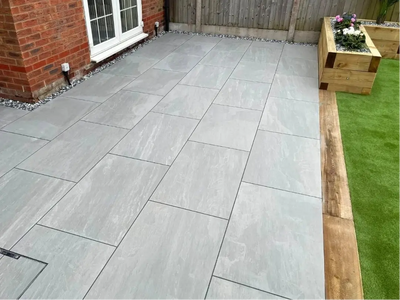
Customer in Birmingham laid Kandla Grey porcelain 900x600mm on compacted sand (no mortar, no primer). "Looked great initially, saved £300 doing it myself."
Six months later: Noticeable rocking on 8 slabs. Nine months: Corners lifting on 12 slabs. Twelve months: Called professional installer. Quote to fix: £1,400.
Total cost: £600 original DIY + £1,400 professional reinstall = £2,000
Cost if done right first time: £900
"Saved" £300, spent £1,100 extra.
Cost Comparison: Doing It Right vs Doing It Twice
Let's put approximate numbers on this for a typical 25m² patio.
DIY Sand Bed (Incorrect Method):
- 25m² porcelain paving: around £520
- Sharp sand (bedding): £60
- MOT Type 1 sub-base: £80
- Basic tools/hire: £40
- Total: roughly £700
Correct Mortar Bed Installation (DIY):
- 25m² porcelain paving: around £520
- Sharp sand: £80 (more needed for mortar)
- Cement: £50 (10 bags)
- Primer: £50 (one tub)
- Jointing compound: £60
- MOT Type 1 sub-base: £80
- Tools/hire: £40
- Total: roughly £880
Difference: £180 for correct materials.
Professional Installation:
- Materials: £880
- Labour: £500-700 (£20-28/m²)
- Total: £1,380-1,580
Reinstallation After Sand Bed Failure:
- Original DIY cost: £700
- Remove failed installation: £200 (labour + skip hire)
- New mortar bed professional install: £1,380-1,580
- Total spent: £2,280-2,480
Paying £180 extra for correct materials saves roughly £1,400-1,600 long-term.
When DIY Makes Sense (And When It Doesn't)
DIY Porcelain Installation: Suitable If:
✅ You have prior paving experience (laid natural stone before)
✅ You understand mortar mixing and bedding techniques
✅ You own or can hire proper tools (plate compactor, mixer, wet saw)
✅ You're prepared to follow instructions precisely (primer, full bed, etc.)
✅ Project is small-medium (under 30m²)
✅ You have time (professional work takes 2-3 days, DIY takes 4-5+)
Hire a Professional If:
❌ First time laying any paving
❌ Large project (40m²+)
❌ Complex cutting required (curves, angles, intricate patterns)
❌ Working near buildings (damp-proof course considerations)
❌ Uneven or challenging ground conditions
❌ Time-constrained (want it done quickly and right)
Professional cost: £20-28/m² labour on top of materials. For 25m² patio, that's £500-700. Worth it for guaranteed results.
The "Just Concrete Pavers" Exception
One important clarification: concrete pavers (block paving) CAN be laid on compacted sand. This is the correct method for concrete blocks.
Why concrete blocks work on sand but porcelain doesn't:
- Concrete pavers are typically 50-80mm thick (porcelain is 20mm)
- Designed for interlocking installation (mutual support)
- Usually laid over large areas (weight distribution)
- Manufactured specifically for sand-bed installation
- Different material properties (porous concrete vs vitrified porcelain)
Don't confuse block paving installation with slab paving installation. Different products, different methods.
Universal Paving's Recommendation
We sell porcelain paving because it's an excellent product—durable, low-maintenance, consistent quality, 25+ year lifespan. But only when installed correctly.
Our advice:
For DIY installers: Follow the full mortar bed method. Don't skip primer. Budget for correct materials. Allow proper time, and read our step-by-step laying guide before you start.
For those uncertain: Hire an accredited installer. The £500-700 labour cost for a 25m² patio is insurance against £1,500 reinstallation costs.
For budget-constrained projects: If you genuinely can't afford mortar bed installation, choose natural stone paving instead. Riven sandstone starts from a similar price to porcelain and CAN be laid on a sand-cement bed (though mortar is still better). You lose porcelain's benefits (consistency, zero maintenance) but you get a properly installed patio that won't fail.
Never compromise on installation to afford the material. Better to have correctly installed sandstone than incorrectly installed porcelain.
The Verdict: Porcelain Needs Mortar (And Primer)
Can you physically lay porcelain on sand? Yes.
Will it work long-term? No.
Should you do it? Absolutely not.
Porcelain paving is a premium product with specific installation requirements. The non-porous vitrified surface that makes it stain-resistant, frost-proof, and low-maintenance also makes it incompatible with sand-bed installation.
The cost difference between sand-only and correct mortar bed installation is around £180 in materials on a 25m² patio. That £180 prevents £1,500+ reinstallation costs within 1-2 years. The full method is here.
Browse Universal Paving's full porcelain paving range:
- Kandla Grey porcelain — our most popular colour
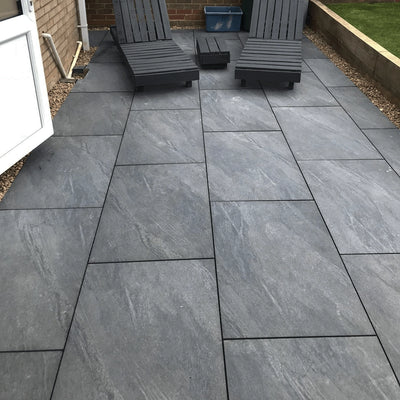
- Anthracite Grey — contemporary dark
- County Light Grey — pale modern
- Or browse by size: 900x600, 1200x600 and 600x600
Installation supplies:
- Slurry primer — essential for bonding porcelain to the mortar bed
- Jointing compound — porcelain-suitable compounds for finishing the joints
- Order samples to see colours in your own garden light before committing
Need installation advice? Call our team on 0115 646 3218 — Monday to Friday 8am-5:30pm, Saturday 9am-3pm. Free UK mainland delivery on all paving orders.
Porcelain paving delivers 25+ years of beautiful, low-maintenance outdoor living—when installed correctly. Cutting corners on installation destroys that value. Do it right first time.