








Why Your Patio Cracked: 7 Causes and How to Avoid Them
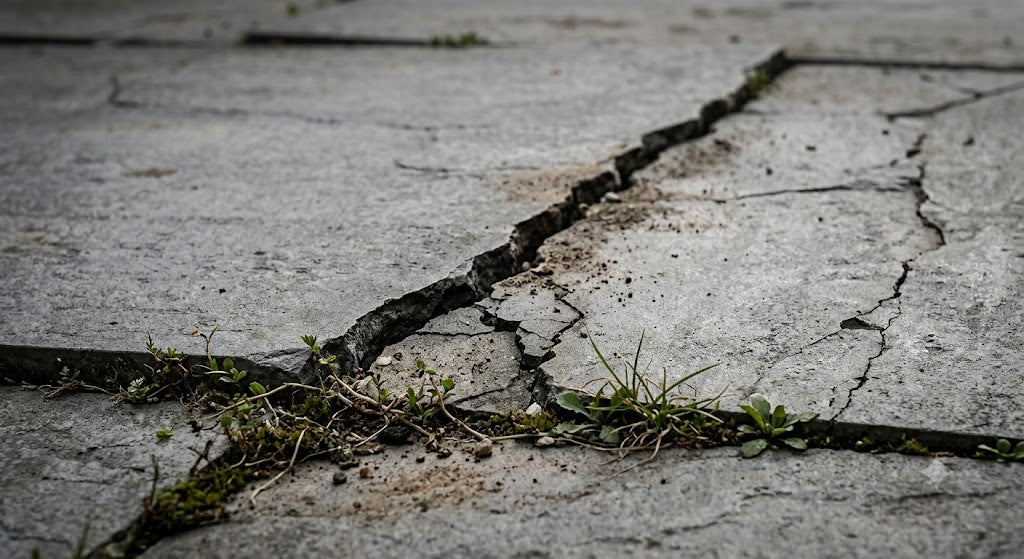
Patios crack for seven main reasons, and almost none of them are the stone's fault: an inadequate sub-base (the most common cause), slabs too thin for the load, a weak or missing mortar bed, ground movement, tree roots, frost damage to porous stone, and vehicle weight on patio-grade slabs. The crack itself tells you which one — and every cause is avoidable with the right preparation. Here's how to diagnose your cracked patio and lay one that lasts 30+ years.
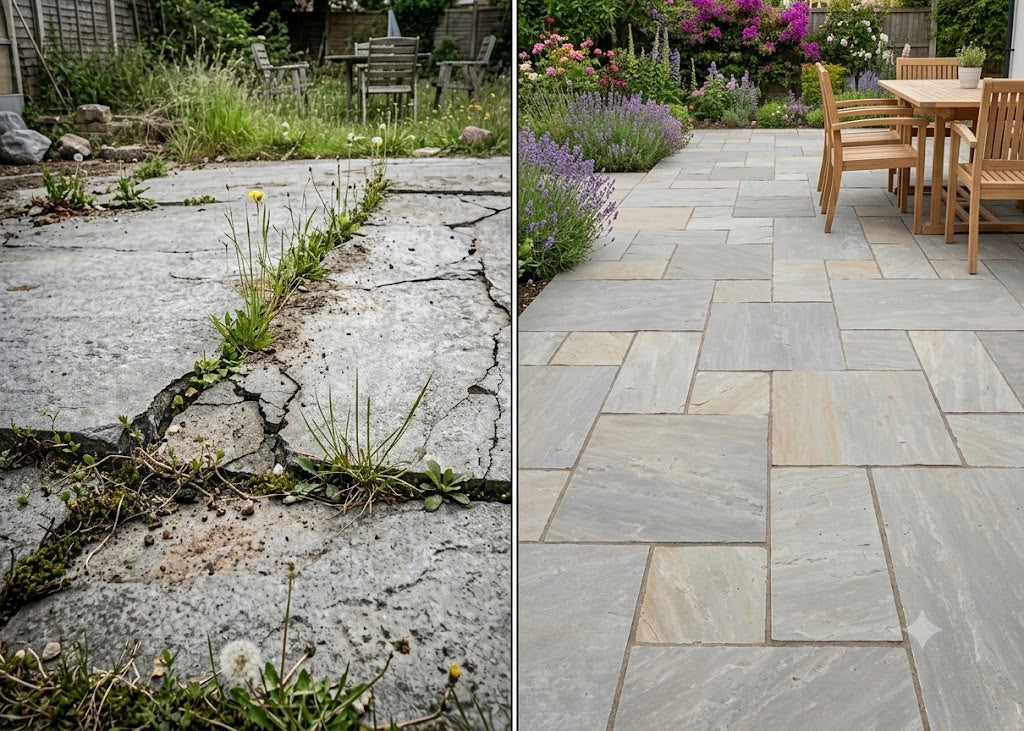
If your patio has cracked, it's frustrating — but it's also informative. A crack is evidence. Where it runs, how it's shaped, and which slabs are affected all point to a specific cause. And once you know the cause, you know exactly what to do differently. The hard truth most suppliers won't tell you: a cracked patio is almost never because the stone was faulty. It's because of what's underneath it, or how it was laid. Here are the seven real causes.
Cause 1: An inadequate sub-base (the #1 reason)
This causes the majority of cracked patios. The sub-base — the compacted layer of MOT Type 1 aggregate beneath the mortar — is what spreads the load and stops the ground moving. If it's too thin, not compacted, or skipped entirely (slabs laid straight onto soil or sand), the patio has no stable foundation. The ground settles unevenly, the slabs flex, and natural stone doesn't flex — it cracks.
How to tell this caused yours: multiple slabs cracked or rocking, often in a patch rather than a single slab. You may see slabs that have sunk lower than their neighbours. If you lift a cracked slab and find sand or soil directly underneath instead of compacted stone, this is your culprit.
How to avoid it: lay a minimum 150mm of MOT Type 1 sub-base for a patio (200-250mm for driveways), compacted in layers with a wacker plate. This is the single most important step in the whole project. Read our sub-base guide.
Cause 2: Slabs too thin for the job
Standard paving slabs are 20-22mm thick — designed for foot traffic. If they're used somewhere that takes more load than walking (a driveway, a spot where a car parks, under a heavy hot tub), they crack because they were never built for it. Thickness determines load capacity, and 20mm simply isn't enough for vehicles.
How to tell this caused yours: the cracks are where heavy loads occur — a corner a car drives over, under a hot tub, where a skip was placed during building work. The rest of the patio is fine.
How to avoid it: match the thickness to the use. 20-22mm slabs for pedestrian patios only. For driveways or anywhere vehicles go, use 50mm setts. For hot tubs, ensure a reinforced concrete base under that section. See our driveway paving guide.
Cause 3: A weak or missing mortar bed
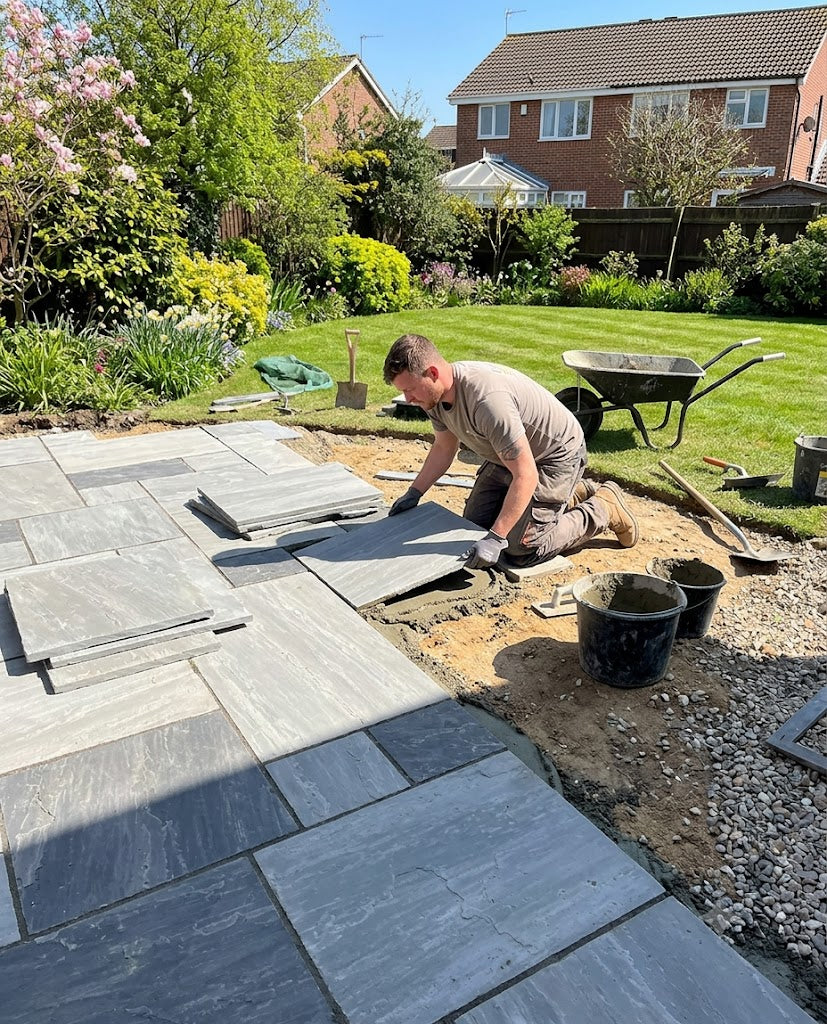
Some installers lay slabs on five dabs of mortar (one in each corner, one in the middle) instead of a full bed. This leaves voids under the slab. When weight lands over a void — a footstep, a chair leg, a planter — the slab has nothing supporting it there, and it cracks. The "five-dot" or "spot" method is a known cause of failure for natural stone and porcelain.
How to tell this caused yours: the crack often runs across the middle of a single slab. If you lift it, you'll see mortar only in patches with hollow gaps between — and the underside may sound hollow when tapped before it broke.
How to avoid it: always lay on a full mortar bed (a continuous layer of semi-dry mortar across the whole slab), not spot dabs. For porcelain, also prime the back of each slab with SBR slurry so it bonds. Read our mortar mix guide.
Cause 4: Ground movement and subsidence
Sometimes the ground itself is the problem. Clay soils expand when wet and shrink when dry, moving the ground seasonally. Made-up ground (where a garden was levelled with loose fill), recently disturbed ground near new building work, or ground over old drainage runs can all settle over time, taking the patio with it.
How to tell this caused yours: cracks appear months or years after laying, often after a very wet or very dry season. The movement may affect a line across the patio, or one area that was over softer ground.
How to avoid it: on clay or made-up ground, dig deeper and lay a more substantial sub-base (200mm+), and ensure good drainage so water doesn't collect and move the ground. On severely unstable ground, a full concrete slab base may be needed before paving.
Cause 5: Tree roots
Tree and large shrub roots grow outward in search of water and can extend far beyond the canopy. As they thicken, they lift and displace whatever is above them — including a patio. The upward pressure cracks slabs and creates trip hazards.
How to tell this caused yours: the cracked or raised area is near a tree or large shrub, and the slabs are lifted upward (rather than sunk). The damage follows the line of a root.
How to avoid it: don't lay patios directly over the root zone of established trees. If you must pave near a tree, install a root barrier during construction, and choose a flexible jointing compound that tolerates minor movement. Consider leaving a planted border between the tree and the paved area.
Cause 6: Frost damage to porous stone
Porous, unsealed natural stone absorbs water. When that water freezes, it expands by about 9%, putting the stone under internal pressure. Repeated freeze-thaw cycles over winters can cause the surface to flake (spalling) or the slab to crack. This affects softer, more porous stones far more than dense ones.
How to tell this caused yours: surface flaking or cracking that appears or worsens after winter, often on stone that sits wet (poor drainage, shaded areas that don't dry out). Porcelain, being non-porous, doesn't suffer this.
How to avoid it: choose dense, low-absorption stone, seal porous sandstone and limestone, and ensure good drainage so slabs aren't sitting in water through freezing weather. Porcelain (water absorption below 0.5%) is completely frost-proof if frost is a particular concern in your garden.
Cause 7: Vehicle weight on patio slabs
This deserves its own entry because it's so common. People extend a patio to the driveway, or park "just for a minute" on patio slabs, and the 1.5-2 tonne point load through the tyres cracks slabs that were only ever rated for footsteps. Even a one-off — a delivery van turning, a skip lorry — can do it.
How to tell this caused yours: cracks in line with where wheels go, or radiating from a single point of heavy contact. Often near the edge of a drive or an access point.
How to avoid it: never drive or park on standard paving. If an area needs to take vehicles, lay 50mm setts on a driveway-grade sub-base. Keep a clear physical distinction between the paved patio and any vehicle area.
Quick diagnosis: what does your crack tell you?
| What you see | Most likely cause |
|---|---|
| Several slabs cracked/rocking in a patch, some sunk | Inadequate sub-base (Cause 1) |
| Cracks only where heavy loads occur | Slabs too thin / vehicle weight (Causes 2 & 7) |
| Single slab cracked across the middle, hollow underneath | Spot-bedding, no full mortar bed (Cause 3) |
| Cracks appeared after a wet/dry season | Ground movement (Cause 4) |
| Raised, lifted slabs near a tree | Tree roots (Cause 5) |
| Surface flaking, worse after winter | Frost damage to porous stone (Cause 6) |
How to lay a patio that never cracks
Every cause above comes down to four principles. Get these right and your patio will last 30-50+ years:
1. Build a proper sub-base. 150mm minimum of compacted MOT Type 1 for patios, 200-250mm for driveways. This is non-negotiable — it prevents Causes 1 and 4.
2. Match thickness to use. 20-22mm slabs for foot traffic only; 50mm setts where vehicles go. Prevents Causes 2 and 7.
3. Lay on a full mortar bed. Never spot-dabs. Prime porcelain with SBR. Prevents Cause 3.
4. Manage water and roots. Good drainage and the right stone for your conditions. Prevents Causes 5 and 6.
Start your next patio right
Quality natural stone and porcelain that lasts decades when laid properly. Sandstone from £20/m², porcelain from £18.50/m². Free UK delivery.
Browse All Paving Order SamplesFrequently asked questions
Can a cracked paving slab be replaced without redoing the whole patio?
Yes — a single cracked slab can be lifted and replaced, provided the sub-base beneath is sound. Carefully break out the damaged slab, clean out the old mortar, check the sub-base is solid, and bed a replacement on fresh mortar. If multiple slabs are cracked or the sub-base has failed, a larger repair is needed.
Is a cracked patio slab the supplier's fault?
Almost never. Natural stone and porcelain are extremely strong in compression. Cracking is nearly always caused by what's beneath the slab (sub-base, mortar bed) or how it's used (excess load), not a defect in the stone. The crack pattern usually reveals the real cause.
Will porcelain crack like natural stone?
Porcelain is very strong but follows the same rules — it cracks if laid on a poor sub-base, spot-bedded, or driven over when it's only 20mm thick. It does have one advantage: being non-porous, it never suffers frost/spalling damage (Cause 6). But it still needs a proper sub-base and full mortar bed.
How deep should a patio sub-base be to prevent cracking?
A minimum of 150mm of compacted MOT Type 1 for a pedestrian patio, and 200-250mm for driveways or areas taking vehicle loads. On clay or made-up ground, go deeper. Compaction with a wacker plate is as important as the depth.
Why did my patio crack in winter?
Two likely reasons: frost damage to porous, unsealed stone sitting in water (the water freezes and expands), or ground movement as wet clay soil shifts in cold conditions. Good drainage prevents both — water that drains away can't freeze under your slabs or move the ground beneath them.
,%20slabs%20too%20thin%20for%20the%20load,%20a%20weak%20or%20missing%20mortar%20bed,%20g...)