






Porcelain Primer: What It Is and Why You Can't Skip It
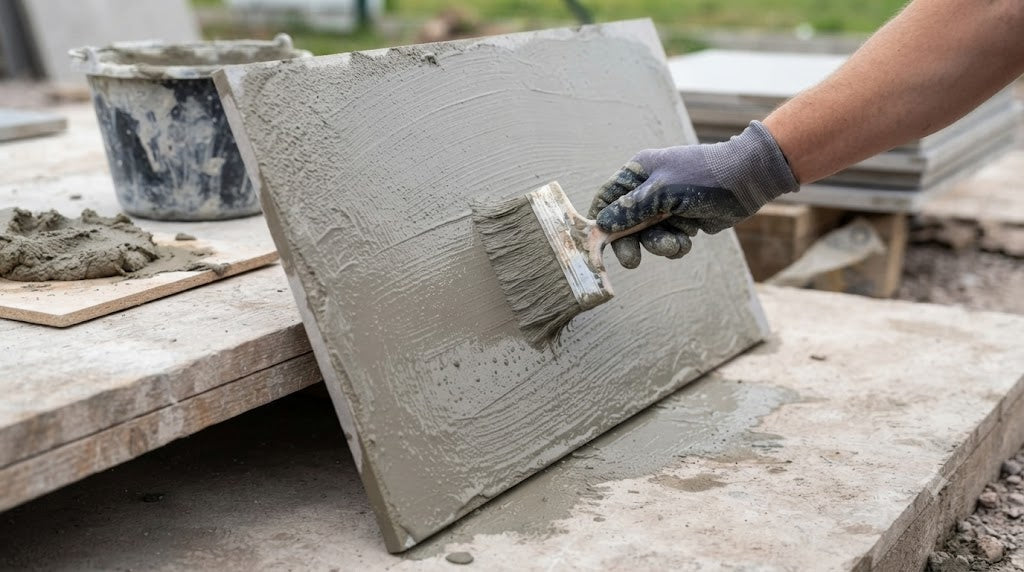
Porcelain paving must be primed before laying, because porcelain is vitrified — it has none of the microscopic pores that let mortar grip natural stone or concrete. Primer creates a bonding bridge between the slab and the mortar bed. Without it the mortar cures against a sealed surface, never bonds, and slabs work loose within a year or two. Use a polymer-modified cement-based slurry primer, brush it across the entire back of the slab, and lay while it's still wet — wet-to-wet contact is what makes the bond work.
Skipping primer is the single most common cause of porcelain paving failure — and it's completely avoidable. It adds a modest amount to the cost of a patio and an hour or two to the job, and it's the difference between paving that's still solid in twenty years and paving that starts rocking in its second winter. Here's what primer actually does, which type to use, and how to apply it properly.
Why porcelain needs primer and sandstone doesn't (as much)
It comes down to porosity. Natural stone — sandstone, limestone, concrete — is full of microscopic capillaries. When you lay it on wet mortar, moisture and fine cement particles migrate into those pores, and as the mortar cures, stone and mortar physically interlock. The bond forms by itself.
Porcelain is vitrified: fired at extremely high temperature until it's effectively glass-like, with a water absorption rate below 0.5%. There are no capillaries for cement to migrate into. Lay porcelain straight onto mortar and the mortar cures against a sealed surface — the slab is sitting on the bed, held by nothing but its own weight and friction.
That's why it fails. Not immediately — a porcelain patio laid without primer usually looks perfect for six to twelve months. Then thermal movement, frost heave and foot traffic start working the unbonded slabs, and they begin to rock, lift at corners, and crack open the joints.
The same applies to other non-porous stone. Granite and slate are far denser than sandstone, so they benefit from priming too. Priming isn't a porcelain-only step — it's a non-porous-material step.
Slurry primer vs SBR — clearing up the confusion
These two terms get used interchangeably, and they're not the same thing. Understanding the difference is worth two minutes, because it changes what you buy.
| Cement-based slurry primer | SBR bonding agent | |
|---|---|---|
| What it is | Pre-blended powder — cement, fine aggregate and polymers. Add water. | A liquid rubber-based bonding agent (styrene butadiene rubber) |
| How it's used | Mixed with water to a paint-like consistency, brushed on | Mixed with cement to make a slurry, or added to mortar as an admixture |
| Consistency | Identical every batch | Depends on getting your own ratio right, every time |
| Best for | Most patios — the reliable default | Trade users comfortable mixing their own, or as a mortar additive |
A cement-based slurry primer is the straightforward choice for most projects. It arrives as a pre-blended powder containing cement, fine aggregate and synthetic polymers, and you just add water. Because the ratios are fixed by the manufacturer, every batch performs the same — and the fine aggregate creates a stronger matrix than cement alone. Gelling agents give it a paint-like application, so you can see clearly where you've covered.
SBR is a liquid bonding agent that you mix with cement yourself to create a slurry. It's a genuinely good product — and worth clearing up a common myth: SBR is not PVA glue. Dried PVA can re-soften when it gets wet; SBR is fully water-resistant once cured. But mixing your own means the sand-to-cement-to-liquid ratio is on you, and getting it consistently right across a whole patio is harder than it sounds.
One practical warning about mixing your own in wet weather: an SBR-and-cement slurry applied in the rain can stay "live" for too long, and the SBR can effectively wash out of the mix — leaving little more than cement on the back of the slab. Pre-blended slurry primers are formulated to resist this. If you're laying in typical British conditions, that consistency is worth having.
Look for products manufactured in accordance with BS 7533, the British Standard covering paving installation. It's a reasonable shorthand for a primer that's been formulated and tested properly rather than improvised.
How to apply primer correctly
Application is simple, but two details decide whether it works.
1. Mix to a paint-like consistency. Follow the manufacturer's water ratio. Too thick and it won't spread evenly; too thin and there isn't enough material to form a bond. It should brush on like thick emulsion.
2. Cover the entire back of the slab. Every square centimetre. Missed patches are voids, and voids under a rigid slab are where cracks start. Brush it right to the edges and corners. This matters most on large-format 1200×600 slabs, where there's more unsupported area to flex if you leave a gap.
3. Lay while it's still wet — this is the critical one. Primer works by bonding wet-to-wet with the mortar bed. If it dries before the slab goes down, you've created a cured layer that the mortar has to bond to instead of a bridge — which defeats the point. Prime one slab, lay it, then prime the next. Don't prime a stack of slabs in advance.
4. Work in small batches. Mixed primer has a limited working life — usually 10–15 minutes. Mix what you'll use in that window and no more.
5. Wipe any primer off the face immediately. Slurry on the visible surface of a porcelain slab is far harder to remove once it's dried — and on a light-coloured slab it can leave a permanent haze. Keep a damp sponge and clean water to hand.
The rule that prevents most failures: full mortar bed, full primer coverage, laid wet-to-wet. Spot-bedding ("dot and dab") is not acceptable for porcelain under any circumstances — the unsupported areas flex under load and the slab cracks. Full bed, every time.
Does natural stone need priming too?
It's not essential in the way it is for porcelain, but it's genuinely worth doing — for a different reason.
For riven sandstone, priming is optional but beneficial. For sawn and honed finishes — which are denser and smoother — it's strongly recommended. And for granite and slate, which are much less porous than sandstone, treat it closer to the porcelain rule.
The second benefit applies to all natural stone: primer acts as a barrier against staining from below. Cement salts in the bedding mortar can be drawn up through porous stone and appear on the surface as pale blotches or the classic "picture frame" outline around the edge of each slab. A primed slab is far less prone to it. On pale limestone and light sandstone, where those marks show most, that alone justifies the step.
How much you need, and what it costs
Coverage varies by product, but a typical tub covers somewhere in the region of 15–25m². So most domestic patios need one or two tubs.
In the context of a full patio — slabs, sub-base aggregate, sand, cement, jointing compound, tool hire — primer is one of the smallest line items on the list. It's also the one with the worst consequences if you leave it out. Relaying a failed porcelain patio costs many times what the primer would have.
Browse our primer range, and the jointing compounds you'll need to finish the job.
What happens if you skip it
A predictable sequence, and one we hear about regularly:
Months 1–6: everything looks perfect. This is what makes skipping primer so tempting — the failure is delayed, not immediate.
Months 6–12: the first slabs start to rock slightly underfoot. Tap them and they sound hollow.
Year 1–2: corners lift, joints crack open, water pools in the low spots, and slabs tip when you step on the edge. Weeds get into the widened joints.
The fix is lifting the affected slabs, cleaning off the old mortar, and relaying properly — and because the failure spreads, it usually means redoing most of the patio. All to save a step that would have taken an afternoon.
Everything you need to lay it properly
Primer, jointing compound and paving — all in one place, prices include VAT and free UK delivery.
Browse Primers Browse PorcelainFrequently asked questions
Do you have to prime porcelain paving?
Yes. Porcelain is vitrified and virtually non-porous, so mortar cannot bond to it the way it bonds to natural stone. Without primer the slab sits on the bed held only by weight and friction, and thermal movement and frost will work it loose within one to two years. Priming is not optional for porcelain — it's the step that makes the installation permanent.
What's the difference between slurry primer and SBR?
A cement-based slurry primer is a pre-blended powder of cement, fine aggregate and polymers that you mix with water — consistent every batch. SBR is a liquid rubber bonding agent you mix with cement yourself to make a slurry, or add to mortar as an admixture. Both work; the pre-blended slurry is more reliable because the ratios are fixed, which matters when you're mixing repeatedly across a whole patio.
Can I use PVA instead of primer?
No. PVA can re-soften when it gets wet, even after drying — which makes it entirely unsuitable for an outdoor patio exposed to rain and frost. Use a proper cement-based slurry primer or an SBR bonding agent, both of which are fully water-resistant once cured.
How long do you have to lay the slab after priming?
Lay it immediately, while the primer is still wet. Primer works by bonding wet-to-wet with the mortar bed — if it dries first, you've created a cured layer rather than a bond bridge. Prime one slab, lay it, then prime the next. Never prime a batch of slabs in advance.
Does natural stone need primer?
It's optional for riven sandstone and recommended for sawn and honed finishes, granite and slate, which are denser and less porous. Priming natural stone also helps prevent cement salts from the bedding mortar being drawn up through the slab and appearing as pale patches or "picture frame" staining — particularly worth it on pale limestone and light sandstone where those marks show most.
How much primer do I need for a patio?
Coverage depends on the product, but a typical tub covers around 15–25m², so most domestic patios need one or two. Check the coverage stated on the product before ordering, and allow a little extra — running out mid-patio means either a delay or an unprimed section, and an unprimed section is a future failure point.