









How to Choose a Paving Supplier: 8 Things to Check
Before you buy paving from any supplier, check eight things: whether the price includes VAT and delivery, whether they hold UK stock or order in, whether you can see the product in person or order samples, how the pallet will actually be delivered to your property, what happens if slabs arrive broken, whether the stone is calibrated, how clearly the coverage per m² is stated, and whether there's someone to call when you have a question. The paving itself is only half of what you're buying — the rest is whether it arrives intact, on time, and matching what you expected.
Paving is one of the harder things to buy online. It's heavy, it's expensive, it arrives on a pallet by lorry, colours look different on a screen, and if something goes wrong you can't just pop it back in the post. Most people buy paving once or twice in a lifetime, which means most people don't know what to ask. Here's what genuinely matters — the questions worth asking any supplier before you place an order, including us.
1. Is the price genuinely the price?
The single most common surprise in paving is the checkout total. A headline price per m² can quietly exclude VAT, delivery, or both — and on a pallet of stone, delivery is not a small number. A quote that looks cheaper per m² can end up more expensive once it's actually in your basket.
Ask: Does this price include VAT? Does it include delivery to my postcode? Are there surcharges for certain areas? Get the delivered, VAT-inclusive price per m² from every supplier you're comparing — that's the only number that compares fairly.
2. Do they hold stock, or order it in?
There's a real difference between a supplier with pallets sitting in a UK warehouse and one that places an order with a third party when you buy. The first can dispatch in days; the second depends on someone else's supply chain, and "in stock" can quietly mean "available to order."
Ask: Is this in stock in the UK right now? How soon does it dispatch? What happens if it's out of stock after I've ordered? It's worth knowing before you've booked a landscaper for a specific week. We hold our Indian sandstone, porcelain, limestone and granite ranges at our Nottingham warehouse year-round for this reason.
Why this matters more than it sounds: paving projects are usually scheduled around a contractor's availability. A two-week stock delay doesn't just move your delivery — it can cost you your installation slot, and the next one might be a month later.
3. Can you see it before you commit?
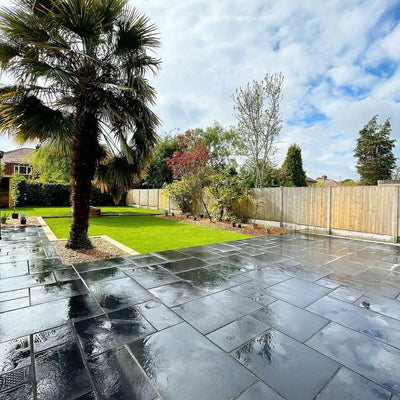
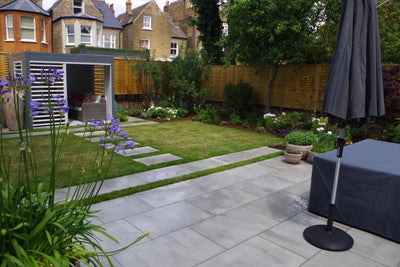
Natural stone and porcelain both look different in reality than on a screen — different again wet versus dry, and different again in your garden's light versus a studio photo. Buying a patio's worth of stone from a photograph is the most common cause of disappointment.
Ask: Can I order samples? Is there a yard or showroom I can visit? Any supplier confident in their product will make it easy to see it first. We'd always rather someone ordered samples and took a week to decide than committed from a photo and regretted it.
4. How will it actually be delivered?
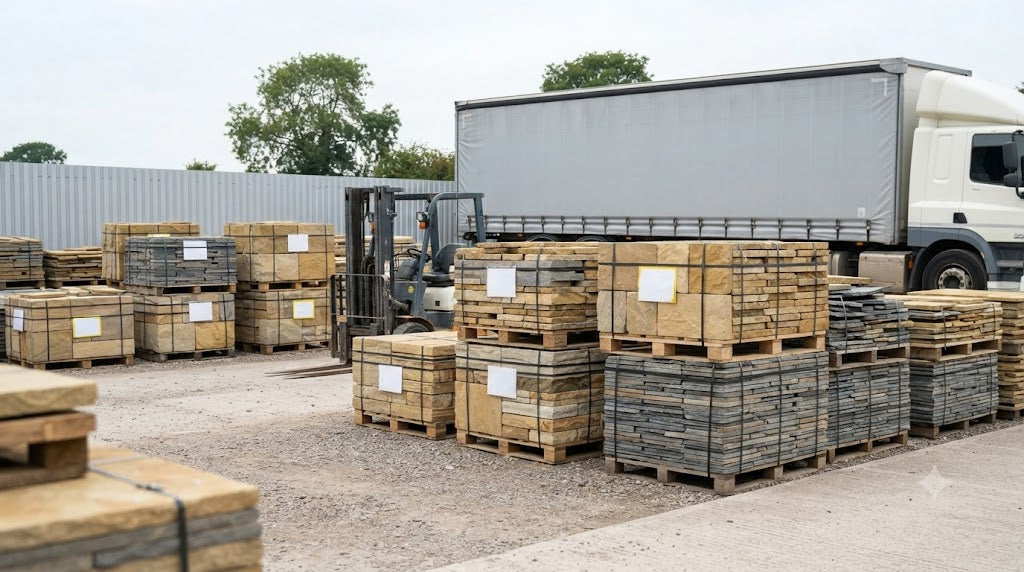
This is the question almost nobody asks, and it causes more delivery-day problems than anything else. Paving arrives on pallets weighing several hundred kilos, on a large lorry. That has practical consequences for your property:
Most free deliveries are kerbside, by tail-lift lorry, with the driver using a manual pallet truck to move the pallet off. That means the drop point needs to be a firm, flat, hard surface — a pallet truck cannot cross gravel, grass, or soft ground. The access road needs to take an 18 or 28-tonne lorry, with room to turn and no low branches or narrow gates in the way. And drivers generally cannot take pallets into gardens, garages, or through the house.
Ask: Is delivery kerbside? Do you use a tail-lift? Can the lorry access my road? Where exactly will the pallet be left? Better to find out now than when a 28-tonne lorry is blocking your street.
Worth planning before you order: where the pallet will sit, whether you have space for it, and how you'll move slabs from the kerb to the garden. It's a genuinely physical job — and if a contractor is laying the patio, agree in advance whether moving the pallet is their job or yours.
5. What happens if something arrives damaged?
Stone travels a long way on a pallet, and occasionally a slab arrives chipped or broken. What separates suppliers isn't whether it ever happens — it's how clearly they tell you what to do about it.
The important part is usually on you, and it's time-limited: inspect the delivery with the driver present, and if the crate is visibly damaged, splintered, or leaning, write "Damaged" next to your signature on the delivery note or handheld device. Then report breakages by email, with photographs, within 24 hours. Signing clean for a damaged pallet makes any later claim far harder to resolve.
Ask: What's your damage procedure? How long do I have to report it? What evidence do you need? A supplier who answers this clearly and specifically is telling you they handle it regularly and fairly. A vague answer is a warning sign.
6. Is the stone calibrated?
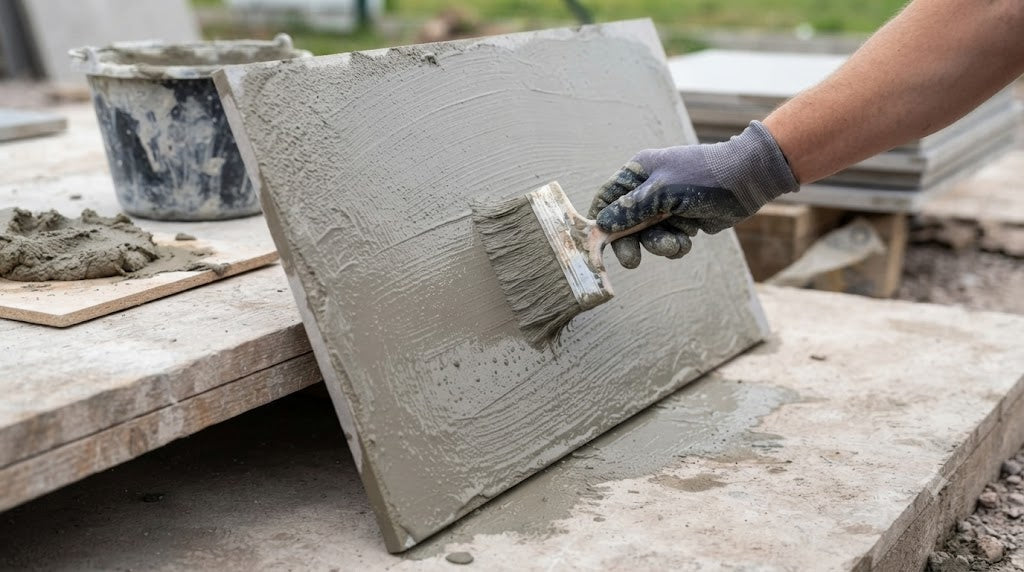
For natural stone, this one directly affects your labour bill. Calibrated stone is machine-finished to a consistent thickness (typically 22mm), so it lays quickly and evenly on a uniform mortar bed. Uncalibrated stone varies in thickness, and the installer has to adjust the mortar under every single slab to bring the surface level.
Uncalibrated stone is cheaper to produce, and it has its place in traditional builds — but if you're paying a landscaper by the day, the extra laying time can cost more than you saved on the stone.
Ask: Is this calibrated? What thickness? Is it consistent across the pallet? All our Indian sandstone and limestone is calibrated to a consistent 22mm; porcelain is factory-made to exact dimensions, so calibration isn't a concern with it.
7. Is the coverage clearly stated?
Paving is sold in several different ways — per m², per slab, per pack, per pallet — and that makes comparison genuinely difficult. A price per slab tells you nothing useful until you know how many slabs cover a square metre.
Ask: What area does this pack or pallet cover? What's the price per m² delivered and including VAT? If a supplier makes that hard to work out, be a little cautious — clarity about coverage is a decent proxy for clarity generally. Our patio cost calculator works out quantities and totals if you'd rather not do the maths.
And whatever you buy, order about 10% extra. Cuts, breakages, and the occasional slab you reject all eat into coverage. Running short mid-project is the worst outcome, because a second delivery may come from a different batch with a slightly different tone.
8. Can you actually talk to someone?
Paving throws up questions that a product page can't answer: how much do I need for an odd-shaped patio, will this colour suit red brick, can I mix sizes, what do I need to lay it. The value of a supplier you can phone is highest exactly when you're least experienced.
Ask: Is there a phone number? Who answers it — someone who knows the products, or a general call centre? Do they help after the sale as well as before?
The short version
Whether you're buying patio slabs or driveway setts, the same checks apply. Compare the delivered, VAT-inclusive price per m² — not the headline number. Check stock is real and dispatch is quick. See samples before committing. Understand how the pallet arrives and whether your access works. Know the damage procedure and the 24-hour reporting window. Confirm the stone is calibrated. Get the coverage per m² in writing. And make sure there's a human to call.
Any supplier worth buying from will answer all eight without hesitation. If several answers are vague, that tells you something useful before you've spent anything.
Questions before you order?
Order samples to see colours in your own light, or call our team on 0115 646 3218 — we import directly and know the products first-hand. All prices include VAT and free UK mainland delivery.
Order Samples Browse PavingFrequently asked questions
What should I look for in a paving supplier?
Clear pricing that includes VAT and delivery, genuine UK stock with a stated dispatch time, samples or a showroom so you can see the product first, a clearly explained delivery method, a defined damage-reporting procedure, calibrated stone, stated coverage per m², and someone knowledgeable you can phone. Vagueness on any of these is worth questioning before you order.
Is it cheaper to buy paving direct from an importer?
Usually the delivered price is lower, because there are fewer margins between the source and you — no wholesaler or reseller markup stacked on top. The important thing is to compare the delivered, VAT-inclusive price per m² rather than headline figures, since delivery on palletised stone is a significant cost that some suppliers add at checkout.
How is paving delivered?
On pallets, usually by tail-lift lorry to the kerbside. The driver moves the pallet with a manual pallet truck, which needs a firm, flat, hard surface — not gravel or grass. The access road must take a large lorry with room to turn. Drivers generally can't take pallets into gardens, garages or through houses, so plan where the pallet will sit and how you'll move the slabs from there.
What do I do if my paving arrives damaged?
Inspect the delivery with the driver still present. If the crate is visibly damaged, splintered or badly leaning, write "Damaged" next to your signature on the delivery note or handheld device, then report the breakages by email with photographs within 24 hours. Signing clean for a damaged pallet makes a later claim much harder, so check before you sign.
How much extra paving should I order?
About 10% more than your measured area. That covers cuts around edges and features, occasional breakages, and any slabs you'd rather not use. Running short mid-project is worth avoiding, because a top-up delivery may come from a different batch with a slightly different tone.