







How to Compare Porcelain Paving Brands: 7 Things That Actually Matter
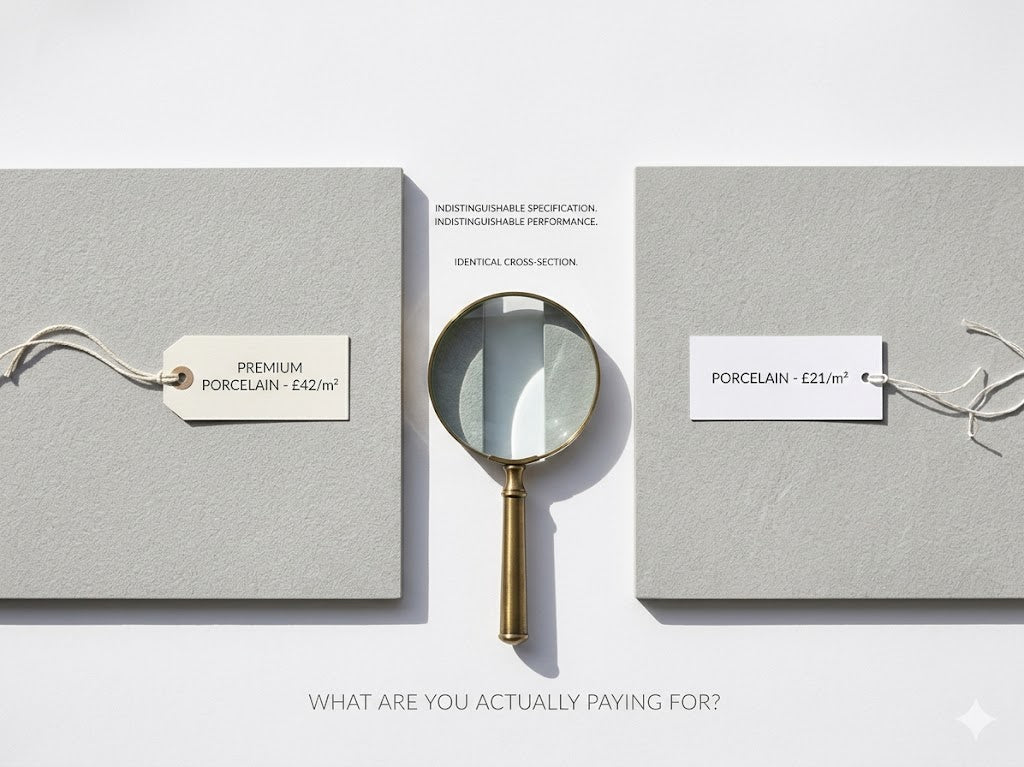
When comparing porcelain paving brands, check seven things: thickness (must be 20mm for outdoor use), anti-slip rating (R11 minimum), frost certification, colour consistency, price per m² delivered (not per slab), whether VAT is included, and delivery charges. The porcelain itself is manufactured to the same international standards regardless of brand — the price difference between a £20/m² slab and a £45/m² slab is almost entirely distribution margin.
There are over 30 porcelain paving brands selling in the UK. Prices range from £18/m² to £48/m². The product descriptions sound identical — "20mm, R11, frost-proof, non-porous, low maintenance." So why does one brand charge double another for what appears to be the same thing? This guide explains what's actually different, what isn't, and how to compare without overpaying.
The 3 pricing tiers in UK porcelain paving
The UK porcelain paving market splits into three clear pricing tiers. Understanding which tier you're buying from — and what the price difference actually pays for — saves hundreds on a typical patio.
The big names — brands sold exclusively through builders merchants and landscaping suppliers. They invest heavily in marketing, trade events, merchant support teams, and printed brochures. You're not paying more for better porcelain — you're paying for the brand's merchant distribution network, sales force, and marketing budget. The porcelain itself is manufactured in the same factories using the same raw materials as lower-priced brands.
What you get for the premium: extensive colour ranges (20-40+ options), merchant availability (collect same day from local stockist), brand recognition among landscapers, and printed specification literature.
What you don't get: better porcelain. The thickness is 20mm, the R-rating is R11, the frost performance is identical, and the raw material is the same vitrified clay and feldspar.
Online paving specialists who buy from importers or manufacturers and sell direct via e-commerce. Lower overheads than merchant brands, but they still buy through middlemen — importers, wholesalers, or UK stockholders — each adding margin. Many run permanent "sales" with inflated RRPs to create a perception of discount. A slab "was £32/m², now £22/m²" may never have actually sold at £32.
What to watch for: delivery charges hidden until checkout, VAT excluded from displayed prices, minimum order quantities, and split-pack surcharges that inflate the real cost above the headline price.
Companies that import porcelain directly from the manufacturer, hold stock in their own UK warehouse, and sell direct to the public. No importer margin, no wholesaler cut, no merchant markup. The porcelain is the same 20mm, R11-rated, frost-proof product — the cost saving comes from cutting out every middleman in the supply chain.
What you get: the same product at 40-60% less than premium brands. What you give up: the brand name on the box and the ability to collect from a local merchant.
The uncomfortable truth: a 900×600mm grey porcelain slab at £21/m² from a direct importer and the same format at £40/m² from a premium brand are both 20mm thick, R11 rated, frost-proof, and made from vitrified clay fired at 1,200°C. The £19/m² difference pays for marketing, merchant margins, and brand name — not better porcelain.
The 7 things that actually matter when comparing
Ignore brand names. Ignore marketing. Check these seven specifications — if two products match on all seven, the only real difference is price.
1. Thickness: must be 20mm
Outdoor porcelain paving must be 20mm thick. Some brands sell 18mm or even 10mm slabs as "outdoor paving" — these are indoor tiles being marketed for external use. 10mm tiles crack under foot traffic on a mortar bed. 18mm is borderline. Only 20mm porcelain is rated for outdoor residential use on a standard sub-base.
Some product listings say "porcelain paving" without specifying thickness. This usually means it's thinner than 20mm and the supplier is hiding it. Genuine outdoor porcelain brands state 20mm prominently because it's a selling point.
2. Anti-slip rating: R11 minimum
R11 is the recommended minimum anti-slip rating for open-air residential paving in the UK. Check that the brand states R11 explicitly — not just "anti-slip" or "textured." "Anti-slip" without an R-rating is a marketing claim, not a tested certification.
R10 is acceptable for covered areas (porches, carports) but not for open-air patios exposed to rain. R9 is indoor only. Read our full anti-slip rating guide.
3. Frost certification
Outdoor porcelain must have a water absorption rate below 0.5% to be classified as frost-proof. This ensures no moisture penetrates the slab to freeze and crack in winter. Most quality outdoor porcelain meets this easily — but check the specification rather than trusting the word "frost-proof" alone. Indoor tiles repurposed as outdoor paving may have higher absorption rates.
4. Price per m² — not per slab, not per pack
This is where most pricing confusion happens. Some brands quote per slab (making comparison difficult), others per pack (hiding the unit cost), and others per m² (the only useful comparison).
How to compare: convert everything to price per m² including VAT. A 900×600mm slab covers 0.54m². If a slab costs £11.40 each, that's £11.40 ÷ 0.54 = £21.11/m². If a 21.6m² pack costs £570, that's £570 ÷ 21.6 = £26.40/m².
Quick conversion: 900×600mm slab → divide slab price by 0.54 to get price per m². 600×600mm slab → divide by 0.36. 1200×600mm slab → divide by 0.72.
5. VAT: included or excluded?
Some suppliers display prices excluding VAT — particularly those targeting trade customers. A slab showing "£17.50/m²" becomes £21/m² with VAT. Always check whether the displayed price includes VAT. If the website doesn't state "inc VAT" clearly, assume it doesn't and add 20%.
6. Delivery: free or charged?
Delivery costs on heavy paving can add £50-150 to an order — or nothing, depending on the supplier. Some offer free delivery above a minimum order value. Others charge per pallet. Others charge differently by postcode. The only fair comparison is the total cost delivered to your door, not the product price alone.
Watch for: "free delivery on orders over £500" (fine if you're ordering a full patio, expensive if you need a few slabs), postcode surcharges for Scotland/Wales/rural areas, and per-pallet delivery charges that multiply on larger orders.
7. Stock availability: in stock or made to order?
Some suppliers show products on their website that aren't physically in stock — they order from the manufacturer after you pay, adding 4-8 weeks to delivery. Check whether the product is described as "in stock" or "available to order." For time-sensitive projects (landscaper booked, weather window), in-stock availability matters more than saving £1/m².
The comparison checklist
Use this checklist when comparing any two porcelain paving brands. If both match on all seven points, buy the one with the lower delivered price — the porcelain is functionally identical.
| Check | What to look for | Red flag |
|---|---|---|
| Thickness | 20mm stated clearly | Thickness not mentioned, or 10-18mm |
| Anti-slip | R11 rating stated | "Anti-slip" with no R-number |
| Frost rating | Water absorption <0.5% | No frost certification stated |
| Price format | Price per m² inc VAT | Price per slab or ex-VAT only |
| Delivery | Free or fixed cost, clearly stated | Delivery cost hidden until checkout |
| Stock | "In stock" with dispatch timeframe | "Available to order" or no stock info |
| RRP vs actual | Consistent pricing year-round | Permanent "50% off sale" with inflated RRP |
What you're actually paying for at each price point
Here's where the money goes at each tier:
| Cost component | Direct importer (£18-22/m²) | Premium brand (£35-48/m²) |
|---|---|---|
| Raw porcelain (manufacturing) | £8-10 | £8-10 |
| Shipping to UK | £3-4 | £3-4 |
| UK warehousing | £2-3 | £2-3 |
| Importer margin | £0 (imports direct) | £4-6 |
| Wholesaler/merchant margin | £0 (sells direct) | £6-10 |
| Brand marketing | £1-2 | £5-8 |
| Sales team / merchant support | £0 | £3-5 |
| Delivered to your door | £18-22/m² | £35-48/m² |
The manufacturing cost is the same. The shipping cost is the same. The warehousing cost is the same. The difference is entirely in the number of businesses between the factory and your garden. Every middleman adds margin. Remove the middlemen, the price drops — the porcelain doesn't change.
The real cost difference on a 20m² patio
On a typical 20m² patio, the tier you buy from determines how much of your budget goes to porcelain vs distribution margins:
| Tier | 22m² cost (inc 10% extra) | You pay for porcelain | You pay for margins |
|---|---|---|---|
| Direct importer (£21/m²) | £462 | ~£330 | ~£132 |
| Mid-range online (£28/m²) | £616 | ~£330 | ~£286 |
| Premium brand (£40/m²) | £880 | ~£330 | ~£550 |
On a 20m² patio, the difference between a direct importer and a premium brand is £418 — enough to pay for your sub-base materials, jointing compound, and skip hire. Same porcelain on your patio, £418 in your pocket.
When paying more makes sense
This guide isn't "always buy the cheapest." There are legitimate reasons to pay more:
Premium brands offer 30-40 colour options vs 10-15 from direct importers. If you need a very specific shade — a particular travertine effect, a wood-grain plank, or a colour that matches your interior tiles exactly — you may need a premium brand to get it. But for standard grey, charcoal, beige, or cream porcelain, every tier offers comparable options.
If your landscaper is on-site and needs slabs today, a local merchant with stock can get you paving in an hour. Direct importers dispatch within 24 hours but delivery takes 2-5 days. For urgent or last-minute requirements, the merchant premium buys you time.
Nobody sees the brand name once the porcelain is laid. Your guests see grey porcelain, not a logo. If two slabs match on all seven checklist points, the brand name is paying for the brand's marketing — not your patio quality.
How Universal Paving fits the framework
We're a direct importer. We buy porcelain from the manufacturer, ship it to our Nottingham warehouse, and sell it direct to homeowners and landscapers. No importer. No wholesaler. No merchant. That's why our grey porcelain starts from £19/m² while functionally identical products from premium brands sell for £35-48/m².
Here's how we score against our own checklist:
| Check | Universal Paving |
|---|---|
| Thickness | 20mm ✓ |
| Anti-slip rating | R11 certified ✓ |
| Frost certification | Water absorption <0.5% ✓ |
| Price format | Per m² inc VAT — from £19/m² ✓ |
| Delivery | Free to all UK mainland addresses ✓ |
| Stock | In stock at Nottingham warehouse, dispatched within 24hrs ✓ |
| Pricing model | Consistent pricing — no inflated RRPs or fake sales ✓ |
We pass our own test. Apply the same checklist to any supplier you're considering — the results will speak for themselves.
See for yourself
Browse our porcelain range and check the specs against any other brand. All prices include VAT and free UK delivery.
Browse Porcelain Paving Order SamplesFrequently asked questions
Is expensive porcelain paving better quality?
Not necessarily. Premium-priced porcelain and budget-priced porcelain are manufactured to the same specifications — 20mm thickness, R11 anti-slip, frost-proof, non-porous. The price difference reflects distribution margins (importer, wholesaler, merchant markups) and brand marketing costs, not better raw materials or manufacturing. Always compare specifications, not prices.
Why is some porcelain paving so much more expensive?
Three reasons: distribution chain (each middleman adds 15-30% margin), brand marketing (trade shows, brochures, merchant support teams), and pricing strategy (some brands position as premium through price alone). The porcelain itself costs £8-10/m² to manufacture regardless of brand — everything above that is margin and marketing.
What's the difference between branded and unbranded porcelain?
Branded porcelain comes with a recognised name, printed brochures, and merchant availability. Unbranded or own-brand porcelain from direct importers comes with the same specifications but no brand recognition. Once laid, there's no visible difference — the brand name is on the box, not on the patio. The functional specs (thickness, R-rating, frost performance) are what determine quality, not the brand.
Should I buy porcelain from a builders merchant?
Merchants offer same-day collection and the ability to see products in person — both genuine advantages. But they carry the premium-tier pricing (£28-48/m²) because their supply chain includes multiple margins. If you can wait 2-5 days for delivery and are comfortable ordering from a product photo and sample, buying from a direct importer saves 40-60% on the same specification porcelain.
How do I know if porcelain is genuine outdoor grade?
Check three things: 20mm thickness (not 10mm indoor tile), R11 anti-slip rating (not just "textured"), and water absorption below 0.5% (frost-proof certification). If any of these three aren't stated, the product may be indoor tile being sold as outdoor paving — regardless of the price or brand name.
,%20anti-slip%20rating%20(R11%20minimum),%20frost%20certification,%20colour%20consistency,%20price%20per%20m%C2%B2%20deliv...)