






Article: What Is Kandla Grey Paving? A Guide to Sandstone and Porcelain
What Is Kandla Grey Paving? A Guide to Sandstone and Porcelain
Silver-grey natural sandstone and porcelain compared — what to know about appearance, performance, maintenance and installation before it goes into your patio.
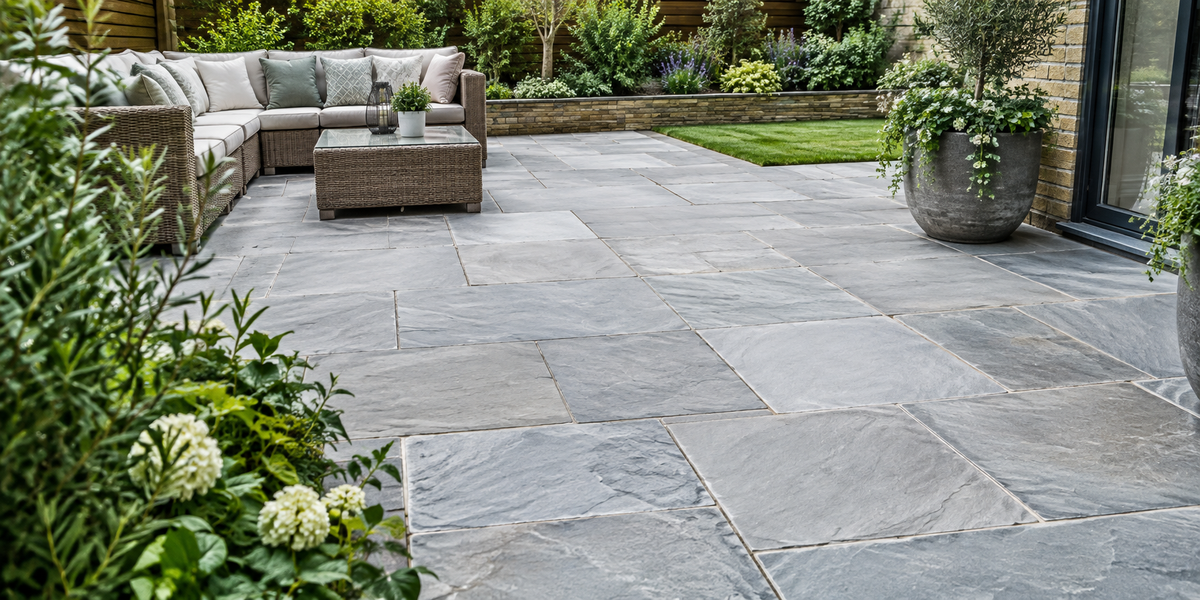
Browse Kandla GreyOrder SamplesWhen planning high-end garden patios and exterior renovations across the United Kingdom, specifying kandla grey sandstone has long been the benchmark for authentic, cleft natural stone. In recent years, the rapid development of exterior ceramics has introduced kandla grey porcelain as an equally compelling alternative for those seeking modern, low-maintenance living. Both materials share the celebrated silver-grey colour palette that suits British architecture, yet each delivers distinct physical characteristics, maintenance requirements, and aesthetic qualities.
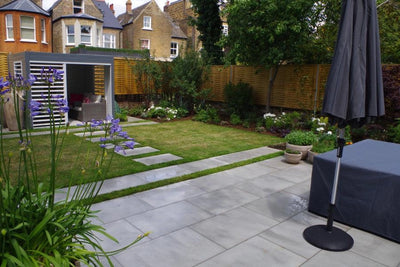
Kandla Grey is a versatile silver-grey tone that complements historic British housing stock and contemporary building additions. Whether set against weathered Victorian red brick, warm stonework, or modern monochrome render, this understated shade provides an elegant foundation for outdoor spaces. Today, direct UK importers like Universal Paving supply this iconic tone in two distinct formats: authentic quarried stone and high-performance porcelain tiles. Deciding between them requires understanding their physical structures, slip ratings, maintenance demands, and long-term performance.
What Is Kandla Grey? Geology and Colour Profile
Kandla Grey originates from the stone quarries of Rajasthan in northwestern India. Geologically, it is a hard quartzitic sedimentary stone formed over millions of years through tectonic pressure. Fine quartz crystals, cemented naturally by silica, give the stone structural density, compressive strength, and a subtle surface shimmer.
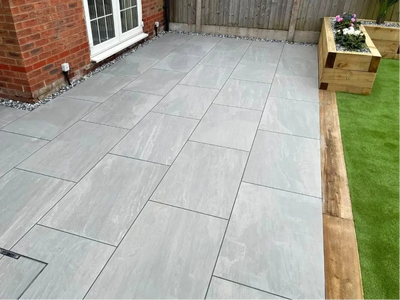
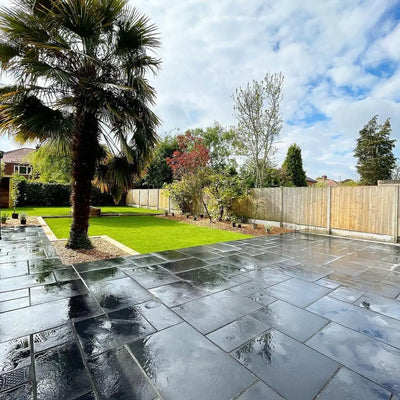
The visual appeal of Kandla Grey lies in its delicate tonal movement. Rather than presenting a flat, artificial shade, natural slabs display soft silver-grey tones accented with faint hints of cool blue, dove grey, and occasional quartz veining. When dry in the summer sun, the pale stone reflects ambient light, brightening garden areas. During typical British rain, the surface deepens to an attractive darker slate hue that contrasts crisply against lawn borders and brickwork. Because the UK market welcomed this balanced aesthetic, tile manufacturers produced outdoor porcelain tiles that replicate the exact same colourway.
Natural Stone Profile: Heritage and Character

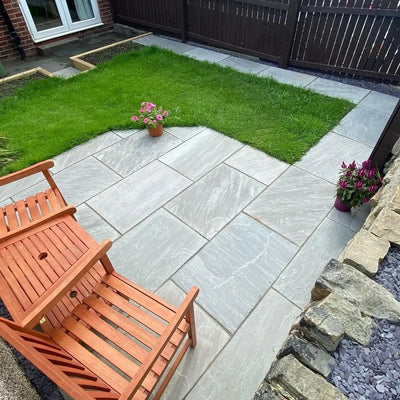
For buyers seeking an authentic connection to traditional masonry, investing in kandla grey sandstone provides organic charm that synthetic options cannot fully duplicate. Every quarried slab is an individual piece of geological history, featuring subtle sediment layering, gentle surface clefts, and distinct mineral markings.
Natural stone is traditionally split along its geological bedding planes, creating an undulating riven surface with dependable traction. Stonemasons hand-dress perimeters with chisels to produce rustic edges that suit traditional mortar joints. For sleek contemporary projects, manufacturers also supply sawn and honed slabs, cut with precision diamond blades to create smooth, matte surfaces with straight edges. When properly installed on a full mortar bed with slurry primer, sandstone paving displays impressive longevity under typical British rainfall and freeze-thaw cycles. Quartzitic stone handles pedestrian loads reliably and remains comfortable under bare feet during warm summer months, as its crystalline matrix slowly disperses solar warmth.
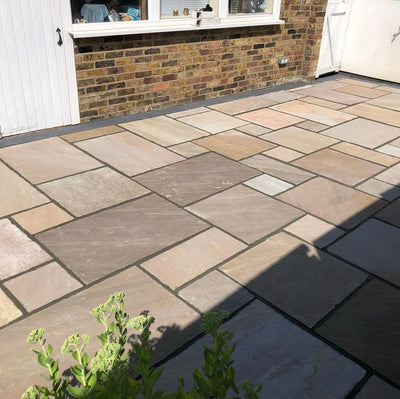
Over decades of exposure, natural stone absorbs ambient moisture and airborne minerals, acquiring a mature weathered patina that many heritage property owners cherish. Property developers frequently observe that using natural Indian sandstone in garden renovations boosts kerb appeal by establishing an elegant, neutral ground tone that appeals to prospective buyers who value authentic natural materials.
Outdoor Porcelain Profile: Engineered Performance

To meet the rising demand for low-maintenance outdoor spaces, Kandla Grey porcelain was developed as an engineered solution that combines the soft aesthetic of Indian stone with contemporary manufacturing precision. Homeowners, property managers, and commercial developers increasingly seek outdoor surfaces that retain their clean finish without requiring seasonal chemical washing or periodic sealants.
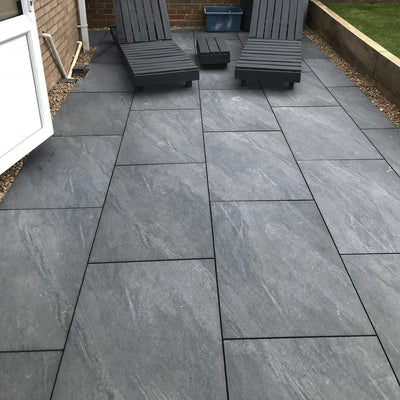
Outdoor porcelain is produced from a refined slurry of kaolin clay, quartz, and feldspar. The raw mixture is compacted under hydraulic pressure and fired in kilns at temperatures exceeding 1200 degrees Celsius. This intense heat fuses the minerals into a dense, non-porous body with virtually zero internal voids. The resulting material achieves a water absorption rate below 0.05 percent, making it exceptionally resilient in the British climate. Water cannot penetrate the tile body, preventing frost heave, surface spalling, or cracking during freezing winters. Moss and algae cannot take root, keeping paved zones clean throughout damp months.
For commercial courtyards, dining terraces, and rental properties where upkeep must remain minimal, engineered porcelain proves exceptionally practical because stubborn grease, red wine, and damp organic debris cannot penetrate its non-porous body. Cooking spills around a barbecue or dropped food on a terrace wash away with warm soapy water, leaving no permanent dark stains behind. Manufactured to a calibrated 20mm thickness, outdoor porcelain slabs feature micro-textured surfaces that achieve an R11 slip rating, certifying them for wet UK conditions.
Head-to-Head Comparison: Sandstone Versus Porcelain
Choosing between natural stone and modern porcelain involves balancing functional requirements, aesthetic goals, and maintenance expectations. The following breakdown compares how both materials perform across primary project criteria:
| Feature / Criteria | Natural Sandstone | Outdoor Porcelain |
|---|---|---|
| Material Composition | 100% quarried quartzitic natural stone | Engineered clays and minerals fired at 1200°C |
| Water Absorption Rate | Porous (approx. 1.5% to 3.0% uptake) | Near-zero (<0.05% uptake) |
| Slip Resistance | Naturally textured; R10 to R11 equivalent | Engineered micro-grip; certified R11 rating |
| Frost Resilience | Highly durable; weathers to a natural patina | Frost-proof; retains original factory colour |
| Algae & Moss Resistance | Susceptible in shaded, damp locations | High resistance; non-porous face prevents spores |
| Stain Resistance | Requires prompt cleaning or protective sealer | High resistance; oils and food spills wipe clean |
| Edge Finish | Hand-chiselled (riven) or sawn straight (smooth) | Precision-rectified straight edges |
| Maintenance Routine | Periodic washing, sweeping, and breathable sealing | Occasional mop or light pressure wash; no sealing |
| Entry Price Point | From £20 to £24/m² incl. VAT | From £20 to £30/m² incl. VAT |
While manufactured tiles remain pristine with simple jet washing, traditional sandstone paving matures into its surroundings, acquiring a soft natural patina that many heritage home owners cherish. That gradual weathering process gives natural stone its timeless character. Conversely, commercial specifiers and busy professionals who prioritize crisp geometric lines, minimal maintenance, and stable colour over a fifteen-year horizon find modern porcelain the ideal fit for their functional objectives.
Technical Installation Standards and Groundwork
Regardless of which material you choose, the lifespan of a paved area depends on the quality of groundwork beneath it. Sub-base preparation and bonding methods are where poorly executed installations fail, leading to loose slabs, joint cracking, or surface discolouration. Every successful project requires excavating topsoil down to a firm subgrade and installing a compacted sub-base of at least 100mm to 150mm of Type 1 MOT crushed aggregate, compacted in progressive layers with a mechanical vibrating plate.
Paving must always be laid on a full, wet mortar bed consisting of five parts sharp sand to one part Portland cement. Installers must avoid the outdated ring-bedding method, which creates empty hollows beneath slabs where moisture collects and freezes, lifting stones and cracking joints. Applying a polymer-modified cement slurry primer to the reverse of porcelain slabs is mandatory to create a chemical suction bond with the mortar bed. For natural stone, slurry primer stops sub-base salts and iron minerals from leaching into the stone face, keeping the silver-grey tone uniform.
Commercial, Developer, and Residential Applications
In hospitality courtyards and residential developments seeking rustic elegance, specifying kandla grey sandstone brings warmth and tactile richness that complements varied brickwork styles. Country pubs, boutique hotels, and residential restoration schemes benefit from the stone's hand-chiselled edges and natural cleft face, which sit comfortably alongside planted borders, stone boundary walls, and timber structures.
For property investors and residential landlords preparing housing portfolios for sale or tenancy, selecting low-maintenance surfaces is essential. Tenants rarely maintain outdoor stone with annual pressure washing or sealant applications. From a financial perspective, choosing kandla grey porcelain often reduces overall lifetime facility costs by eliminating periodic chemical sealing treatments and power-scrubbing routines. A pristine courtyard shown in a property listing supports rental valuations, signaling to prospective tenants that the outdoor space is modern, clean, and straightforward to look after.
Sourcing Quality Paving and Product Specifications
When purchasing paving across the UK market, buying direct from a specialist importer provides clear advantages in material consistency, technical transparency, and value. Independent retailers often add substantial markups to stone crates, whereas direct importers streamline the supply chain straight from production facilities to site deliveries.
As a leading direct importer based in Nottingham, Universal Paving supplies calibrated slabs, patio packs, and project accessories designed specifically to meet British building standards. Sourcing directly ensures that crates contain consistent slab thicknesses, reducing waste on site. Available formats include 900x600mm, 600x600mm, and 1200x600mm single-size slabs, multi-size patio packs for random layouts, and 100x100mm setts for driveway borders. Ordering sample swatches from Universal Paving allows property owners and developers to evaluate the silver-grey tone directly against their brickwork under natural daylight.
Frequently Asked Questions
Q1. Does natural Kandla Grey stone require sealing after installation?
Ans: Sealing is strongly recommended for natural sandstone in the UK. Applying a breathable, impregnating stone sealant several weeks after laying allows trapped moisture to escape while creating a protective chemical barrier against food grease, fallen leaves, and algae spores. Outdoor porcelain has an impermeable structure and must never be sealed.
Q2. Can Kandla Grey slabs be installed on a vehicle driveway?
Ans: Standard 20mm porcelain and 22mm calibrated sandstone are engineered for pedestrian patios and should not be used for vehicle traffic. However, heavy-duty 25mm calibrated sandstone flags or 40mm to 50mm thick Kandla Grey setts and cobbles are purpose-built for driveway installations over a reinforced concrete sub-base.
Q3. How do the slip characteristics compare in wet British weather?
Ans: Both materials perform safely in wet conditions when properly specified. Authentic riven stone features a naturally cleft surface that provides dependable grip underfoot. Exterior porcelain is manufactured with a dedicated micro-grip finish achieving an R11 slip rating, certifying it for outdoor use in residential and commercial settings prone to standing rain.
Q4. What is the fundamental difference between Riven and Sawn finishes?
Ans: Riven stone is split by hand along its natural bedding planes, giving it an undulating, textured surface with hand-chiselled, rustic edges. Sawn and honed stone is cut on all sides by precision mechanical blades, resulting in a smooth, matte face with sharp 90-degree edges suitable for crisp architectural layouts.
Q5. How should stubborn outdoor stains and algae build-up be cleaned?
Ans: Porcelain surfaces clean easily using warm soapy water, neutral pH detergent, or a standard pressure washer, as stains cannot penetrate the surface glaze. For natural sandstone, avoid harsh acid-based cleaners that react with iron minerals; instead, use a specialist stone wash combined with gentle pressure washing.
Conclusion: Making the Right Selection for Your Project
Selecting the ideal ground finish balances personal design preferences against the realities of outdoor maintenance, installation budgets, and property usage. Kandla Grey remains the United Kingdom's definitive silver-grey paving tone because it provides an enduring, elegant foundation that harmonizes with virtually any home style, garden planting scheme, or commercial facade.
For clients who value timeless tactile heritage and the organic individuality of geological formations, natural stone remains an attractive choice that matures with age. For those managing busy households, high-traffic commercial venues, or rental properties where seasonal scrubbing and sealing are impractical, modern porcelain delivers precision, certified slip safety, and dependable stain resistance. By ordering samples from Universal Paving, property owners and commercial contractors can inspect both textures first-hand, ensuring complete confidence before starting their next outdoor renovation.