








How to Remove Weeds Between Paving Slabs (And Stop Them Returning)
To remove weeds between paving slabs, pull or scrape out the growth, then treat the roots — with boiling water, a vinegar solution, or a weed knife for a chemical-free approach, or a path weedkiller for stubborn cases. But removal is only temporary: weeds keep coming back because the joints between your slabs are open, letting seeds and soil settle. The one permanent fix is to re-joint the paving with a modern polymeric jointing compound, which seals the gaps so weeds can't take hold. Do both — remove now, then re-joint — and the problem stops for good.
Weeds between paving slabs are the most common patio frustration in the UK — and the most misunderstood. Most people pull them out, only to watch them return weeks later. The reason is simple: pulling weeds treats the symptom, not the cause. Here's how to clear them fast, and then the permanent fix almost nobody talks about.
Why weeds grow between paving slabs
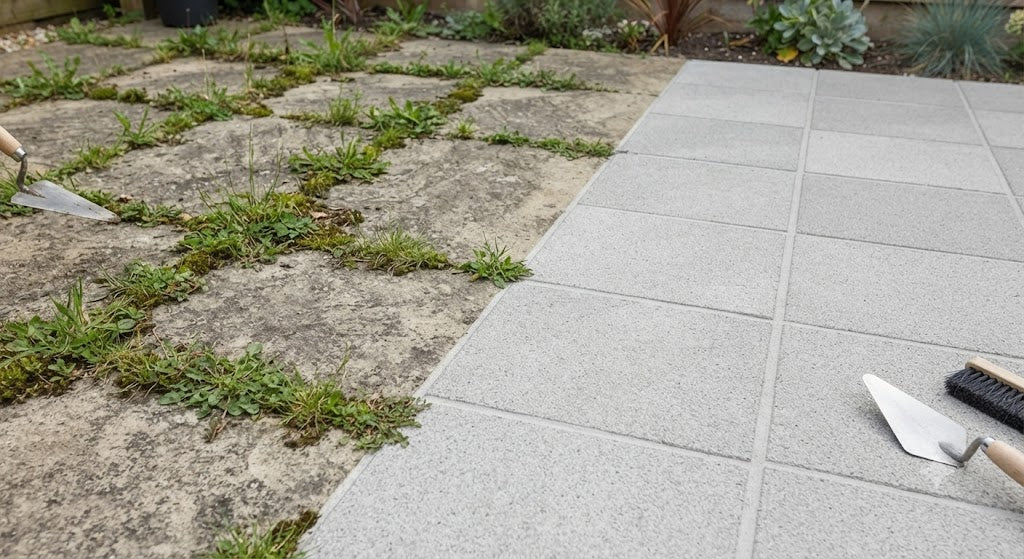
It helps to understand the cause before you treat it. Weeds between paving almost never grow up from underneath a properly laid patio — the sub-base blocks that. Instead, they grow in the joints. Over time, windblown seeds, dust and organic debris collect in the gaps between slabs, forming a thin layer of soil. Add rain and sunlight, and that's a perfect seedbed. Moss and weeds germinate right there in the joint.
This is why pulling weeds never works long-term: you remove the plant, but the open joint and its little pocket of soil are still there, ready for the next seed. The permanent solution is to close the joint so debris and seeds can't settle in the first place.
How to remove weeds between paving slabs
First, clear what's there. Choose the method that suits how many weeds you're dealing with:
Chemical-free methods (best for light growth)
Boiling water. The simplest, cheapest method. Pour boiling water directly onto the weeds in the joints — it scalds the foliage and roots. Effective for young weeds and moss, though you may need to repeat it.
Weed knife / block paving brush. A hooked weed knife or a stiff wire block-paving brush physically scrapes weeds, moss and debris out of the joints. Physical, satisfying, and it clears the joint ready for re-filling — the ideal first step before re-jointing.
White vinegar solution. A strong vinegar (acetic acid) solution sprayed on the foliage dries weeds out over a day or two. Best on a dry, sunny day. Keep it off adjacent planting.
Weedkiller (for stubborn or widespread growth)
For an established weed problem, a path-and-patio weedkiller clears growth and roots. Apply on a dry day per the instructions, and keep children and pets off until dry. Use it as a one-off reset before you re-joint — not as a repeated crutch.
Pressure washing (clears, but has a catch)
A pressure washer blasts out weeds, moss and joint debris quickly and is great for a deep clean. But there's a catch: it also blasts out whatever jointing is in the gaps, leaving them open and more prone to weeds afterwards. If you pressure wash, you should always re-joint afterwards — which brings us to the actual fix.
The permanent fix: re-joint your paving
Here's what stops weeds coming back — and it's the step most people skip. Once the joints are clear, fill them with a modern polymeric jointing compound (also called brush-in or all-weather jointing). Unlike old-fashioned loose sand or crumbling mortar, these compounds set into a firm, flexible, water-resistant joint that:
- Seals the gap so seeds, soil and debris can't settle in it
- Leaves no pocket of soil for weeds to germinate in
- Resists washout from rain and pressure washing
- Suppresses moss as well as weeds
- Lasts for years with no re-doing
Application is straightforward: the joints must be clear and (depending on the product) either dry or damp, then you simply brush the compound into the gaps and tool it off. It's a weekend job for most patios, and it's the difference between fighting weeds every summer and never thinking about them again. A quality jointing compound is the single best investment for a low-maintenance patio — a brush-in option like UltraScape Flowpoint is designed exactly for this, and for porcelain patios UltraScape Porcelpoint is the porcelain-specific grout.
Stop weeds for good — re-joint your patio
The permanent fix is a proper jointing compound that seals the gaps weeds grow in. We stock professional-grade UltraScape Flowpoint and porcelain-specific Porcelpoint grout, with free UK delivery. Speak to us if you need help choosing the right one.
Shop Jointing & Grouting Order SamplesHow to keep weeds away long-term
Once you've cleared and re-jointed, a little routine keeps your patio weed-free:
- Sweep regularly. Removing debris before it breaks down into soil denies weeds their seedbed.
- Rinse occasionally. A wash keeps organic matter from building up in and around the joints.
- Deal with moss early. Moss holds moisture and creates the conditions weeds like — clear it as it appears.
- Check joints yearly. Top up any jointing that's worn or washed out before gaps reopen.
- Keep gutters and drainage clear so water isn't pooling on the patio, which encourages both moss and weeds.
Do porcelain patios get fewer weeds?
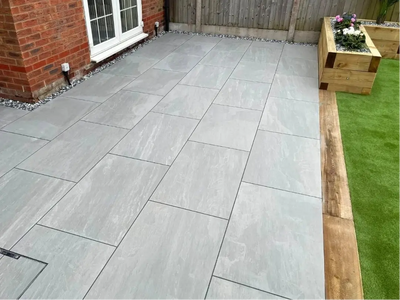
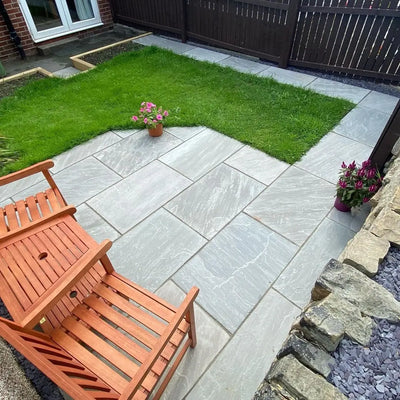
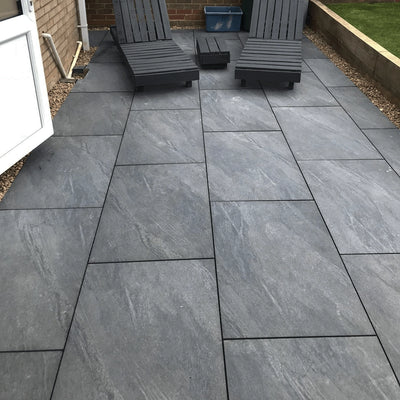
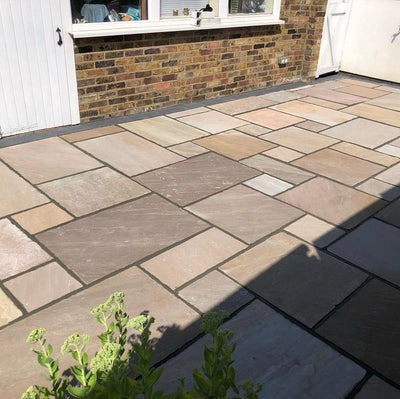
They can — and it's worth knowing if you're planning a new patio. Porcelain paving is non-porous and typically laid with tight, sealed joints, giving weeds far less opportunity to take hold than an old patio with worn sand joints. It won't make weeds impossible — any open joint can collect debris — but a porcelain patio properly jointed from the start is one of the lowest-maintenance, most weed-resistant options available. The same applies to a well-jointed sandstone paving patio.
Frequently asked questions
What is the best way to remove weeds between paving slabs?
For light growth, boiling water or a weed knife works well and is chemical-free. For stubborn weeds, a path weedkiller clears roots. But to stop them returning, you must re-joint the paving with a polymeric compound afterwards — removal alone is always temporary.
Why do weeds keep growing back between my slabs?
Because the joints are open. Seeds and soil collect in the gaps between slabs and germinate there. Pulling the weed removes the plant but not the seedbed, so new weeds grow. Sealing the joints with jointing compound is what breaks the cycle.
Does vinegar kill weeds between paving?
Yes — a strong white vinegar (acetic acid) solution dries out weed foliage over a day or two, best applied on a dry, sunny day. It's a good chemical-free option for light growth, but won't stop regrowth on its own. Keep it off nearby plants.
Should I pressure wash weeds off my patio?
Pressure washing clears weeds and debris quickly, but it also removes the jointing from the gaps, leaving them open and more weed-prone afterwards. Always re-joint after pressure washing to seal the gaps back up.
What stops weeds growing between paving permanently?
Sealing the joints. A modern polymeric jointing compound brushed into clean joints sets into a firm, weed-resistant seal that stops seeds and soil settling in the gaps. It's the one step that turns a recurring problem into a permanent fix.
Are some paving types more weed-resistant?
Yes — porcelain paving, laid with tight sealed joints, gives weeds much less opportunity than an old patio with worn sand joints. Any paving stays weed-resistant when it's properly jointed and maintained; the joint matters more than the material.