





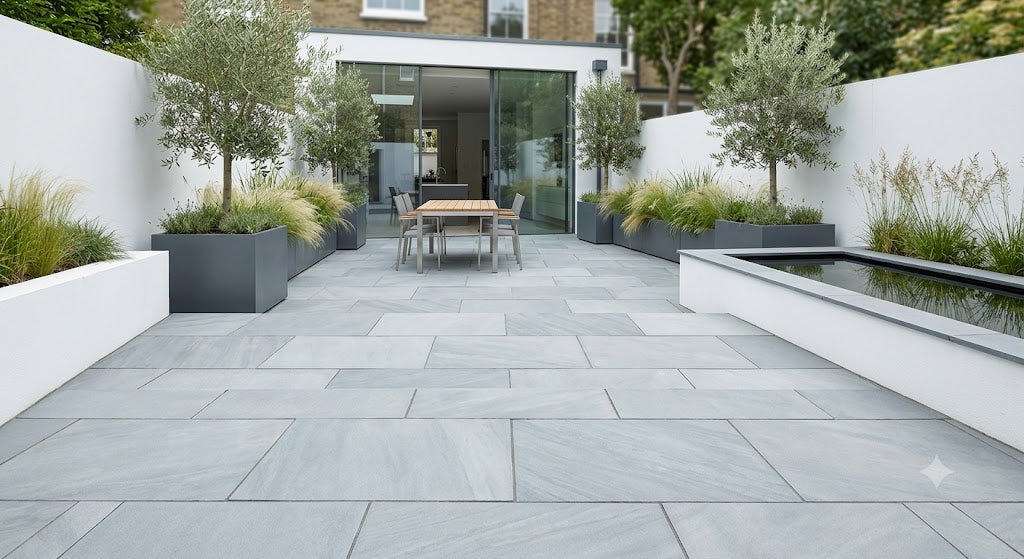
The Architect Who Found Silence in Stone — Kandla Grey
She was the loudest architect in London. Glass towers. Neon lobbies. Statement staircases. Every surface screamed for attention. Then she travelled to Rajasthan and found a stone so quiet it changed everything she believed about design.
This is the story of Nara Voss. And the grey stone that taught her the power of silence.
Nara Voss — The Architect Who Couldn't Stop Shouting
Nara Voss was brilliant. Everyone said so. Her buildings won awards. Her interiors were photographed for magazines. Her name appeared on shortlists before she'd even submitted.
But Nara had a problem. Everything she designed was loud. Bold colours. Dramatic angles. Surfaces that demanded you look at them. Her work was stunning — and exhausting. Even to her.
By forty-two, she was burnt out. Not from overwork, but from overstimulation. She'd spent twenty years designing spaces that competed for attention, and she'd forgotten what it felt like to stand in a room that didn't ask anything of her.
Her therapist suggested a holiday. Her business partner suggested retirement. Nara booked a flight to Rajasthan instead.
The Quarry Landscape of Kandla
She didn't plan to visit a quarry. She ended up at one by accident — a wrong turn on a dusty road outside the port town of Kandla, on the western coast of Gujarat.
The landscape stopped her. Not because it was dramatic — but because it wasn't.
For miles in every direction, the earth was grey. Not a cold, lifeless grey. A warm, layered grey with blue undertones and silver veining that shifted with the light. At dawn, the stone looked almost blue. At noon, it was cool silver. By evening, it glowed with a warmth she hadn't expected from something so quiet.
Nara sat on a slab of Kandla Grey sandstone and didn't move for an hour. No drama. No noise. No competition. Just stone, sky, and silence.
For the first time in twenty years, she felt her mind go still.
The Moment She Understood Grey
Nara spent three days at the quarry. She watched the stone cutters work. She ran her hands across freshly split surfaces. She photographed the same slab every hour as the light moved across it.
On the third evening, she wrote one line in her notebook:
"Grey isn't the absence of colour. It's the presence of every colour, resting."
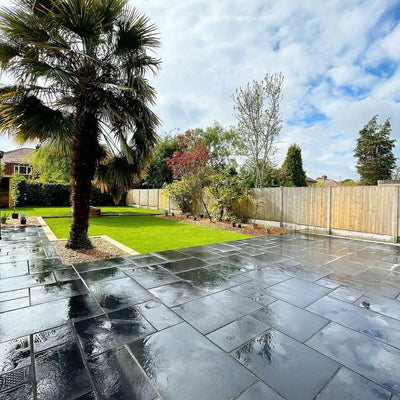
That was the revelation. Kandla Grey sandstone wasn't neutral because it lacked character. It was neutral because it contained character — blue, silver, charcoal, ivory, all folded together into a surface that didn't compete with anything around it. It made everything else look better.
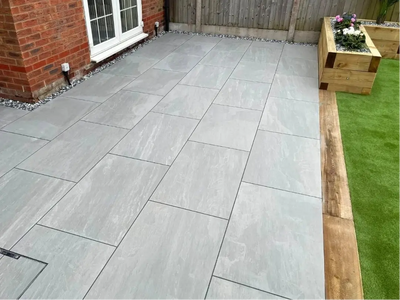
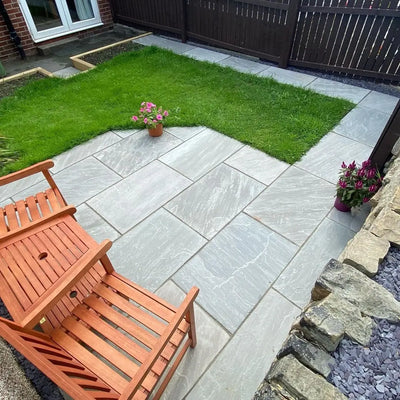
Plants looked greener against it. Timber looked warmer. Brick looked richer. Even light itself seemed to behave differently — landing on the grey surface and scattering softly instead of bouncing harshly.
Nara had spent twenty years trying to make surfaces the centre of attention. Kandla Grey showed her a different approach: be the foundation that makes everything else shine.
Back to London — The Courtyard That Won Everything
Nara returned to London with a container of Kandla Grey sandstone and an idea she'd never had before: design a space that doesn't ask to be noticed.
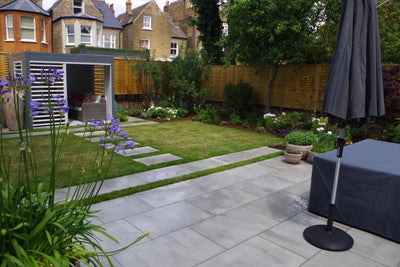
She was commissioned to redesign the courtyard of a Kensington townhouse. Previous architects had proposed marble, polished concrete, resin. Nara proposed Kandla Grey sandstone. The client was confused. Grey stone? For a premium London property?
Nara laid the patio herself. 900×600 slabs in a staggered bond. No pattern. No feature strips. No decorative borders. Just stone.
Then she planted. Olive trees. Lavender. Ornamental grasses. White roses against the garden wall. And she stepped back.
The courtyard won three design awards that year. Not because the stone was spectacular — but because it made everything around it spectacular. The planting glowed. The architecture breathed. The space felt like it had always been there. Quiet, confident, and impossible to improve.
The judges' citation said it all: "A masterclass in restraint. The material doesn't compete — it completes."
That material was Kandla Grey. The UK's most popular paving colour. And now you know why.
See Kandla Grey for Yourself
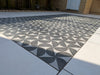
Available in sandstone and porcelain — the UK's favourite paving colour, from £19/m².
Sandstone or Porcelain — Which Kandla Grey?
Here's something Nara discovered during that London project: Kandla Grey exists in two forms, and each serves a different kind of homeowner. The colour is the same. The character is different.
Kandla Grey Sandstone
For homeowners who want character
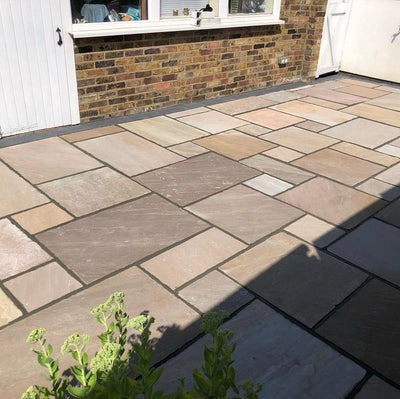
- Every slab naturally unique — no two are identical
- Riven texture with hand-split surface grain
- Develops a gentle patina over time
- Warm underfoot in sunlight
- 18mm calibrated thickness
Kandla Grey Porcelain
For homeowners who want precision
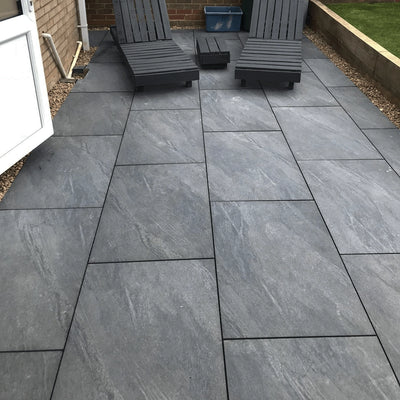
- Consistent colour and surface across every slab
- R11 anti-slip rated, frost-proof, stain-proof
- Zero maintenance — no sealing required
- UV-stable — won't fade over time
- 20mm thickness, near-zero water absorption
Sandstone for character. Porcelain for precision. Both Kandla Grey. Both beautiful. Both available from our Nottingham yard with free UK delivery.
Nara used sandstone for the Kensington courtyard because the client wanted natural variation. For her next project — a rooftop terrace in Shoreditch — she used porcelain, because the client wanted a zero-maintenance surface that would look identical in year ten. Same colour. Different needs. Same result: a space that felt quiet, confident, and complete.
Why Kandla Grey Is the UK's Most Popular Paving Colour
Nara's story explains something that sales data already proves: across our whole sandstone paving range, Kandla Grey outsells every other colour in the UK. Not because it's trendy. Because it works with everything.
- Works with every garden style — modern, traditional, cottage, urban, rural. Grey is the universal background
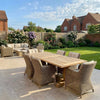
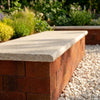
- Complements every material around it — brick, timber, render, planting, gravel, decking. Nothing clashes
- Looks different at every hour — cool silver in the morning, warm grey in the evening, luminous after rain
- Never dates — grey doesn't belong to any era or trend. It looked right in 2015 and it looks right today
- Available in sandstone and porcelain — choose natural character or engineered precision, same colour either way
That's why architects specify it. That's why landscapers default to it. And that's why homeowners who've never laid a patio before instinctively reach for it. Kandla Grey doesn't need explaining. It just looks right.
What Nara Teaches Us About Design
After the Kensington courtyard won its third award, a journalist asked Nara what had changed in her design philosophy. She answered without hesitation:
"I used to design surfaces that demanded attention. Now I design surfaces that give attention back — to the planting, the light, the architecture, the people. Kandla Grey taught me that. The best material in a garden is the one you stop noticing because everything else looks so good."
— Nara Voss, ArchitectShe was right. The best patios don't compete with your garden. They complete it. And no colour does that more naturally than Kandla Grey — quiet, confident, and endlessly versatile.
That's not an opinion. That's why it's our best seller. By a distance.
Browse Kandla Grey
Ready to Let Your Garden
Do the Talking?
Nara found silence in a quarry. You'll find it in your garden — the moment Kandla Grey goes down and everything around it starts to shine.