






Indian Sandstone Patio Ideas: Design & Layout Guide for UK Gardens
You've bought the sandstone. The pallets arrived yesterday. Three tons of Kandla Grey sitting on your driveway, and you're standing there with a tape measure thinking: "Right, now what?"
This is the bit that separates brilliant patios from mediocre ones—not the material quality (you've already sorted that), but how you arrange it. The layout. The pattern. The relationship between your patio and everything around it.
Here's what nobody tells you: most UK patios look identical not because people choose the same stone, but because they choose the same layout. Random pattern patio pack. Laid wherever seems flat. Job done. And it's... fine. Functional. Boring.
Your garden deserves better than fine.
This guide isn't about which sandstone to buy—we've covered that elsewhere. This is about what to do with it once you've got it. Layout patterns that actually work in UK gardens. Size combinations that create interest rather than confusion. Design ideas stolen from landscapers who do this professionally. The practical stuff that turns "we've got paving" into "we've got a proper patio."

The Layout Fundamentals Nobody Explains
Before we get into specific patterns, let's talk about the three decisions that affect everything else.
Decision 1: Single Size vs Mixed Sizes
This is your first fork in the road, and it changes everything.
Single size (e.g., all 900x600mm):
- Creates clean, contemporary lines
- Easier installation (consistent laying pattern)
- Suits modern properties
- Works brilliantly in small spaces
- Faster to lay (fewer cuts needed)
Mixed sizes (patio pack with 900x600, 600x600, 600x290, 290x290):
- Creates traditional random pattern
- More organic, natural appearance
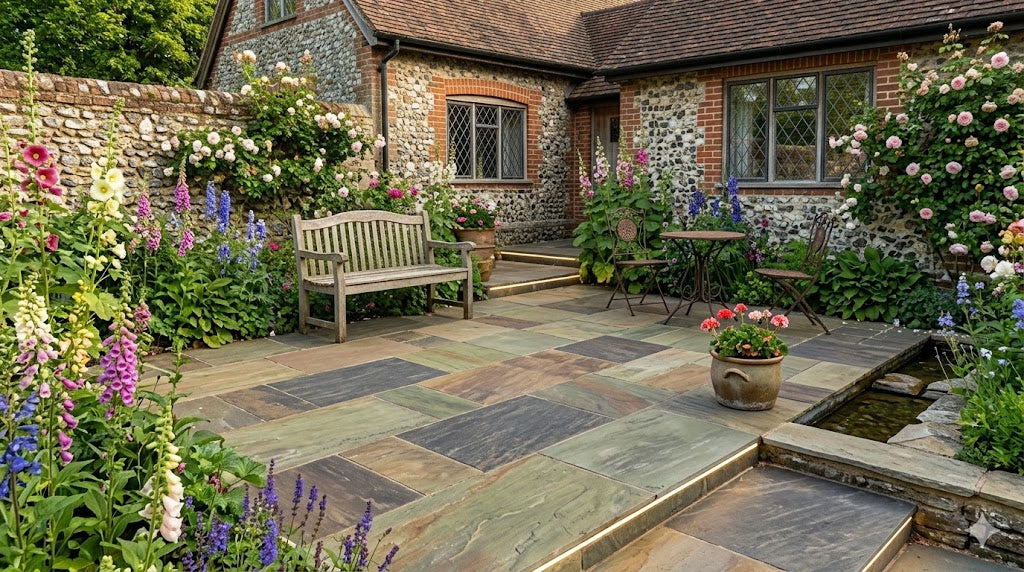
- Suits period properties and cottage gardens
- Requires more planning (puzzle-solving during installation)
- More material wastage (complex cutting)
The honest truth: Single size looks more expensive and professional. Mixed sizes look more traditional and characterful. Neither is objectively better—they serve different aesthetics.
What works in UK gardens: For properties built after 1990, single size usually looks more appropriate. For anything older, mixed sizes often suit the architecture better. Your property age is actually a decent guide here.
Decision 2: Grid vs Offset vs Random
Even with single-size slabs, you've got pattern choices.
Grid (stack bond):
- All joints align perfectly (both directions)
- Clean, architectural, very modern
- Shows installation imperfections clearly (needs perfect execution)
- Can look rigid in traditional gardens
Offset (running bond / brick pattern):
- Each row offset by half a slab
- Classic, timeless, forgiving
- Hides minor installation variations
- Works in virtually any garden style
Random (mixed sizes):
- No repeating pattern
- Requires planning or professional installer
- Traditional cottage garden aesthetic
- Can look messy if poorly executed
What works in UK gardens: Offset running bond is your safe bet—works everywhere, looks good everywhere, forgives installation errors. Grid is for confident contemporary designs. Random is for traditional properties with experienced installers.
Decision 3: Patio Size Actually Matters
This sounds obvious, but size affects which patterns work.
Small (10-15m²):
- Single size works better (less visual chaos)
- Simple patterns (grid or offset)
- Avoid too many cuts/borders (makes space feel smaller)
Medium (15-30m²):
- Mixed sizes work well (enough space for pattern to develop)
- Can incorporate borders or features
- Most flexible for different patterns
Large (30m²+):
- Mixed sizes prevent monotony
- Can zone different areas with different patterns
- Borders and features actually improve rather than crowd

Pattern Ideas That Actually Work in UK Gardens
1. The Contemporary Single-Size Grid
What it is: All 900x600mm slabs laid in perfect grid, all joints aligned both ways.
Best for:
- Modern new-build properties
- Minimalist garden designs
- Small urban courtyards (makes space feel larger)
- Geometric contemporary layouts
Colour choice: Kandla Grey smooth works brilliantly here. The contemporary finish matches the geometric precision.
Installation tip: This pattern is unforgiving—every joint shows. If you're DIYing, offset pattern is safer. If hiring professionals, this creates stunning architectural precision.
Real example: 4m × 6m courtyard patio, Kandla Grey smooth 900x600, perfect grid, dark grey jointing. Looks like it cost twice what it did.
2. The Classic Offset Running Bond
What it is: Each row offset by 300mm (half a 600mm width), creating traditional brick-bond pattern.
Best for:
- Any property style (genuinely versatile)
- DIY installation (forgiving pattern)
- Rectangular patios
- First-time patio projects
Colour choice: Works with any colour. Raj Green riven in running bond = classic British cottage garden. Kandla Grey smooth = contemporary take on traditional pattern.
Installation tip: Start from house wall and work outward. Each slab overlaps the joint below by half. Simple, effective, proven.
Real example: 5m × 5m patio, Rippon Buff riven 900x600, running bond, buff jointing. Timeless, warm, perfect for traditional semi-detached property.
3. The Traditional Random Pattern (Patio Pack)
What it is: Mixed sizes (900x600, 600x600, 600x290, 290x290) arranged in non-repeating organic pattern.
Best for:
- Period properties (Victorian, Edwardian, older)
- Cottage gardens
- Informal traditional gardens
- Large patios where pattern can develop
Colour choice: Raj Green or Rippon Buff riven in random pattern = authentic traditional character. Kandla Grey riven = contemporary colour with traditional layout.
Installation tip: Lay out several square meters dry before mortaring to ensure good pattern distribution. Avoid "rivers" (continuous joint lines running across patio).
Real example: 7m × 4m patio, Raj Green riven patio pack, random pattern, natural jointing. Looks like it's been there for decades.
4. The Herringbone (Requires 600x300mm Slabs)
What it is: Slabs laid at 45° angles in V-shaped pattern, creating dynamic zigzag effect.
Best for:
- Driveways (pattern helps distribute load)
- Pathways (creates visual movement)
- Feature areas within larger patios
- Traditional properties wanting something special
Colour choice: Kandla Grey riven 600x300 in herringbone = sophisticated traditional. Works beautifully for front paths.
Installation tip: Start from straight edge (house wall or path edge). Mark 45° angle carefully. Each row mirrors the previous. Takes longer but looks spectacular.
Real example: 1.2m × 6m front path, Kandla Grey riven 600x300, herringbone pattern, looks like original Victorian path.
5. The Large Format Contemporary (1200x600mm)
What it is: Oversized slabs creating bold, minimalist aesthetic with fewer joints.
Best for:
- Large modern patios (30m²+)
- Minimalist contemporary gardens
- Creating spacious feel
- Properties with clean architectural lines
Colour choice: Kandla Grey smooth 1200x600 = ultimate contemporary. Large format demands smooth finish.
Installation tip: Requires two people minimum (slabs are heavy). Perfect substrate essential (shows every imperfection). Professional installation recommended.
Real example: 8m × 5m patio, Kandla Grey smooth 1200x600, grid layout, creates seamless floor like polished stone.
6. The Bordered Patio
What it is: Main patio in one size/pattern, bordered by contrasting material or size.
Best for:
- Defining patio edges
- Creating visual interest
- Mixing materials (sandstone + setts/cobbles)
- Traditional and contemporary gardens
Popular combinations:
- Kandla Grey 900x600 centre + Kandla Grey setts 200x100 border
- Raj Green patio pack centre + Kandla Grey cobbles border
- Rippon Buff 900x600 centre + brick edging
Installation tip: Install border first, then fill centre. Ensures straight defined edges.
Real example: 6m × 4m patio, Kandla Grey smooth 900x600 running bond, bordered with Kandla Grey cobbles, creates defined room-like space.

Designing for Your Specific Garden
Small Urban Courtyard (10-15m²)
Challenge: Limited space, needs to feel larger.
Solution:
- Single size 900x600 (fewer joints = less visual noise)
- Offset pattern (creates direction, guides eye)
- Light colours (Kandla Grey, Rippon Buff)
- Minimal borders (borders shrink visual space)
Pattern recommendation: Kandla Grey smooth 900x600, offset running bond, tight grey joints.
Why it works: Clean lines maximize perceived space. Light colour reflects light. Simple pattern doesn't overwhelm.
Traditional Cottage Garden (20-30m²)
Challenge: Matching traditional property character.
Solution:
- Patio pack random pattern
- Riven finish (authentic texture)
- Warm colours (Raj Green, Rippon Buff)
- Informal edges (no harsh borders)
Pattern recommendation: Raj Green riven patio pack, random pattern, natural jointing colour.
Why it works: Organic pattern suits cottage aesthetic. Warm multi-colour complements planting. Riven texture feels period-appropriate.
Modern New-Build (25-40m²)
Challenge: Contemporary property needs matching patio.
Solution:
- Single size 900x600 or 1200x600
- Grid or offset pattern (geometric precision)
- Cool neutrals (Kandla Grey, Fossil Mint)
- Smooth finish
Pattern recommendation: Kandla Grey smooth 900x600, perfect grid, dark grey joints.
Why it works: Architectural precision matches modern property. Smooth finish contemporary. Grey colour neutral backdrop.
Large Informal Garden (40m²+)
Challenge: Preventing monotony across large area.
Solution:
- Mixed sizes (visual variation)
- Zone different areas (dining vs lounging)
- Consider multiple materials (sandstone + gravel + planting)
- Create levels or steps
Pattern recommendation: Main patio in Kandla Grey smooth 900x600 running bond, stepping stones through planting in Kandla Grey riven 600x600.
Why it works: Pattern variation across zones creates interest. Mixing finishes adds texture. Large area accommodates complexity.

The Practical Planning Stuff
How Much Cutting Will You Actually Need?
Different patterns require different cutting amounts:
Minimal cutting (5-10% wastage):
- Single size running bond
- Single size grid (if patio dimensions match slab multiples)
Moderate cutting (10-15% wastage):
- Random patio pack
- Bordered designs
- Most standard layouts
Heavy cutting (15-20% wastage):
- Herringbone pattern
- Circular features
- Complex curves or obstacles
Budget tip: Order 10% extra for simple patterns, 15% for complex. You'll need it.
Joint Width Matters More Than You Think
Tight joints (5-10mm):
- Contemporary appearance
- More precise installation needed
- Shows installation imperfections
Medium joints (10-15mm):
- Traditional appearance
- Forgiving (hides minor variations)
- Standard UK practice
Wide joints (15-20mm):
- Very traditional/rustic
- Easier installation (very forgiving)
- Can look deliberately rough
Recommendation: 10-12mm for most UK patios. Tight enough to look professional, forgiving enough to accommodate natural stone variation.
Drainage Fall: The Bit Everyone Forgets
Your patio needs a slight slope away from house—usually 1:60 (roughly 15mm drop per meter).
Pattern impact:
- Grid patterns show slope less obviously
- Running bond perpendicular to house looks better (joints follow fall)
- Random patterns hide drainage slope completely
Pro tip: Run your pattern parallel to drainage fall direction when possible. Makes installation easier and looks more natural.

Common Mistakes (And How to Avoid Them)
Mistake 1: Starting Installation Without Dry Layout
The problem: Cutting final row, discovering pattern doesn't work, having to relay.
The fix: Lay out at least 4-6m² dry before mortaring anything. Check pattern, spacing, cuts needed.
Mistake 2: Mixing Different Stone Batches Randomly
The problem: Natural stone varies between batches. Clustering same batch creates uneven colour patches.
The fix: Mix slabs from different pallets/packs during installation. Distributes colour variation evenly.
Mistake 3: Ignoring Property Architecture
The problem: Contemporary pattern on Victorian cottage, or traditional random pattern on modern new-build.
The fix: Match pattern style to property age and character. Your house tells you what works.
Mistake 4: Overcomplicating Small Spaces
The problem: Random patio pack pattern in 12m² courtyard = visual chaos.
The fix: Small spaces need simple patterns. Single size, simple layout.
Quick Decision Guide
Modern property + small space (under 20m²): → Kandla Grey smooth 900x600, offset or grid pattern
Traditional property + medium space (20-35m²): → Raj Green riven patio pack, random pattern
Contemporary property + large space (35m²+): → Kandla Grey smooth 900x600 main area, bordered with setts/cobbles
Cottage garden + any size: → Rippon Buff or Raj Green riven, patio pack random pattern
Modern minimalist + medium-large space: → Kandla Grey smooth 1200x600, perfect grid
Front path (any property): → Kandla Grey riven 600x300, herringbone pattern
The Verdict
Here's the thing about patio design: the materials matter, but the layout matters just as much. You can buy the finest Indian sandstone available and still end up with a mediocre patio if you lay it badly or choose a pattern that fights your property's character.
The best patio designs feel inevitable—like that's obviously the only way those slabs should have been arranged in that particular garden. They're not clever or showy. They just work.
Match your pattern to your property. Match your colours to your planting. Keep it simple unless you've got space for complexity. And when in doubt, offset running bond has worked in British gardens for 200 years—it'll work in yours too.
Need help planning your layout?
- Phone advice: 07480 959706
- Order samples to plan pattern: £5 per colour
- Free UK delivery on all paving orders
- Professional installation available
Your garden's waiting. The sandstone's ready. Now you know what to do with it.