





Raj Green Indian Sandstone: Why Britain Fell in Love with This Multi-Colour Paving
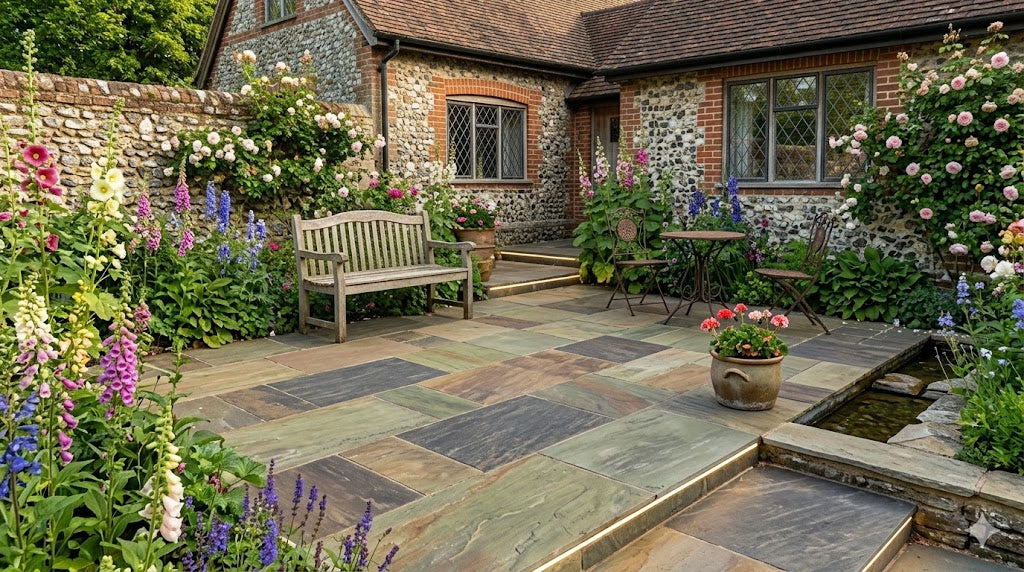
There's something about walking into a British garden centre and seeing Raj Green sandstone paving for the first time. The colours catch you off guard—not in a loud, demanding way, but with this quiet, earthy confidence. Greens that remind you of moss on old stone walls. Browns like autumn leaves still damp from rain. Greys that appear and disappear depending on how the light hits.
It's not what most people expect when they think "paving." And that's exactly why it works.
Raj Green has been Britain's go-to traditional paving choice for over two decades, and if you've ever walked through a cottage garden or admired a period property's patio, there's a decent chance you were standing on it. But here's what's interesting: while Kandla Grey has stolen some spotlight in recent years with its contemporary cool-grey aesthetic, Raj Green just keeps selling. Steadily. Reliably. Because some things don't need to be trendy—they just need to be right.
This guide isn't about convincing you that Raj Green is the only option (it's not). It's about helping you understand what makes this multi-colour Indian sandstone different, when it works brilliantly, when it doesn't, and whether your garden is one of the places where it'll feel absolutely perfect.

What Actually Is Raj Green? (And Why the Name's Slightly Misleading)
Let's clear something up straight away: despite the name, Raj Green isn't predominantly green. I know. Bit confusing.
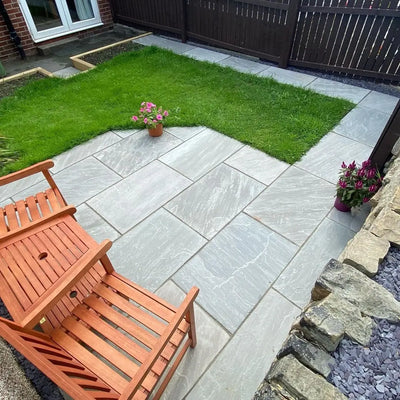
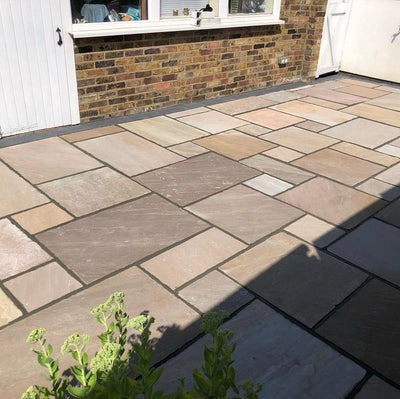
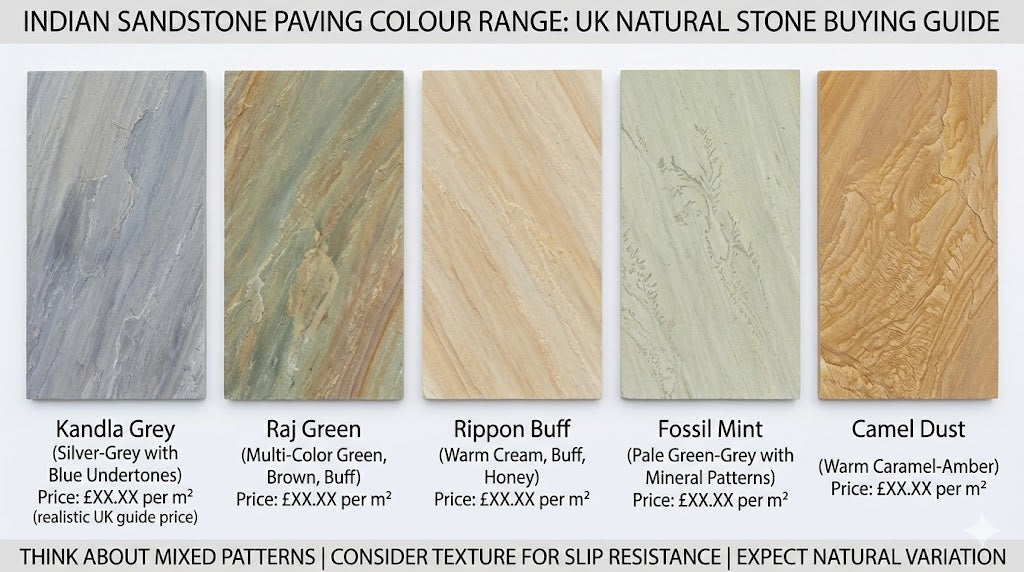
The colour palette is more accurately described as multi-tonal earth tones—think of it as nature's version of a well-curated paint palette. You get rich mossy greens, yes, but they're beautifully woven together with warm light browns, subtle charcoal greys, and occasional hints of buff or honey. Some slabs lean more green, others more brown, most show a mix. It's this natural variation that gives Raj Green its character.
The stone itself is Indian sandstone quarried in Rajasthan—the same region producing Kandla Grey, Rippon Buff, and most other Indian sandstone sold in the UK. It's sedimentary rock formed over millions of years from compressed sand deposits, which explains both its durability and its natural layered texture.
Key characteristics:
- Density: 2,200-2,400 kg/m³ (proper outdoor-grade density)
- Porosity: Moderate (allows moisture movement, prevents freeze-thaw damage)
- Lifespan: 25+ years with basic maintenance
- Variation: Significant (every slab genuinely unique)
That last point—variation—is crucial to understanding Raj Green. If you're the type of person who wants every slab to match perfectly, this isn't your stone. But if you appreciate the organic, slightly unpredictable beauty of natural materials, that variation becomes the whole point.
The Colour Palette: What You're Actually Getting
Here's where Raj Green gets interesting. The colour isn't consistent across slabs—it's a deliberate mix designed to create visual depth.
The Dominant Tones:
Green (30-40% of most slabs): Not bright emerald or artificial turf green—we're talking moss green, sage, soft olive. The kind of green that looks like it's been there for centuries. Some pieces show darker forest green patches, others have lighter sage sections. This is the colour that gives Raj Green its name and its distinctive character.
Brown (30-40% of most slabs): Warm light browns ranging from honey-coloured buff through to deeper earthy browns. Think autumn leaves, weathered wood, rich soil after rain. These tones stop Raj Green feeling too cool or grey, adding warmth that works beautifully in UK gardens where we often lack consistent sunshine.
Grey (20-30% of most slabs): Charcoal grey, slate grey, sometimes almost silver. Usually appears as undertones or accent areas rather than dominating whole slabs. Provides contrast and prevents the colour palette feeling too warm or rustic.
What this means in practice: When you lay a 25m² patio, you're not creating a single-colour surface. You're creating a naturally varied floor where individual slabs complement each other rather than match. It's the difference between a choir singing in harmony versus everyone singing the same note—both valid, but very different results.

Riven vs Smooth: The Two Raj Green Personalities
Raj Green comes in two distinct surface finishes, and choosing between them changes the entire character of your patio.
Riven (Traditional Texture) - £21.58-22.95/m²
What it is: Natural cleft surface created by splitting stone along its grain. Hand-dressed edges. Traditional rustic finish.
Best for:
- Cottage gardens
- Period properties (Victorian, Edwardian, Georgian)
- Traditional garden styles
- Buyers wanting authentic natural stone character
- Gardens with established planting
Why it works: The riven texture amplifies Raj Green's earthy, organic character. The peaks and valleys catch light differently throughout the day, making the colour variation even more pronounced. Looks like it's been there for decades from day one.
Current pricing:
- 900x600: £22.95/m²
- Patio Pack (mixed sizes): £21.58/m²
- 600x600: £21.81/m²
Smooth (Sawn & Honed) - £25.25-27.89/m²
What it is: Precision-cut with diamond saws, machine-honed to smooth finish. Straight sawn edges. Contemporary refined surface.
Best for:
- Modern properties wanting natural stone with refined finish
- Outdoor furniture areas (stable, flat surface)
- Contemporary gardens with traditional colour preferences
- Barefoot use priority
Why it works: Smooth Raj Green is an interesting contradiction—traditional multi-colour palette in contemporary format. The refined finish makes the colours more saturated and vibrant while maintaining natural variation. Bridges traditional and modern aesthetics.
Current pricing:
- 900x600: £27.89/m²
- Patio Pack: £25.25/m²
The verdict: Riven is more popular (represents about 80% of Raj Green sales) because it aligns better with the traditional aesthetic most Raj Green buyers want. But smooth Raj Green fills a specific niche: people who love the colour but live in contemporary properties.

When Raj Green Works Brilliantly
1. Traditional Properties & Period Homes
This is Raj Green's natural habitat. Victorian terraces, Edwardian semi-detached homes, rural cottages—Raj Green complements period architecture beautifully because it doesn't try to compete. The multi-tonal earth palette feels appropriate to the era without being deliberately "heritage" or themed.
Why it works: Period properties often feature natural materials (brick, stone, timber). Raj Green's natural variation echoes this rather than clashing with modern uniformity.
2. Cottage Gardens & Established Planting
If your garden is packed with herbaceous borders, climbing roses, lavender, or dense mixed planting, Raj Green provides the perfect neutral-but-interesting backdrop. The varied colours don't fight for attention—they recede visually, letting your plants take centre stage.
Why it works: The greens, browns, and greys in the stone naturally complement foliage, soil, and bark. Creates visual harmony rather than competition.
3. North-Facing Gardens
Here's where Raj Green has a practical advantage over cooler grey stones. The warm brown tones prevent north-facing patios feeling cold or uninviting. Even without direct sunshine, those earthy colours create perceived warmth.
Why it works: While Kandla Grey can feel clinical in low light, Raj Green maintains warmth through its brown and green undertones.

4. Large Open Patios (30m²+)
Raj Green's colour variation becomes a design feature on larger installations. With more slabs comes more variation, creating an organic, almost tapestry-like effect that prevents large expanses feeling monotonous.
Why it works: Single-colour paving can look flat and boring across large areas. Raj Green's built-in variation solves this naturally.
When Raj Green Doesn't Work (The Honest Truth)
1. Ultra-Modern Minimalist Properties
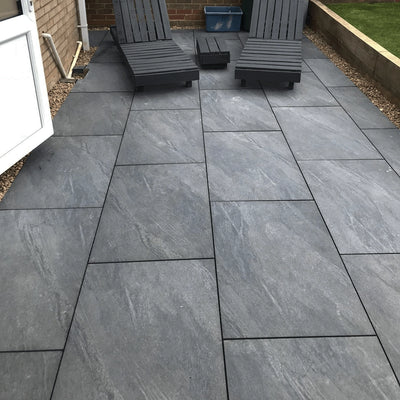
If your property is all clean lines, white render, frameless glass, and architectural precision... Raj Green probably isn't right. The rustic multi-colour palette clashes with minimalist aesthetics. You'd be better served by Kandla Grey or anthracite porcelain.
Why it fails: Minimalism requires visual restraint. Raj Green's busyness works against that.
2. Small Urban Courtyards (Under 15m²)
In very small spaces, Raj Green's colour variation can feel overwhelming—too much going on in too little space. The multi-tonal palette needs room to breathe.
Better alternative: Single-colour options like Kandla Grey or pale limestone work better in compact spaces.
3. If You Want Colour Predictability
Some people just want to know exactly what they're getting. They want slab 1 to match slab 50. They want certainty. That's not Raj Green. Natural variation means every pack is different, every slab is unique.
Better alternative: Porcelain paving (manufactured consistency) or very consistent natural stones like some granites.

Raj Green vs Kandla Grey: The Generational Shift
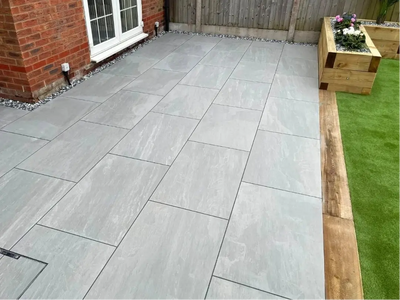
Here's something interesting that's happened over the past decade: Raj Green used to dominate UK sandstone sales completely—probably 60-70% of all Indian sandstone sold. Now? It's closer to 35-40%, with Kandla Grey taking most of that lost ground.
Why the shift?
Modern properties: New-build homes with contemporary aesthetics suit Kandla Grey's cool neutral tones better than Raj Green's warm traditional palette.
Instagram effect: Grey paving photographs beautifully, looks clean and modern in photos. Raj Green looks better in person than in photos—the subtle colour variation doesn't translate well to Instagram grids.
Perceived trendiness: Grey feels current. Multi-colour feels traditional (even if that's a perception rather than reality).
But here's what's important: Raj Green hasn't declined because it's worse. It's declined because the UK housing stock and garden design trends have shifted toward contemporary minimalism. For traditional properties and cottage gardens—which still represent millions of UK homes—Raj Green remains the better choice.
Real UK Pricing (April 2026)
Riven Raj Green:
- 900x600 single size: £22.95/m²
- Patio pack (mixed sizes): £21.58/m²
- 600x600 square: £21.81/m²
Smooth Raj Green:
- 900x600 single size: £27.89/m²
- Patio pack: £25.25/m²
Total Project Costs (25m² Patio):
Materials (Riven): £540 (patio pack) or £574 (900x600)
Professional installation: £500-700 (£20-28/m² labour)
Total installed: £1,040-1,274
Materials (Smooth): £631 (patio pack) or £697 (900x600)
Professional installation: £500-700
Total installed: £1,131-1,397
All prices include free UK mainland delivery.
Maintenance: What to Actually Expect
Raj Green requires moderate maintenance—more than porcelain, less than pale limestone.
Quarterly:
- Sweep to remove debris
- Light scrub with outdoor paving cleaner
- The multi-colour palette hides everyday dirt brilliantly
Annually:
- Pressure wash (medium pressure, 45° angle)
- Check jointing compound condition
- The varied colours mean you won't see every leaf stain or mark
Optional:
- Sealing enhances colour depth and provides stain protection
- Costs £150-250 for professional sealing (25m² patio)
- Re-seal every 2-3 years
Realistic time commitment: 2-3 hours per quarter for 25m² patio
The dirt-hiding advantage: This is where Raj Green shines. The natural colour variation means everyday marks, light staining, and weathering blend into the overall palette. Pale grey or buff stones show every leaf stain—Raj Green just absorbs them into its character.

Design Combinations That Actually Work
1. Raj Green + Kandla Grey Edging
Why it works: Provides definition without clashing. The cool grey edges frame the warm multi-colour centre, creating visual structure.
Application: Raj Green main patio, Kandla Grey cobbles or setts as borders.
2. Raj Green + Natural Timber
Why it works: Both materials age beautifully together. Weathered oak decking or sleepers complement Raj Green's earthy tones perfectly.
Application: Raised timber planters on Raj Green paving, or timber steps leading to Raj Green patio.
3. Raj Green + Traditional Brick
Why it works: Period-appropriate combination. Victorian/Edwardian-era engineering bricks match Raj Green's rustic character.
Application: Brick edging around Raj Green patios, or brick steps with Raj Green landings.
The Verdict: Is Raj Green Right for Your Garden?
Choose Raj Green if:
- ✅ You have a traditional or period property
- ✅ You appreciate natural variation and organic character
- ✅ Your garden has established planting and cottage-style aesthetics
- ✅ You want warmth in a north-facing garden
- ✅ You're creating a large patio (25m²+) where variation becomes a feature
- ✅ You want natural stone that ages beautifully
Choose something else if:
- ❌ Your property is ultra-modern minimalist
- ❌ You have a very small courtyard (under 15m²)
- ❌ You want colour predictability and uniformity
- ❌ You prioritize minimal maintenance above character
- ❌ You photograph your garden constantly for social media
Ready to see if Raj Green suits your garden?
- Order £5 sample (delivered 5-7 days)
- Phone advice: 07480 959706
- Free UK delivery on all orders
- Riven and smooth finishes in stock
Raj Green isn't trendy. It doesn't dominate Instagram. It won't win any contemporary design awards. But it does something more valuable: it looks right in traditional British gardens, feels appropriate to period properties, and develops character rather than just age. For millions of UK homes, that's exactly what matters.