






Kandla Grey Driveway Cobbles - Complete Selection Guide
Kandla Grey Driveway Cobbles: Complete Selection Guide UK
Kandla Grey sandstone cobbles have become one of the UK's most popular driveway materials over the past decade, and it's not hard to see why. The consistent cool-toned grey palette works brilliantly with modern properties, the natural stone texture provides genuine slip resistance, and unlike multi-colour alternatives, Kandla Grey creates a clean, architectural finish that doesn't compete with your property's exterior.
But if you're considering Kandla Grey cobbles for your driveway, you'll have questions. Which size works better - 100x100mm or 200x100mm? Should you choose handcut or tumbled finish? What patterns work best with contemporary properties versus period homes? And when should you consider alternatives instead?
This guide covers everything you need to know about selecting Kandla Grey driveway cobbles, from understanding what makes them different through to practical design decisions and pattern options. Whether you're a homeowner planning a driveway project or a landscaper specifying materials for a client, you'll find the practical information you need to make the right choice.
Looking for installation requirements and cost breakdowns? Read Part 2: Kandla Grey Driveway Cobbles Installation & Cost Guide.

What Makes Kandla Grey Different From Other Driveway Cobbles
Kandla Grey is an Indian sandstone from Rajasthan that's become the go-to choice for contemporary driveway projects across the UK. Unlike Raj Green (which mixes greens, browns, and greys in a multi-tonal palette) or traditional granite setts (which come in dark charcoals and blacks), Kandla Grey offers consistent cool-toned grey colouring with subtle charcoal variations.
The colour consistency is the key advantage. While Raj Green's natural variation creates beautiful traditional character, it can look busy across large driveway areas and doesn't always suit modern properties built after 1990. Kandla Grey delivers that clean, neutral palette that works with white render, grey brick, timber cladding, and contemporary architectural styles without creating visual competition.
The natural riven surface texture provides slip resistance that's essential for UK driveways - particularly on sloped approaches where smooth materials become skating rinks in winter. The stone is calibrated to 40-50mm thickness, which is the minimum depth for vehicular traffic when properly installed on the correct sub-base with full mortar bedding.
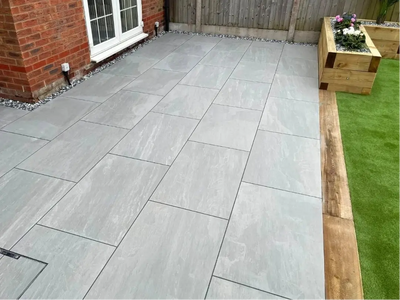
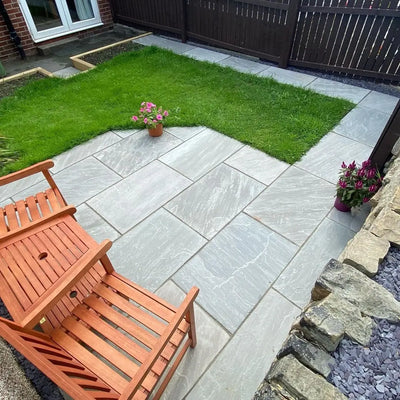
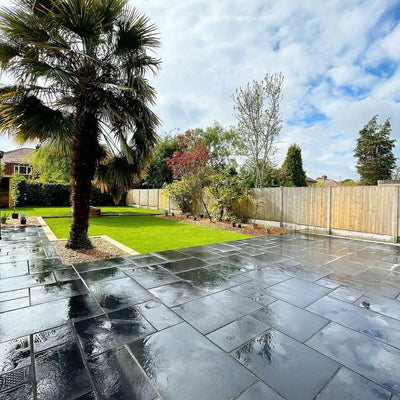
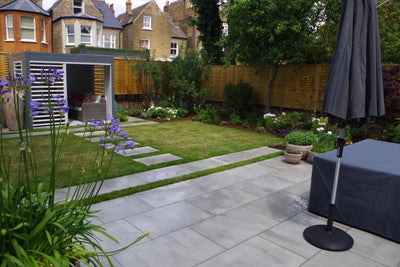
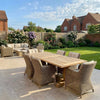
Kandla Grey works particularly well when you're extending an existing Kandla Grey patio or path. You can use the same colour family throughout your outdoor space, with large format paving (900x600mm or 600x600mm) for the main patio area and cobbles/setts for driveway surfaces or edging detail. This creates visual continuity impossible with multi-colour materials or when mixing natural stone types.
One important clarification: Kandla Grey is natural sandstone, not porcelain or concrete. This means it will weather and develop patina over time, requires sealing for driveways (to protect against oil stains and enhance colour depth), and shows natural colour variation between batches. If you need absolutely uniform grey with zero maintenance, porcelain paving is the better choice - but you'll lose the authentic texture and natural character that makes Kandla Grey cobbles so appealing for traditional driveway aesthetics.
Typical applications for Kandla Grey cobbles:
- Main driveway surfaces (residential properties)
- Driveway edging and borders
- Parking areas and turning circles
- Integration with Kandla Grey patio paving
- Contemporary front garden landscaping
The material suits modern properties (built after 1980) particularly well, but also works for period properties when you want clean, neutral character without the busyness of multi-colour traditional cobbles.
Size Options: 100x100mm Cobbles vs 200x100mm Setts for Driveways
Kandla Grey is available in two formats: 100x100mm cobbles and 200x100mm setts. For driveways, the 200x100mm sett format is the more practical choice for most projects, but understanding the differences helps you make the right decision for your specific situation.
200x100mm Kandla Grey Setts (£40/m² handcut)
The 200x100mm format is the default recommendation for driveway surfaces. You need approximately 50 pieces per square metre (with 10-12mm joints), which means a standard 30m² driveway requires around 1,500 setts across 3.5 packs. Installation is faster than the smaller format because you're laying fewer individual pieces, and the larger size creates structured linear patterns that suit contemporary driveway designs.
The 200x100mm format works brilliantly for straight runs, rectangular driveways, and modern properties where clean lines matter. You can lay them in running bond (like brickwork), herringbone pattern (for added visual interest), or basket weave (for traditional character). The format also handles vehicular turning circles better than 100x100mm because there are fewer joints to potentially shift under lateral forces when cars manoeuvre.
Most professional installers prefer working with 200x100mm for driveways because the larger format means better productivity - a skilled team can complete 12-15m² per day compared to 8-10m² with the smaller cobbles. This translates directly to lower labour costs on your project.
When to choose 200x100mm setts:
- Standard rectangular or straight driveways
- Modern properties (built after 1980)
- Projects prioritising cost-effectiveness
- Herringbone or running bond patterns
- Larger driveway areas (25m²+)
100x100mm Kandla Grey Cobbles (£43.22/m² handcut)
The 100x100mm format requires approximately 80-85 pieces per square metre, which means significantly more individual pieces to level and bed. For a 30m² driveway, you're looking at 2,400-2,550 cobbles across 7-8 packs. Installation takes longer and costs more in labour, but the smaller format excels in specific situations.
Choose 100x100mm cobbles when your driveway has curves, tight turning circles, or complex geometric patterns that would require excessive cutting with the larger format. The smaller size also works better for Victorian or Edwardian properties where authentic period cobbled character matters more than installation efficiency. Some homeowners deliberately choose 100x100mm for the busier, more textured appearance - it creates traditional cobblestone visual impact that 200x100mm setts can't match.
The 100x100mm format is also the better choice for decorative edging or defining borders between different materials. You can use 200x100mm setts for the main driveway surface, then run a double row of 100x100mm cobbles as a contrasting border or to create visual separation from adjacent paving.
When to choose 100x100mm cobbles:
- Driveways with curves or irregular shapes
- Victorian, Edwardian, or Georgian properties
- Decorative borders and edging details
- Projects wanting traditional cobblestone character
- Complex geometric or circular patterns
Quick decision guide: For most residential driveways on modern properties (built after 1980), the 200x100mm sett format delivers better value, faster installation, and more appropriate contemporary aesthetic. Choose 100x100mm cobbles only if you have curved areas, period property requirements, or deliberately want the busier traditional cobblestone appearance.

Handcut vs Tumbled Finish: Which Works Better for Driveways?
Both Kandla Grey cobbles and setts are available in handcut and tumbled finishes, and the choice is purely aesthetic - both perform identically under vehicular traffic.
Handcut Finish (£40-43/m²)
Hand-chiselled edges create crisp corners and defined joints between pieces. The top surface retains the natural riven texture (essential for slip resistance), but the sides are precisely cut with sharp edges. This creates a formal, intentional appearance with clear geometric definition. Handcut Kandla Grey looks newly laid even after installation, with distinct joints and structured character.
Most driveway projects specify handcut finish because it suits the formal nature of driveway surfaces. The sharp edges mean tighter joints (10-12mm rather than 12-15mm with tumbled), which creates a more cohesive surface with less jointing compound required. The crisp edges also make pattern-laying easier - herringbone and basket weave patterns depend on precise corners to achieve clean geometric effects.
Visual characteristics:
- Crisp, defined edges and sharp corners
- Looks newly laid and intentional
- Clean geometric patterns
- Tight 10-12mm joints
- Contemporary formal aesthetic
Best for:
- Modern properties (built after 1980)
- Contemporary architectural styles
- Driveways prioritising clean lines
- Herringbone or geometric patterns
- Projects wanting 'new installation' appearance
Handcut is the default recommendation for modern properties where the driveway should complement clean contemporary architecture. It's also easier to maintain because the sharp edges and tighter joints collect less debris than rounded tumbled edges.
Tumbled Finish (£40.55-42.77/m²)
Mechanically tumbled to soften edges and create an aged appearance with rounded corners. The cobbles look as if they've been there for decades rather than weeks, with organic worn character. Tumbled finish works brilliantly for restoration projects matching existing aged cobbles, cottage gardens wanting immediate weathered character, or deliberately rustic driveway aesthetics.
The rounded edges mean slightly wider joints (12-15mm typically) and a less formal appearance. Some homeowners love the instant patina - your driveway looks established from day one rather than obviously new. But the softer edges can make precise pattern-laying more challenging, and the wider joints require more jointing compound (adding ~£50-80 to material costs on a 30m² driveway).
Visual characteristics:
- Rounded, softened edges
- Looks aged and established immediately
- Organic, less formal appearance
- Wider 12-15mm joints
- Traditional weathered aesthetic
Best for:
- Period properties (Victorian, Edwardian, Georgian)
- Cottage and rural settings
- Restoration projects matching existing features
- Projects wanting 'aged from day one' character
- Informal rustic driveway aesthetics
Performance comparison:
Both finishes perform identically for:
- Slip resistance (both have natural riven top surface)
- Durability under vehicular traffic
- Frost resistance
- Long-term weathering
The rounded edges of tumbled cobbles don't reduce performance - they're purely aesthetic. The choice comes down to whether you prefer formal crisp character (handcut) or informal weathered character (tumbled).
Which finish for driveways? Handcut is the practical default for 90% of driveway projects. Choose tumbled only if you're deliberately pursuing aged character, matching existing period features, or want that instant weathered cottage aesthetic. The performance difference is zero - this is style over substance.

Pattern Options: Making the Most of Kandla Grey Cobbles
Pattern choice significantly affects the visual impact of your driveway. Here are the most popular patterns and when to use them.
Running Bond (Simplest)
Laid like brickwork with staggered joints - each row offset by half the cobble length. This is the fastest pattern to install, creates clean contemporary lines, and works particularly well with the 200x100mm format. Running bond emphasises the linear direction, so it's ideal for straight driveways leading to garages or entrances.
Installation time: Standard (baseline)
Visual impact: Clean, structured, contemporary
Best with: 200x100mm setts, modern properties
Difficulty: Easy
Herringbone (Classic Premium)
Cobbles laid at 90-degree or 45-degree angles creating interlocking zigzag pattern. Herringbone is the premium choice for driveways - it creates structured geometric interest and is the strongest pattern mechanically because the interlocking arrangement resists individual cobbles shifting under lateral forces.
90-degree herringbone (cobbles perpendicular to driveway edge) suits wider driveways and emphasises width. 45-degree herringbone (diagonal to edges) suits narrower driveways and creates dynamic visual movement.
Installation time: +20% longer than running bond
Visual impact: Premium, structured, geometric interest
Best with: 200x100mm setts, all property styles
Difficulty: Moderate (requires cutting at edges)
Herringbone takes longer to install because every edge requires cut pieces to maintain the pattern, but the visual impact justifies the extra cost for premium projects.
Basket Weave (Traditional)
Pairs of cobbles laid at right angles creating woven square pattern. This delivers traditional character with moderate complexity - easier than herringbone but more interesting than running bond. Basket weave works with both 100x100mm and 200x100mm formats and creates a more relaxed, informal aesthetic than herringbone.
Installation time: +10% longer than running bond
Visual impact: Traditional, woven texture, informal
Best with: Both sizes, period properties
Difficulty: Moderate
Stretcher Bond (Linear Contemporary)
All cobbles laid in same orientation with continuous straight joints. This is the most contemporary pattern - clean parallel lines creating strong directional emphasis. Works brilliantly for modern architecture but looks too formal for traditional properties.
Installation time: Standard
Visual impact: Ultra-contemporary, strong linear emphasis
Best with: 200x100mm setts, ultra-modern properties
Difficulty: Easy
Random Layout (Traditional Cobblestone)
No formal pattern - each cobble placed with varied orientation creating organic appearance. This is the most traditional approach and works best with 100x100mm format to create authentic historical cobblestone character. Takes the most installation time because there's no repetitive pattern - each cobble requires individual placement decisions.
Installation time: +30% longer than running bond
Visual impact: Rustic, traditional, organic
Best with: 100x100mm cobbles, period properties
Difficulty: High (no pattern repetition, constant decisions)
Pattern selection guide:
Modern property (built after 1990):
→ Running bond or 90-degree herringbone with 200x100mm handcut setts
Period property (Victorian/Edwardian):
→ Basket weave or 45-degree herringbone with 200x100mm handcut OR random layout with 100x100mm tumbled cobbles
Contemporary architectural:
→ Stretcher bond or running bond with 200x100mm handcut setts
Cottage/rural:
→ Random layout with 100x100mm tumbled cobbles OR basket weave with 200x100mm tumbled setts
Combining Kandla Grey Cobbles with Other Materials
Kandla Grey Paving Borders
Use 900x600mm or 600x600mm Kandla Grey paving slabs as driveway borders with cobbles as the main surface. This creates visual separation, defines edges clearly, and adds premium detail. The larger format slabs contrast beautifully with the textured cobble surface while maintaining colour continuity.
Installation: Lay paving slab borders first (on full mortar bed), then infill with cobbles. The border acts as edge restraint and creates clean definition between driveway and garden/lawn areas.
Contrasting Colour Edging
Run a double row of Raj Green cobbles as border with Kandla Grey cobbles as the main surface. The warm multi-colour Raj Green creates striking contrast against cool grey, defining edges beautifully. This works particularly well for period properties where single-colour driveways might look too modern.
Installation: Typically 200mm wide border (two rows of 100x100mm cobbles) around entire driveway perimeter.
Mixed Format Detail
Use 200x100mm setts for the main driveway surface, then switch to 100x100mm cobbles for curves, circular features, or decorative panel inserts. This combines the installation efficiency of larger setts with the flexibility and texture of smaller cobbles where it matters visually.
Example: Straight main driveway in 200x100mm herringbone, circular feature at entrance in 100x100mm random layout.
Integration with Patio Paving
When your driveway connects to a Kandla Grey patio, use the same colour family throughout but vary the format for visual interest and functional appropriateness. Large format smooth paving (900x600mm sawn & honed) for patio seating areas, cobbles for driveway surfaces.
This creates cohesive design while respecting the different functional requirements of each area.
When Kandla Grey Cobbles Aren't the Right Choice
1. Modern Minimal Aesthetic
If you're after ultra-clean contemporary styling with perfectly straight joints and no texture variation, porcelain paving delivers better uniformity. Kandla Grey is natural stone with inherent colour and texture variation - that's part of its character, but it won't achieve the precision look of porcelain.
Alternative: Consider Kandla Grey-effect porcelain cobbles for zero maintenance and perfect uniformity.
2. Zero-Maintenance Requirement
Natural stone requires periodic sealing (3-5 years) and more maintenance than porcelain or resin-bound surfaces. If you want a driveway you can genuinely ignore for 10+ years, porcelain or resin are better choices.
Alternative: Porcelain paving or resin-bound surfaces require minimal maintenance.
3. Heavy Commercial Use
Residential driveways with normal car traffic are fine. Delivery lorries, commercial vehicles, or frequent heavy traffic may exceed what 40-50mm sandstone cobbles can handle long-term, especially on sloped surfaces.
Alternative: Consider granite setts (60-80mm thick) for heavy-duty applications.
4. Very Steep Driveways
Maximum recommended slope for cobbles is 1:10 (10% gradient). Steeper slopes create lateral forces during braking that can shift individual cobbles even with full mortar bedding.
Alternative: Consider alternative materials or redesign the gradient with stepped sections.
5. Tight Timelines
Installation takes 5-7 days plus 7-day cure time before vehicular use. If you need the driveway usable in 2-3 days, cobbles aren't suitable.
Alternative: Resin-bound surfaces cure faster, or some block paving systems allow earlier use.
6. Specific Colour Matching
Kandla Grey is natural stone - colour varies between batches and quarries. If you need exact colour match to existing materials, porcelain offers better batch consistency.
Alternative: Order all materials from single batch, or choose porcelain for guaranteed colour consistency.
Design Approach: Modern vs Traditional Styling
Modern Contemporary Approach:
- 200x100mm handcut setts
- Running bond or 90-degree herringbone pattern
- Straight clean edges
- Minimal or no borders
- Integrated with Kandla Grey smooth paving throughout garden
- Tight 10mm joints with grey resin jointing compound
- Clean architectural aesthetic
Example: Modern suburban house (built 2010s) with white render, grey windows, minimal landscaping. Straight driveway in 200x100mm handcut herringbone leading to integrated double garage.
Traditional Period Approach:
- 200x100mm tumbled setts OR 100x100mm tumbled cobbles
- Basket weave or random pattern
- Curved edges where appropriate
- Contrasting Raj Green borders
- Deliberately rustic character matching period property
- 12-15mm wider joints
- Aged weathered aesthetic
Example: Victorian terrace with red brick exterior, traditional front garden. Curved driveway in 100x100mm tumbled random layout with Raj Green double border.
Transitional Approach (works for both):
- 200x100mm handcut setts
- 45-degree herringbone pattern
- Defined edges with Kandla Grey paving border
- Clean but with visual interest
- Suits properties built 1980-2010
This approach bridges contemporary and traditional - structured enough for modern sensibility, pattern interest for character.
Ready to Choose? Here's Your Decision Framework
Step 1: Property Style
→ Modern (post-1990): 200x100mm handcut
→ Period (pre-1950): 100x100mm tumbled OR 200x100mm tumbled
→ Transitional (1950-1990): 200x100mm handcut
Step 2: Driveway Shape
→ Straight rectangular: 200x100mm, any pattern
→ Curves or irregular: 100x100mm recommended
→ Large area (40m²+): 200x100mm for efficiency
Step 3: Pattern Preference
→ Contemporary clean: Running bond or stretcher bond
→ Premium structured: Herringbone (90° or 45°)
→ Traditional character: Basket weave or random layout
Step 4: Budget Consideration
→ Cost-conscious: 200x100mm handcut, running bond pattern
→ Premium project: 200x100mm handcut, herringbone pattern
→ Character-driven: 100x100mm format (higher cost but authentic)
Step 5: Aesthetic Priority
→ 'New installation' look: Handcut finish
→ 'Aged from day one': Tumbled finish
Next steps:
- Order £5 samples - see actual Kandla Grey colour in your driveway location before committing to full order
- Measure your area - calculate square meterage for quantity requirements
- Choose pattern - decide which layout suits your property style
- Read Part 2 - understand installation requirements and full cost breakdown
Get Expert Selection Advice
Not sure which size, finish, or pattern works best for your specific property? Call 07480 959706 to speak with our team. We can advise on:
- Format selection for your driveway shape and style
- Pattern recommendations for your property type
- Finish choice (handcut vs tumbled) based on aesthetic goals
- Combining cobbles with other materials
- Quantity calculations including wastage allowance
Order £5 samples to see Kandla Grey colour and texture in your actual driveway location before committing to full packs - natural stone appears different in morning vs afternoon light and against different property colours.
Ready for installation details and cost breakdown? Continue to Part 2: Kandla Grey Driveway Cobbles Installation & Cost Guide.