






Granite vs Sandstone Setts — Which Is Better for Your Project?
Granite and sandstone are the two most popular natural stone materials for setts and cobbles in the UK. Both work outdoors, both look good, and both last considerably longer than concrete block paving. But they're different materials with different strengths — and the right choice depends entirely on where you're using them and what you need them to do.
This is a straightforward comparison based on how these materials actually perform in UK conditions.
The Quick Answer
Choose granite setts if your project involves vehicle traffic, heavy loading, or areas where stain resistance matters — driveways, parking areas, and commercial entrances. Choose sandstone setts if you want warmer colour options, natural character that develops with age, and you're working on garden paths, patio edging, or traditional cottage-style landscaping where vehicle loading isn't a factor.
Full Comparison
| Feature | Granite Setts | Sandstone Setts |
|---|---|---|
| Hardness | 6–7 Mohs — extremely hard | 5–6 Mohs — hard but softer than granite |
| Weight per m² (50mm thick) | ~120–130 kg | ~100–110 kg |
| Water absorption | Below 0.4% — virtually non-porous | 1–5% — low but absorbs some moisture |
| Frost resistance | Excellent — unaffected by freeze-thaw | Good — calibrated Indian sandstone handles UK frost well |
| Stain resistance | Excellent — oil, fuel, food barely penetrate | Moderate — porous surface can absorb stains if not cleaned quickly |
| Colour range | Limited: silver grey, black, pink, yellow | Wide: Kandla Grey, Raj Green, Fossil Mint, Rippon Buff, Autumn Brown |
| Colour change over time | Minimal — granite holds its colour for decades | Develops natural patina — colours deepen and mellow with age |
| Surface texture | Uniform mineral sparkle, consistent grain | Natural variation between pieces — riven, layered texture |
| Driveway suitability | Excellent — handles heavy vehicles | Suitable for standard cars only |
| Supply cost (per m², inc VAT) | From £55.45 at Universal Paving | From £43.22 at Universal Paving |
| Lifespan | 50+ years | 20–30+ years |
| Maintenance | Occasional jet wash — that's it | Occasional jet wash + algae may grow in shaded areas |
Durability and Strength
This is where granite pulls clearly ahead. Granite is an igneous rock — formed from cooled magma — which makes it one of the densest natural stones available. It doesn't absorb water, so freeze-thaw cycles have virtually no effect on it. Granite setts that were laid in Victorian streets 150 years ago are still in service today.
Sandstone is a sedimentary rock — formed from compressed sand grains. It's hard, but it has a layered structure and higher porosity than granite. In practical terms, this means sandstone setts can be affected by repeated freeze-thaw cycles over many years, particularly if water sits in the joints. Properly laid Indian sandstone setts will last 20–30 years in UK conditions, which is excellent — but it's not the 50+ year guarantee you get with granite.
For driveways specifically, granite is the better choice. The repeated point-loading from vehicle tyres puts more stress on setts than foot traffic, and granite's superior compressive strength handles this without degradation. Sandstone setts can be used on driveways with light vehicle traffic, but they're not ideal for heavy or frequent use.
Appearance and Character
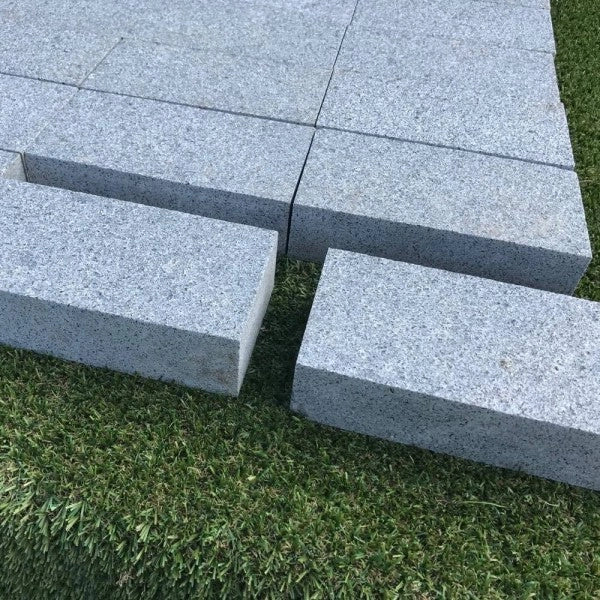
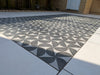
This is where sandstone wins. Granite is beautiful in a precise, architectural way — the silver-grey mineral flecks catch the light and create a clean, contemporary look. But the colour palette is limited. Silver grey accounts for the vast majority of UK granite setts sales, with black, pink, and yellow making up a small niche.
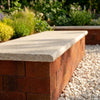
Sandstone offers a completely different aesthetic. Kandla Grey gives you cool, contemporary tones that work in modern settings. Raj Green provides a warm, multi-tonal palette of greens, browns, and greys. Fossil Mint offers creamy, warm tones for traditional gardens. Each piece is slightly different in colour and texture, which creates natural variation across the laid surface — something granite can't replicate.
Sandstone also ages beautifully. Over time, the colours deepen and the stone develops a natural patina that many homeowners actually prefer to the fresh-from-the-pallet look. Granite, by contrast, looks essentially the same after 20 years as it does on day one. Whether that's a positive or negative depends on your preference.
Price
The supply cost is closer than most people expect, though granite does carry a premium. At Universal Paving, sandstone setts start from £43.22/m² and granite cobbles from £55.45/m² (both inc VAT). The gap is around £12 per square metre — meaningful on a large driveway, but not dramatic on a smaller edging or path project.
The bigger cost difference is in installation. Granite setts are heavier and denser, which makes them slightly more labour-intensive to cut and lay. On a typical driveway project, you might pay 10–15% more for labour on granite compared to sandstone.
On a cost-per-year-of-life basis, granite works out cheaper because of its longer lifespan. But if your budget is fixed and you need to cover a larger area, sandstone gives you significantly more square metres for the same spend — roughly 30% more coverage per pound.
When to Use Granite Setts
When to Use Sandstone Setts
Can You Mix Granite and Sandstone Setts?
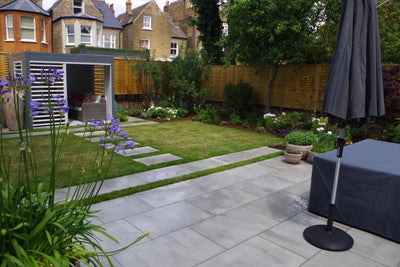
Yes — and it can look excellent when done deliberately. A common combination is a Kandla Grey sandstone patio with granite sett edging, which creates a clean, durable border around softer paving. Or granite setts for the driveway transitioning into sandstone setts for the garden path, with the material change marking the boundary between vehicle and pedestrian zones.
The key is making the material change look intentional. Match the tone family (grey granite with Kandla Grey sandstone, not grey granite with Raj Green sandstone) and use the transition at a natural boundary — a step, a planting strip, or a change in level.
Our Range
We stock both granite and sandstone setts, along with porcelain setts for a contemporary alternative. Browse the full range:
Granite setts — silver grey flamed from £55.45/m², black handcut from £61/m²
Sandstone setts — Kandla Grey and Raj Green from £43.22/m²
Porcelain setts — anthracite black, £0.64/piece
All available with free UK delivery from our Nottingham warehouse. Order samples to compare the materials side by side before committing to your project.