





Why Does Grey Porcelain Paving Look Different When Wet? (UK Weather Guide)
Right, let's address the question that catches everyone off guard about three days after their new grey porcelain patio is installed: "Why does it look completely different when it's wet?"
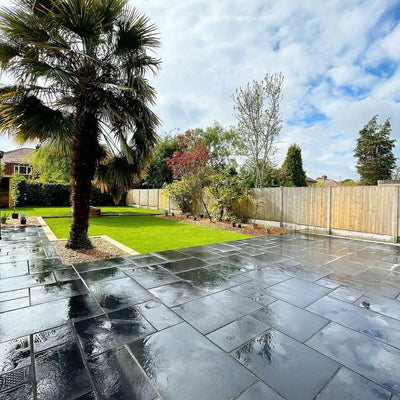
You've spent weeks choosing the perfect shade of grey porcelain—maybe Kandla Grey for that subtle blue-grey tone, or Smoke Grey for something darker. The sample looked brilliant. The dry patio looks exactly as expected. Then it rains, and suddenly your carefully chosen light grey paving turns two shades darker and stays that way for hours.
Is this normal? Is it permanent? Will it always look like this? And most importantly—should you have chosen a different colour?
Let me explain what's actually happening, which grey porcelains change most dramatically, and what you can realistically expect living with grey paving in Britain's famously damp climate.

The Science: Why Porcelain Changes Colour When Wet
Here's what's happening at a microscopic level. Porcelain, despite being incredibly dense and non-porous compared to natural stone, still has a textured surface. When water sits on that surface, it fills in the tiny peaks and valleys of the texture, creating a smoother, more reflective surface.
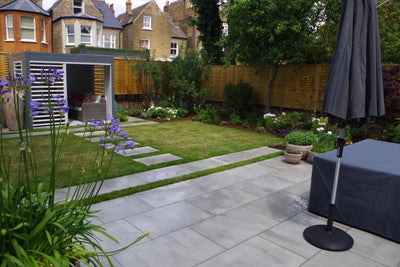
Dry porcelain: Light hits the textured surface, bounces in multiple directions, appears lighter and more matte.
Wet porcelain: Water creates a smooth film, light reflects more uniformly, appears darker and slightly glossier.
It's the same phenomenon that makes dry sand look pale yellow but wet sand look dark brown. The material hasn't changed—the way light interacts with the surface has changed.
With grey porcelain specifically, this effect is particularly noticeable because grey sits in the middle of the colour spectrum. Light greys can shift two full shades darker when wet. Dark greys become almost black. Mid-tone greys can look muddy or inconsistent depending on how wet different areas are.

How Much Darker? Real UK Product Examples
Let's get specific with actual grey porcelain products from Universal Paving and how much they change when wet.
Kandla Grey Porcelain (900x600mm, £19.09/m²)
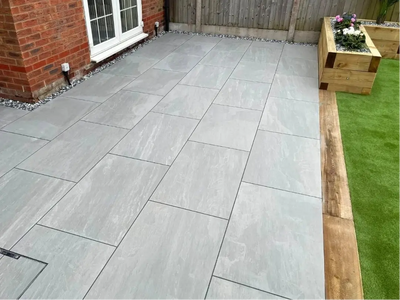
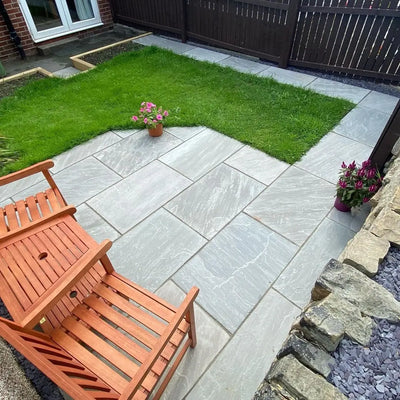
Dry appearance: Soft blue-grey with subtle warm buff undertones. Reads as a light-medium grey.
Wet appearance: Shifts to a much cooler, darker slate grey. The blue undertones become more pronounced, warm buff tones disappear almost completely.
Darkness shift: Approximately 30-40% darker when fully wet.
Recovery time: Dries reasonably quickly (2-3 hours in decent weather) because the textured finish doesn't hold water in puddles.
Verdict: One of the more dramatic shifters. If you loved the light, warm grey when dry, the wet version will surprise you. It's not bad—just noticeably different.
Anthracite Grey Porcelain (900x600mm, £19.09/m²)
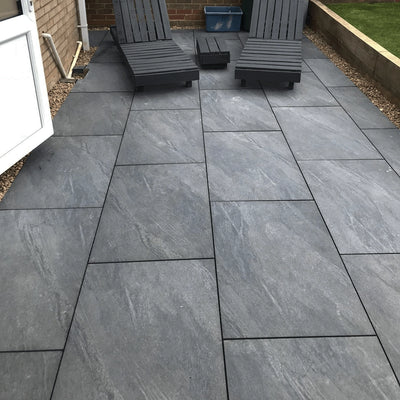
Dry appearance: Dark charcoal grey with subtle variation.
Wet appearance: Deepens to almost black, loses the charcoal variation, reads as very uniform dark.
Darkness shift: Approximately 25% darker (less dramatic because it's already dark).
Recovery time: Takes longer to dry (3-4 hours) because darker surfaces show moisture longer even after most water has evaporated.
Verdict: Wet version looks intentionally dramatic rather than "wrong." If you wanted dark grey, wet Anthracite delivers properly moody outdoor spaces.
County Light Grey Porcelain (900x600mm, £19.09/m²)
Dry appearance: Pale, clean light grey—almost approaching white-grey territory.
Wet appearance: Transforms to medium grey, loses the fresh pale tone completely.
Darkness shift: Approximately 40-50% darker when wet (the most dramatic shift of the standard greys).
Recovery time: Shows drying patches badly—goes blotchy as some areas dry faster than others.
Verdict: Biggest visual shock factor. People who chose this specifically for the pale, bright tone often feel genuinely disappointed the first time it rains.
Smoke Grey Porcelain (900x600mm, £19.09/m²)
Dry appearance: Medium grey with subtle darker veining.
Wet appearance: Darkens to deep charcoal, veining becomes less visible.
Darkness shift: Approximately 30% darker.
Recovery time: Mid-range (2-3 hours), dries fairly evenly without obvious blotchiness.
Verdict: Sits in the sweet spot—wet version still looks intentional rather than "wrong," and the shift isn't shocking.
Everest Pearl Porcelain (900x600mm, £19.09/m²)
Dry appearance: Very pale grey-white with subtle warm undertones.
Wet appearance: Shifts to a cool, darker off-white grey.
Darkness shift: Approximately 35-40% darker, also loses warmth dramatically.
Recovery time: Quick to dry but shows uneven drying badly—creates patchy appearance.
Verdict: If you wanted pale and bright specifically, wet Everest Pearl can feel like a different material entirely.

UK Weather Reality: How Often Will It Be Wet?
Let's be honest about British weather and what "wet paving" actually means in practice.
Heavy rain: Patio looks properly soaked, uniformly dark, stays wet for 2-4 hours after rain stops. Happens 10-15 days per month October-March, 5-10 days per month April-September.
Light rain/drizzle: Patio gets damp but not soaked, creates patchy appearance as some areas dry faster. Happens constantly in UK climate—adds another 5-10 days per month where paving looks "off."
Morning dew: Patio looks wet first thing, dries by mid-morning. Happens nearly every day April-October in most of UK, especially in gardens with poor air circulation.
After cleaning: Patio stays wet-looking for 2-4 hours depending on weather. You'll see this whenever you hose it down or pressure wash.
After frost/snow melt: Patio can look wet/dark for extended periods as frozen moisture slowly evaporates. Common December-February.
So realistically? Your grey porcelain patio will be in its "wet" colour state roughly 30-40% of the time in a typical UK year. Maybe 50% if you're in Scotland, Wales, or northern England. Maybe 25% if you're in the southeast with good drainage and full sun.
This isn't a fault—it's just physics meeting British weather.
Does Sealing Stop the Colour Change?
Short answer: No.
Porcelain manufacturers and most installers will tell you not to seal porcelain paving. It's already extremely low-porosity (<0.5% water absorption), so sealing doesn't add meaningful protection. More importantly, sealing can:
Create a permanent wet look: Some sealers give porcelain a glossy finish that makes it look perpetually damp even when bone dry. Defeats the purpose if you're trying to avoid the wet appearance.
Trap moisture: Porcelain breathes very slightly. Sealing can trap tiny amounts of moisture underneath, potentially causing long-term issues.
Void warranties: Many porcelain manufacturers specifically say sealing voids the warranty because it changes the surface properties.
Change slip resistance: Sealed porcelain can become more slippery when wet, which is dangerous for outdoor areas.
I've seen people seal grey porcelain thinking it'll reduce the colour shift. What actually happens is they get a slightly glossy grey that still darkens when wet but now also looks artificially shiny. Not an improvement.
The exception: If you deliberately want a "wet look" finish permanently, colour-enhancing sealers exist. But that's a specific design choice, not a solution to the colour-change issue.
Pattern Matters: Why Some Areas Look Wetter Longer
Here's something that catches people off guard: not all areas of your grey porcelain patio will dry at the same rate, which creates a patchy, uneven appearance that can last for hours.
Low spots: Even with proper fall/drainage, tiny low spots (1-2mm difference) hold water longer. These stay dark whilst surrounding areas dry.
Shaded areas: Under pergolas, near walls, beneath furniture—anywhere that doesn't get direct sun or air movement stays wet-looking significantly longer.
Joint lines: Grouted joints often stay darker longer than the paving itself because grout is more porous. Creates a grid pattern of dark lines across drying paving.
Traffic patterns: Areas you walk on frequently can develop slightly smoother surfaces over time, which hold moisture films differently than less-trafficked areas.
This patchiness is often more visually annoying than the uniform wet appearance. A completely wet patio looks intentional. A patio that's 70% dry with random wet patches looks messy and unfinished.
Light greys (County Light Grey, Everest Pearl) show this patchiness worst because the contrast between wet and dry is most dramatic. Mid-tone greys (Kandla Grey, Smoke Grey) handle it better. Dark greys (Anthracite) hide it reasonably well.
Does Textured vs Smooth Finish Make a Difference?
Yes, significantly.
Textured/riven finish grey porcelain:
- Holds water in tiny surface grooves longer
- Takes 30-50% longer to dry completely
- Shows uneven drying more obviously (wet patches vs dry patches)
- Colour shift slightly more dramatic because texture creates more light scatter difference
Smooth finish grey porcelain:
- Water sheets off more easily
- Dries faster (maybe 30-40% quicker)
- Shows colour shift but dries more uniformly
- Wet appearance often looks more intentional/designed
Example: Kandla Grey Smooth Porcelain (£19.09/m²) dries noticeably faster than standard textured Kandla Grey, with less patchy appearance during the drying process.
If you live somewhere with heavy rainfall and poor sun exposure, smooth finish grey porcelain will spend less time looking wet than textured versions. Worth considering.
The "Morning Dew Problem" Nobody Mentions
Here's an issue that doesn't show up until you've lived with grey porcelain through a full UK spring/summer: morning dew.
From April through October, grey porcelain patios in most UK gardens wake up looking wet nearly every morning. Not soaking wet—just damp enough to darken the colour and create that patchy appearance.
Why it happens: Porcelain cools overnight, moisture in the air condenses on the cold surface, sits there until sun/warmth evaporates it.
How long it lasts: Usually clears by 9-11am depending on sun exposure and air temperature.
Which greys show it worst: Light greys (County Light Grey, Everest Pearl) look dramatically darker with morning dew. Dark greys barely show it.
Practical impact: If you use your garden primarily in mornings (breakfast outside, morning coffee), your carefully chosen light grey patio will rarely look the colour you selected. It'll be in its "wet grey" state most of the time you actually see it.
This is why I always suggest people with north-facing or heavily shaded gardens think very carefully before choosing pale grey porcelain. You might genuinely never see it at its dry colour during the months you're actually using the garden.
Real UK Example: Dave in Manchester
Dave installed County Light Grey porcelain (900x600mm) in his back garden in Didsbury, Manchester. Specifically chose the palest grey available because he wanted a bright, light-reflecting patio to make his small garden feel larger.
What he didn't anticipate: Manchester gets approximately 150 wet days per year. His garden is partially shaded by neighbouring trees. The patio faces northeast.
The reality: From October through March, his patio is in its "wet dark grey" state roughly 70% of the time. Morning dew keeps it dark until late morning most days April-September. On the occasional fully sunny, dry afternoon, it looks brilliant—exactly the pale grey he wanted.
But actual usage time in that ideal dry state? Maybe 20-25% of the year.
Would he choose differently? Absolutely. He'd have gone with Smoke Grey or Kandla Grey—mid-tone greys where the wet/dry difference is less jarring and the wet state still looks intentional rather than "wrong."
His advice: "Don't choose grey porcelain based solely on how it looks dry in the showroom on a sunny day. Ask to see it wet. Better yet, pour a bucket of water on the sample and leave it for an hour to see how it dries."
Which Grey Porcelain Handles Wet Best?
Based on colour shift, drying time, and how intentional the wet appearance looks:
Best performers (least dramatic wet change):
- Smoke Grey Porcelain - Mid-tone that darkens gracefully, wet version still looks designed
- Anthracite Grey Porcelain - Already dark, wet version reads as "dramatic" not "wrong"
- Kandla Grey Smooth Porcelain - Faster drying, warm tones help wet version look less stark
Moderate performers:
- Standard Kandla Grey Porcelain - Noticeable shift but both dry and wet look good
- Hammerstone Grey Porcelain - Mid-tone with texture that handles transitions reasonably
Challenging performers (most dramatic change):
- County Light Grey Porcelain - Massive colour shift, shows patchiness badly
- Everest Pearl Porcelain - Goes from pale warm to cool medium grey, loses character when wet
This doesn't mean the "challenging" ones are bad products. They're brilliant porcelain. Just be aware what you're signing up for in a wet climate.
Should You Choose Differently Because of This?
Depends entirely on your specific situation.
Choose darker greys (Anthracite, Smoke Grey) if:
- Your garden is heavily shaded or north-facing
- You live in high-rainfall areas (Scotland, Wales, northern England, Lake District)
- Your patio has poor drainage or low spots
- You use your garden primarily in mornings (dew issue)
- Visual consistency matters more than having the palest possible tone
Light greys (County Light, Everest Pearl) work if:
- Your patio gets excellent sun exposure most of the day
- You're in relatively dry southeast England with good drainage
- You mainly use your garden on dry, sunny days
- You're okay with significant wet/dry colour variation
- The specific pale tone when dry is essential to your design
Mid-greys (Kandla, Hammerstone) suit most UK gardens:
- Reasonable wet/dry variation that doesn't shock
- Both states look intentional and designed
- Handle British weather transitions gracefully
- Work with various garden aspects and rainfall zones
The "Live Sample" Recommendation
Here's what I genuinely recommend before committing to any grey porcelain, especially if you're considering light greys:
Order samples from Universal Paving. They deliver within 5-7 working days and you can get samples of multiple grey shades.
Then actually test them in your garden conditions:
- Place samples where the patio will be (same sun exposure, drainage, shade)
- Leave them for a full week minimum
- Check them at different times of day (morning dew, midday dry, evening after watering)
- Pour water on them and watch how they dry—does it dry evenly or patchy?
- Note which grey you actually see most often based on your garden's microclimate
The grey you love bone dry in full sun might not be the grey you actually live with 70% of the time.
Contact Universal Paving:
- Phone: 07480 959706
- Samples available (small charge, delivered 5-7 working days)
- Free UK delivery on full orders
The Bottom Line
Yes, grey porcelain paving looks different when wet. Sometimes dramatically different. This isn't a defect—it's basic physics.
Light greys can shift 40-50% darker when wet. Dark greys shift less but stay dark longer. Mid-tone greys handle the transition most gracefully.
In UK climate, your grey patio will be wet or damp 30-50% of the time depending on location and weather patterns. That wet colour is as much "your patio" as the dry colour is.
Choose your grey shade based on how it looks wet as much as how it looks dry. Better yet, assume you'll see the wet version more often and make sure you're happy with that colour state.
And if someone tells you sealing will fix it? They're wrong. Sealing porcelain creates different problems without solving the colour-shift issue.
The good news? Once you adjust expectations and choose appropriately for your specific garden conditions, grey porcelain paving is brilliant. Low maintenance, durable, looks fantastic in both wet and dry states—provided you picked the right shade of grey to begin with.