





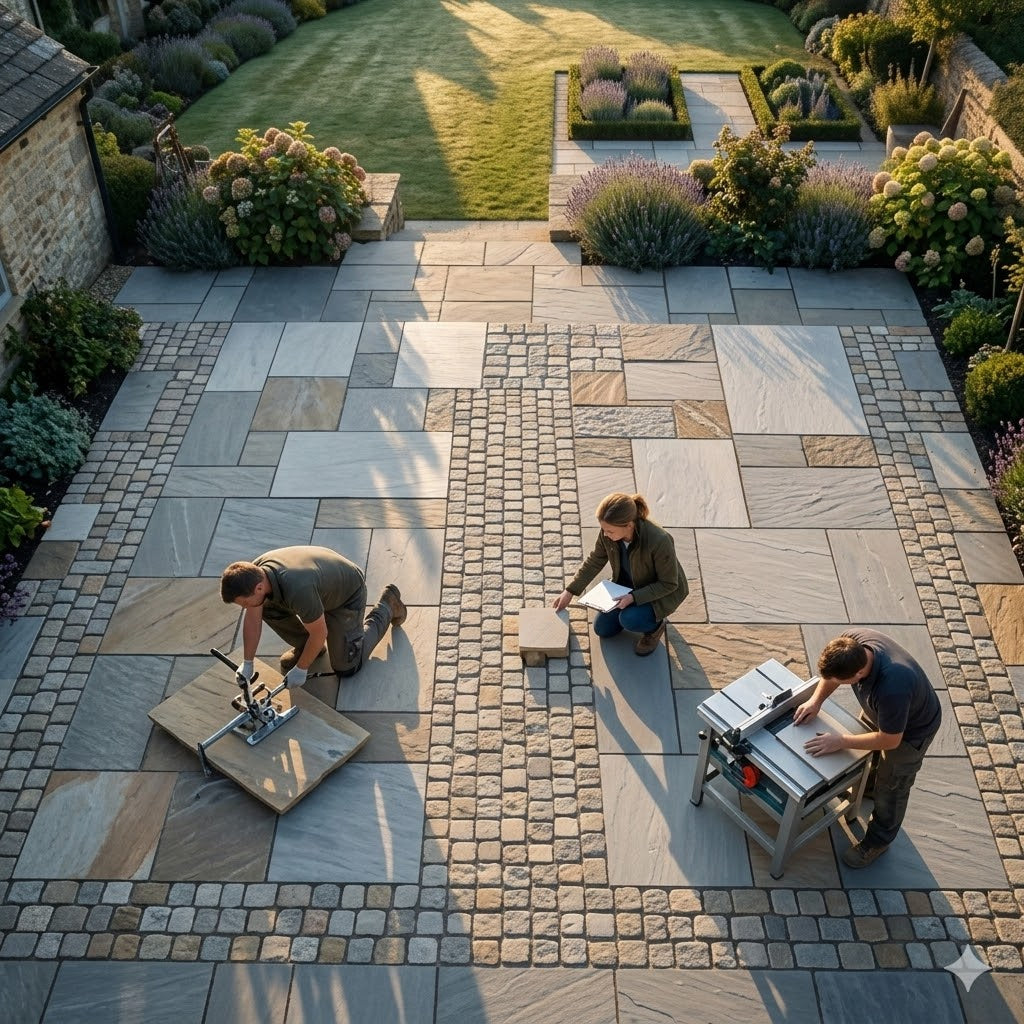
Mixing Porcelain Paving with Natural Stone: Does It Work? (UK Design Guide)
Right, here's a question I get asked constantly: "Can I mix porcelain with sandstone?" And the honest answer is—it depends entirely on how you do it. Done well, mixing materials creates proper depth and character in your garden. Done badly, it looks like you ran out of money halfway through the project.
I've seen both. The brilliant combinations that make you stop and think "that's clever," and the absolute disasters that scream "DIY gone wrong." Let's talk about when mixing porcelain paving with natural stone actually works, and when it's a terrible idea.

Why Mix Materials in the First Place?
People mix porcelain and sandstone for three main reasons, and honestly, they're all valid.
Cost management. Porcelain for the main patio area (lower maintenance, harder wearing) with sandstone setts or cobbles for borders keeps the budget sensible. You're putting the premium material where it matters most—the high-traffic zone—and using natural stone for visual interest where it won't get hammered.
Design flexibility. Sometimes a single material feels flat. Adding contrasting borders, pathways, or feature areas creates visual breaks that make gardens feel larger and more considered. It's the difference between a car park and an actual outdoor room.
Practical zoning. Main entertaining area in porcelain (easy to clean, furniture sits level), pathways in sandstone (character and grip), maybe cobbles around planters for drainage. Each material doing what it does best.
When Mixing Materials Works Brilliantly
1. Porcelain Patio with Sandstone Setts Border
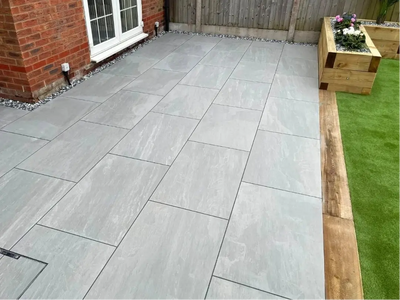
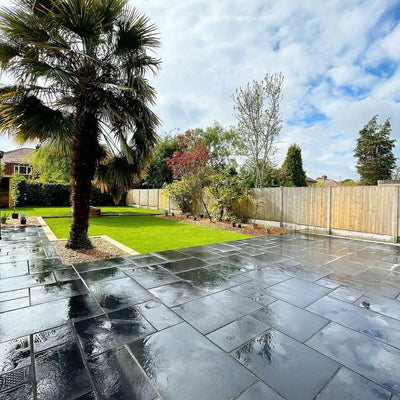
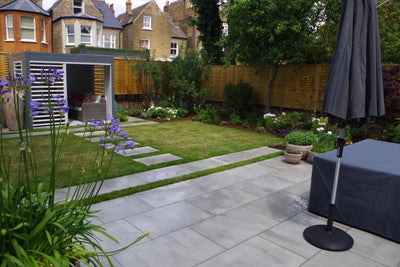
This is the classic combination and it works because the scale difference creates natural definition. Your main patio in Kandla Grey porcelain 900x600mm (£19.09/m² at Universal Paving right now) bordered with Kandla Grey or Raj Green sandstone setts 200x100mm.
The porcelain gives you that clean, modern surface—brilliant for furniture, minimal grout lines, easy cleaning. Then the smaller-format setts create a textured frame that defines the patio edge without looking like you've just stuck a random strip around it.
Why it works: The materials complement rather than compete. Porcelain = function, setts = detail. The colour match (Kandla Grey porcelain with Kandla Grey setts) keeps it cohesive whilst the format change adds interest.
Cost reality: For a 20m² patio with 2m perimeter sett border:
- Kandla Grey porcelain 900x600: 20m² = £382 inc. VAT
- Kandla Grey setts border (4m²): £160 inc. VAT
- Total materials: around £542
Compare that to all porcelain (£420 for 22m² pack) or all premium sandstone patio packs (£24-28/m²). You're adding visual interest for reasonable money.
2. Porcelain Main Area with Sandstone Pathway
Works particularly well in L-shaped gardens or where you're connecting patio to shed/summer house. Main patio in porcelain for entertaining, then a sandstone pathway leading through the garden.
The format stays consistent—both 900x600mm—but the material change signals transition from "outdoor room" to "garden journey." Proper landscaping psychology without overthinking it.
Installation tip: Use the same bed depth and installation method for both. Don't switch from concrete bed (porcelain) to sand bed (sandstone) mid-project or you'll get differential settlement and wonky pathways within six months.
3. Contrasting Colour Borders
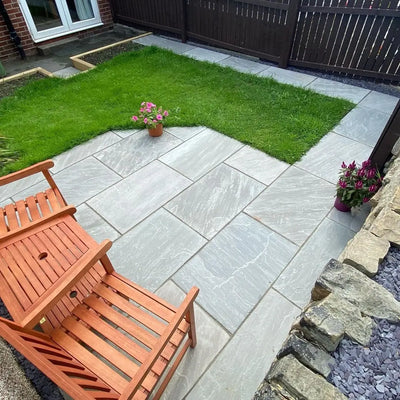
Raj Green sandstone setts framing anthracite black porcelain? Brilliant. The warm, multicolour tones of Raj against the clean dark porcelain creates restaurant-level outdoor spaces. I've seen this in Manchester beer gardens and it absolutely delivers.
Or Kandla Grey porcelain with Rippon Buff sandstone plank borders—the soft buff tones warm up the cooler grey without looking matchy-matchy boring.
The rule: One material provides the neutral base, the other adds the colour accent. Never mix two busy, multicolour materials unless you want your patio looking like a crazy paving tribute act.
When Mixing Materials Looks Terrible
1. Random Patchwork "We Ran Out" Aesthetic
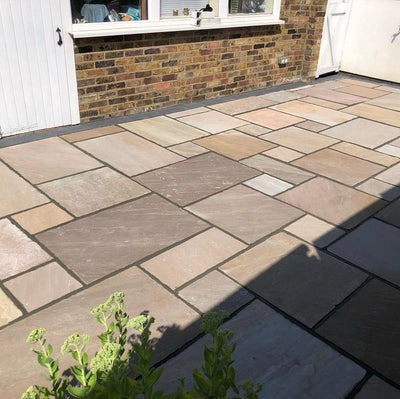
Porcelain here, bit of sandstone there, back to porcelain—no clear pattern or purpose. Looks like you bought two different materials on sale and just laid whatever came off the pallet first.
If you're mixing, there needs to be intentional design logic: borders, pathways, defined zones. Not "we got 15m² of porcelain but needed 25m² so chucked in some sandstone to finish."
2. Mismatched Scale Chaos
900x600mm porcelain mixed randomly with 600x600mm sandstone mixed with 100x100mm cobbles all in the same 20m² space. Too many formats creates visual noise. Your eye doesn't know where to settle.
The fix: Maximum two formats in one area. Large-format paving (900x600mm) paired with smaller setts/cobbles for borders works. Three or more different sizes? You're making a mess.
3. Clashing Colours That Fight Each Other
Warm Raj Green sandstone (greens, browns, plums) butted directly against cool Anthracite Black porcelain with no transition element? Jarring. The materials are screaming at each other rather than working together.
What works instead: Neutral-to-neutral (Kandla Grey porcelain with Kandla Grey sandstone), or neutral-base with warm-accent (black porcelain main area, Raj Green sett border with a black sett transitional row).
4. Different Finishes Creating Trip Hazards
20mm porcelain laid flush against 22mm riven sandstone with no thought to the step-change between surfaces. One material smooth and level, the other naturally uneven—you've created a trip hazard and highlighted the awkward join.
Installation reality: If mixing finishes, use trim pieces, step changes, or deliberately create a visual break (gravel strip, planting gap) so the material change looks intentional rather than accidental.

Best Material Combinations from Universal Paving
Here are specific product pairings that actually work:
Modern Minimalist:
- Kandla Grey Porcelain 900x600 (£19.09/m²) main patio
- Kandla Grey Setts 200x100 (£40/m²) borders
- Result: Tonal consistency, format contrast, contemporary clean lines
Traditional Warmth:
- Raj Green Sandstone Patio Pack (riven) main area
- Kandla Grey Porcelain 900x200 planks (borders/pathways)
- Result: Natural stone character where you see it, low-maintenance porcelain where you walk
Urban Industrial:
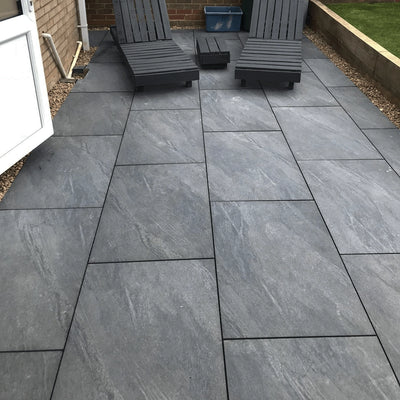
- Anthracite Black Porcelain 900x600 (£19.09/m²) patio
- Raj Green Setts 200x100 (£42.77/m²) feature borders
- Result: Bold contrast, restaurant-grade outdoor room vibe
Cottage Contemporary:
- Rippon Buff Smooth Sandstone patio packs main area
- Kandla Grey Porcelain 900x600 pathways
- Result: Warm stone for gathering areas, practical porcelain for traffic zones
Installation Considerations
Bed Preparation
Both porcelain and sandstone for permanent installations should go on full mortar bed over concrete base. Don't cut corners—sand bed for sandstone, concrete for porcelain creates different settlement rates and you'll get movement.
Proper spec:
- Compacted MOT Type 1 sub-base (minimum 100mm)
- Concrete slab (minimum 100mm)
- Priming layer (essential for porcelain adhesion)
- Full mortar bed for both materials
- 10-15mm joints for porcelain, 10-20mm for sandstone
Joint Width Strategy
Porcelain typically uses tighter joints (10-15mm) whilst natural stone can go slightly wider (10-20mm) to accommodate natural size variation. When mixing materials, keep joint widths consistent where they meet—don't go from 10mm porcelain joints to 25mm sandstone joints at the border transition. Looks sloppy.
Grouting Coordination
Use the same jointing compound colour throughout. EASYJoint in Stone Grey works for both Kandla Grey porcelain and Kandla Grey/Raj Green sandstone. Switching from light joints (porcelain area) to dark joints (sandstone area) fragments the design visually.
Design Rules That Actually Matter
Rule 1: One Material Dominates 70-80% of your paved area should be one material (typically porcelain for main patio), with 20-30% accent material (sandstone borders, pathways, features). Flip that ratio and it looks confused.
Rule 2: Clear Intentional Zones Materials should change at logical points: patio edge, pathway start, planter surrounds, step transitions. Not randomly across the middle of an open space.
Rule 3: Match Tones or Deliberately Contrast Either stay tonal (Kandla Grey porcelain + Kandla Grey setts = cohesive) or create deliberate contrast (black porcelain + buff sandstone = statement). The awkward middle ground (light grey porcelain with mid-grey sandstone) reads as accidental mismatch.
Rule 4: Consistent Laying Pattern If your porcelain is laid in stretcher bond (running bond), continue that rhythm into sandstone pathways. Switching from linear porcelain to random sandstone pattern looks disjointed unless there's a clear visual break (planting, gravel strip) between.
Cost Comparison: Mixed vs Single Material
Scenario: 25m² Patio with 2m Perimeter Border
All Porcelain:
- Kandla Grey 900x600: 25m² = £477 inc. VAT
- Grouting: £55
- Primer: £55
- Total: ~£587
All Sandstone:
- Raj Green Patio Pack (riven): 25m² = £580 inc. VAT (based on £23.20/m²)
- Grouting: £50
- Total: ~£630
Mixed Materials (Porcelain + Sandstone Setts Border):
- Kandla Grey Porcelain 900x600: 21m² = £401 inc. VAT
- Kandla Grey Setts border: 4m² = £160 inc. VAT
- Grouting: £55
- Primer: £55
- Total: ~£671
So mixing materials costs slightly more than single-material approaches, but you're paying for the design sophistication. Whether that's worth it depends on how much you value the visual interest.
Real-World Example
Dave in Sheffield wanted a modern patio but was worried all-porcelain would look too stark. We specified Kandla Grey Porcelain 900x600 for the main 18m² entertaining area (£343 inc. VAT), then added a Raj Green sett border along the house wall and patio edge (3m² of setts, £128).
The result? Proper contemporary outdoor room with just enough warmth from the multicolour setts to keep it from feeling cold. Total materials cost: £471 plus grouting/primer. Installation took his landscaper four days including base prep.
Six months later, the porcelain still looks pristine (easy hosing), whilst the Raj Green setts have developed a bit of character from weathering. Exactly what he wanted—low maintenance where it matters, natural patina where it adds charm.
When to Just Stick with One Material
Honestly? If your patio is under 15m², mixing materials can make it feel busy and fragmented. Small spaces benefit from simplicity—one high-quality material throughout creates visual calm and makes the area feel larger.
Also, if budget's tight, don't mix materials as a cost-saving exercise. You're better off with 20m² of quality porcelain than 15m² of porcelain plus 5m² of cheap sandstone that'll need replacing in three years.
Why Buy from Universal Paving
When you're mixing materials, buying from one supplier means colour-matched stock, coordinated delivery (both materials arrive same day), and consistent quality specs. Universal Paving stocks full ranges of both Kandla Grey porcelain and Kandla Grey sandstone—same UK-held stock, same delivery timeline.
Plus if you order samples (both porcelain and sandstone, delivered within 5-7 working days), you can physically test the material combinations in your actual garden light before committing. Colours that work brilliantly online can clash horribly in your south-facing garden at 6pm in summer.
Contact Universal Paving:
- Phone: 07480 959706
- Free UK delivery on all orders
- Samples available (small charge)
The Bottom Line
Mixing porcelain paving with natural stone works brilliantly when you follow clear design logic: one dominant material, intentional zoning, tonal coordination or deliberate contrast, consistent installation methods.
It looks terrible when it's random patchwork, mismatched scales fighting each other, clashing colours, or different bed depths creating uneven surfaces.
Start with porcelain for main high-use areas (maintenance wins), add natural stone borders or pathways for character (visual interest), keep everything colour-coordinated, and for goodness sake use the same installation spec throughout.
Done right, mixed materials create outdoor spaces with proper depth and sophistication. Done wrong, it looks like you got lost halfway through a building project and just laid whatever was on sale that week.