






Smooth Sandstone Colours UK - Kandla Grey vs Raj Green vs Buff vs Fossil Mint
Smooth sawn sandstone delivers the best of both worlds for UK patios: the contemporary clean surface that modern architecture demands combined with the authentic natural stone character that porcelain cannot replicate. The sawn finish removes traditional riven texture while preserving the colour variation, fossil detail, and organic warmth that make natural stone appealing. But choosing between the four core smooth sandstone colours available in the UK market - Kandla Grey, Raj Green, Rippon Buff, and Fossil Mint - fundamentally shapes your outdoor space's character, aesthetic temperature, and compatibility with your property.
Kandla Grey creates cool, architectural neutrality that works with virtually any building colour or garden style. Raj Green delivers warm, traditional multi-colour character that suits period properties and cottage gardens. Rippon Buff provides honey-toned warmth without Raj Green's colour complexity. Fossil Mint offers distinctive fossil-rich character with subtle green-grey tones. Each colour tells a different story and creates different emotional response when you step onto your patio.
This guide compares all four smooth sandstone colours across the dimensions that actually matter when selecting paving: colour character and variation, compatibility with UK property styles, how they work with planting and garden furniture, maintenance and aging characteristics, and practical decision-making guidance. Whether you're renovating a Victorian terrace garden, building a contemporary extension patio, or creating outdoor living space for a suburban family home, you'll find the information needed to choose the colour that serves your project best.
Understanding Smooth Sawn Sandstone Finish
Before comparing colours, it's worth understanding what "smooth sawn" means and how it differs from traditional riven sandstone.
Sawn Finish Characteristics:
All four colours are processed using the same diamond gang saw cutting method, creating consistent surface characteristics:
- Flat surface plane: Unlike riven sandstone (with natural undulations), sawn surfaces are mechanically flat, making them comfortable for furniture and easy to clean
- Subtle linear texture: Fine parallel saw marks create gentle texture - smooth enough for bare feet, textured enough for slip resistance
- R10 anti-slip rating: Adequate for most patio and path applications
- Calibrated thickness: Consistent 18-22mm thickness makes installation easier than natural riven stone
- Contemporary aesthetic: Clean lines and flat surface suit modern architecture while maintaining natural stone character
The sawn process affects how each colour presents. Natural colour variation still occurs (this is sandstone, not porcelain), but the flat surface creates different visual impact than riven finish.

Kandla Grey Smooth Sandstone: Cool Architectural Neutrality
Colour Character:
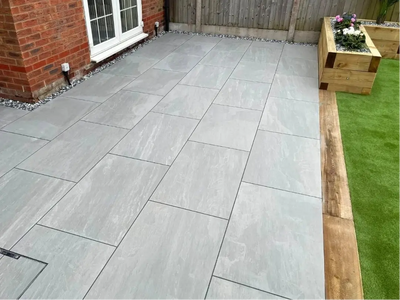
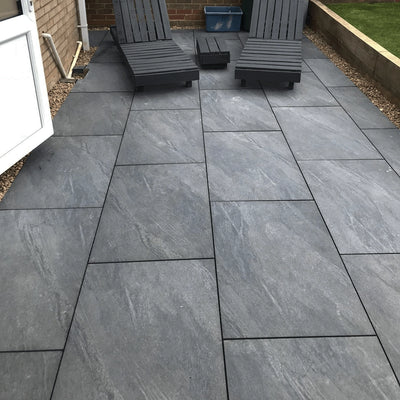
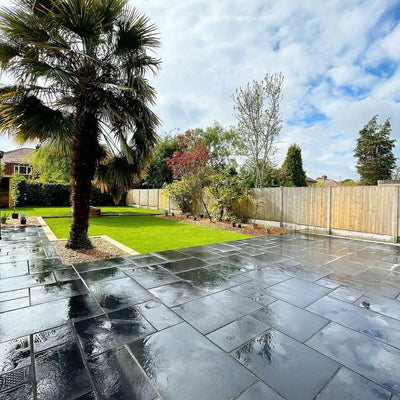
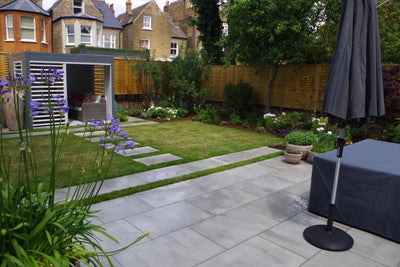
Kandla Grey is a cool-toned grey sandstone with subtle charcoal variations and occasional warm buff undertones. The dominant impression is consistent mid-grey - not dark charcoal, not pale silver, but balanced neutral grey. Individual pieces show tonal variation (some lean slightly warmer, some cooler), but the overall effect is cohesive grey palette.
Natural variation: Moderate. All pieces read as "grey" but you'll see tonal shifts between pieces - some mid-grey, some darker grey-brown, some lighter silvery-grey. This variation prevents the uniform appearance some find sterile while maintaining overall colour consistency.
Fossil content: Minimal to none. Kandla Grey's geological formation didn't preserve fossils, so you get clean mineral appearance rather than fossil-rich character.
Sawn vs riven difference: Sawn Kandla Grey appears slightly lighter and more uniform than riven Kandla Grey because the flat surface doesn't create the shadow variation that riven texture does.
Best Suited For:
Modern properties (built after 1990): The cool grey palette coordinates perfectly with contemporary architecture - white render, grey brick, aluminium windows, glass extensions. Kandla Grey doesn't compete visually with modern design elements.
Neutral backdrop for bold planting: If your garden design centres on colourful planting schemes or vibrant furniture, Kandla Grey provides clean neutral canvas that lets other colours shine.
Properties with grey or white exteriors: Creates harmonious colour flow from building to garden without introducing competing tones.
Minimalist contemporary gardens: When the design aesthetic requires restraint and neutrality, Kandla Grey delivers sophisticated backdrop.
Urban and courtyard gardens: The architectural quality suits formal urban spaces where clean lines matter.
Less Suitable For:
Traditional cottage gardens: The cool grey can feel too contemporary for deliberately rustic or period aesthetics. Raj Green or Rippon Buff create warmer traditional character.
Properties with warm brick or stone exteriors: Red brick or honey stone buildings sometimes clash with cool grey paving - creates cold/warm colour tension.
Shaded north-facing gardens: Cool grey in shade can feel cold and unwelcoming. Warmer colours (Buff or Raj Green) add perceived warmth.

Raj Green Smooth Sandstone: Warm Multi-Colour Traditional
Colour Character:
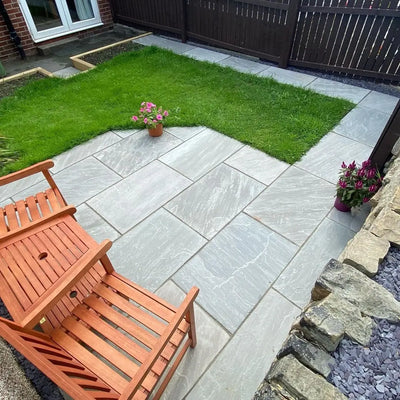
Raj Green is a multi-colour sandstone blending greens, browns, greys, and occasional buff tones in natural mosaic. No two pieces are identical - some lean heavily green, others predominantly brown, some show balanced mix. The "green" in Raj Green refers to moss-green and olive tones (not bright emerald), creating earthy organic palette.
Natural variation: High. This is Raj Green's defining characteristic - the colour variation between pieces creates tapestry effect impossible with single-colour materials. Some pieces show dramatic colour contrast within a single slab.
Fossil content: Moderate. Raj Green often contains visible plant fossils, leaf impressions, and organic markings that add historical character and visual interest.
Sawn vs riven difference: Sawn Raj Green shows colour variation more clearly than riven because the flat surface allows you to see colour changes without texture distraction. Some find this enhances character; others prefer riven's softer presentation.
Best Suited For:
Period properties (Victorian, Edwardian, Georgian): The warm multi-colour palette suits traditional architecture beautifully. Raj Green has authentic heritage feel.
Cottage gardens and traditional landscaping: When the garden aesthetic embraces naturalistic planting, traditional design, and characterful materials, Raj Green provides appropriate palette.
Properties with red brick, terracotta, or warm stone exteriors: The warm tones coordinate naturally with traditional building materials.
Gardens wanting colour variation without planting: If planting maintenance is limited but you want visual interest, Raj Green's natural colour variation creates activity.
Rural and semi-rural settings: The organic earthy tones suit countryside locations and traditional rural gardens.
Less Suitable For:
Ultra-modern contemporary properties: The multi-colour variation feels too busy for minimalist modern aesthetics requiring clean colour discipline.
Small confined spaces: In tiny courtyards or balconies, Raj Green's colour variation can feel visually cluttered. Single-colour materials work better in compact spaces.
Formal modern planting schemes: Contemporary garden design with architectural plants (grasses, sculptural specimens) sometimes clashes with Raj Green's traditional character.

Rippon Buff Smooth Sandstone: Honey-Toned Warmth
Colour Character:
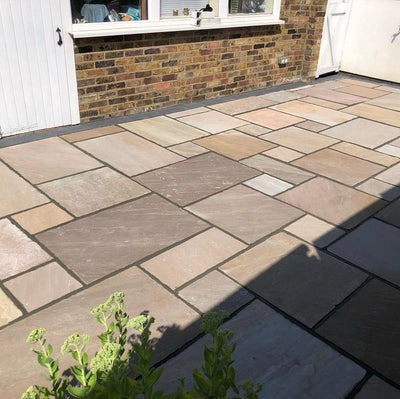
Rippon Buff is a warm buff-toned sandstone ranging from pale cream through honey gold to light brown. The dominant impression is consistent honey/biscuit colour - warmer than Kandla Grey, less varied than Raj Green. Individual pieces show tonal variation but remain within the buff family.
Natural variation: Moderate. All pieces read as "buff/honey" but you'll see lighter cream pieces and deeper golden-brown pieces. The variation creates gentle visual interest without Raj Green's dramatic colour shifts.
Fossil content: Low to moderate. Some pieces contain fossils and organic markings, others are clean mineral appearance.
Sawn vs riven difference: Sawn Rippon Buff appears slightly more uniform than riven because the flat surface reduces the shadow play that emphasises colour variation on textured finishes.
Best Suited For:
Traditional properties wanting warmth without colour complexity: When you want traditional warm character but find Raj Green too varied, Rippon Buff provides honey tones with more restraint.
Properties with honey stone, cream render, or buff brick exteriors: Creates harmonious colour continuation from building to paving.
South-facing sunny gardens: The warm honey tones glow beautifully in sunlight, creating inviting Mediterranean feel.
Transitional design styles: Bridges traditional and contemporary - warm enough for period properties, restrained enough for modern settings.
Gardens with purple, blue, or white planting schemes: Buff provides warm neutral backdrop that makes cool-coloured flowers pop visually.
Less Suitable For:
Ultra-contemporary minimalist designs: The warm honey tones feel slightly traditional for severe minimalist aesthetics. Cool grey or black work better.
Properties with grey or white-grey exteriors: Creates warm/cool colour tension that can feel disconnected.
Very shaded gardens: Buff tones can look muddy in deep shade. Grey or lighter colours work better in permanently shaded locations.

Fossil Mint Smooth Sandstone: Distinctive Fossil Character
Colour Character:
Fossil Mint is a unique grey-green sandstone heavily marked with fossils, plant impressions, and organic detail. The base colour is soft grey-green (like eucalyptus or sage), but the defining feature is the rich fossil content creating distinctive textured appearance even on sawn flat surface.
Natural variation: High, but different character than Raj Green. Variation comes from fossil density and distribution rather than colour changes. Some pieces are heavily fossil-marked, others show clean areas.
Fossil content: Very high. This is Fossil Mint's signature characteristic - the fossils aren't incidental but fundamental to the material's character.
Sawn vs riven difference: Sawn Fossil Mint reveals fossils more clearly than riven because the flat surface allows fossil detail to show without texture interference. The fossils become visual focal points.
Best Suited For:
Distinctive character-driven designs: When you want paving that makes a statement and creates conversation, Fossil Mint's unusual appearance delivers impact.
Contemporary gardens with naturalistic themes: Modern designs incorporating natural materials, organic forms, and environmental themes find resonance with fossil-rich stone.
Educational family gardens: Children find fossils fascinating - Fossil Mint creates built-in natural history lesson.
Properties with green or grey-green exteriors: The soft eucalyptus tones coordinate with sage greens, grey-greens, and natural wood cladding.
Gardens wanting unique character: When you specifically don't want standard grey or buff, Fossil Mint offers distinctive alternative.
Less Suitable For:
Buyers wanting clean minimal appearance: The heavy fossil marking creates busy visual texture - contradicts minimalist design principles.
Traditional period properties: The grey-green colour and fossil character can feel too unusual for authentic period aesthetics.
Formal structured gardens: The organic fossil patterns suit naturalistic designs better than geometric formal layouts.
Colour Comparison: Side-by-Side Decision Matrix
| Characteristic | Kandla Grey | Raj Green | Rippon Buff | Fossil Mint |
|---|---|---|---|---|
| Colour family | Cool grey | Warm multi | Warm buff | Cool grey-green |
| Colour variation | Moderate | High | Moderate | High (fossil-driven) |
| Visual temperature | Cool | Warm | Warm | Cool-neutral |
| Fossil content | Minimal | Moderate | Low-Moderate | Very High |
| Best property style | Modern (post-1990) | Period/Traditional | Traditional-Transitional | Contemporary-Naturalistic |
| Design aesthetic | Minimalist-Contemporary | Traditional-Cottage | Traditional-Warm | Distinctive-Character |
| Planting coordination | All colours | Warm schemes | Cool schemes | Natural schemes |
| Maintenance appearance | Hides dirt well | Shows dirt moderately | Shows dirt more | Busy pattern hides marks |
| Typical price | £21-24/m² | £22-25/m² | £21-24/m² | £23-26/m² |

How Each Colour Works With UK Property Styles
Modern Properties (2000-Present):
Best choice: Kandla Grey (first choice), Rippon Buff (warmer alternative)
Why: Cool grey coordinates with contemporary materials (glass, steel, render). Rippon Buff works for modern properties wanting warmth.
Avoid: Raj Green (too traditional), Fossil Mint (unless deliberately contrasting)
Transitional Properties (1980-2000):
Best choice: Rippon Buff (first choice), Kandla Grey (cooler alternative)
Why: These properties bridge traditional and modern - buff provides warmth without strong period character. Grey works for cooler contemporary lean.
Works: Raj Green in semi-detached suburban if garden leans traditional
Victorian/Edwardian Properties (1850-1920):
Best choice: Raj Green (first choice), Rippon Buff (simpler alternative)
Why: Multi-colour Raj Green suits period architecture authentically. Buff provides period warmth with more restraint.
Works: Kandla Grey if extensively modernised property
Cottage and Rural Properties:
Best choice: Raj Green (natural first choice), Rippon Buff (cleaner alternative)
Why: Traditional multi-colour suits cottage gardens. Buff works for cottages wanting slightly cleaner aesthetic.
Works: Fossil Mint for naturalistic cottage gardens with educational/environmental themes
Combining Colours: Mixed Paving Strategies
Kandla Grey + Raj Green Border:
Use Kandla Grey as main patio field with Raj Green double border (two rows around perimeter). This combines grey's clean contemporary main surface with warm traditional edging character. Works for transitional properties bridging modern and traditional styles.
Rippon Buff Main + Kandla Grey Accent:
Buff main patio with grey bands, inserts, or geometric panels creates visual structure and contemporary detail within warm traditional base. Works for modern extensions on traditional properties.
Single Colour Variation:
Order from different batches within one colour to create subtle tonal variation - multiple Kandla Grey batches create gentle grey shading across patio. This adds interest while maintaining colour family consistency.
Path vs Patio Differentiation:
Use one colour for main patio (e.g., Kandla Grey) and different colour for garden paths (e.g., Rippon Buff). This creates functional zoning and adds visual variety across whole garden.
Planting Schemes: Which Colours Work With Garden Plants
Kandla Grey + Planting:
Works beautifully with: All colours (neutral backdrop)
Particularly stunning with: Purple (lavender, alliums), white (roses, hydrangeas), bright colours (orange, yellow, red)
Planting style: Contemporary architectural planting, Mediterranean schemes, minimalist green-only gardens
Raj Green + Planting:
Works beautifully with: Warm colours (yellow, orange, red), pink, white
Can clash with: Purple (too much colour competition), very formal architectural planting
Planting style: Cottage garden abundance, traditional borders, naturalistic planting
Rippon Buff + Planting:
Works beautifully with: Cool colours (purple, blue, white), silver foliage
Particularly stunning with: Lavender, nepeta, white roses, blue delphiniums
Planting style: Traditional borders, Mediterranean schemes, pastel cottage gardens
Fossil Mint + Planting:
Works beautifully with: Natural greens, grasses, ferns, woodland planting
Particularly stunning with: Green-only planting schemes, naturalistic gardens
Planting style: Naturalistic, woodland, contemporary green gardens, native plant schemes
Furniture and Hardscaping Coordination
Kandla Grey Coordination:
Furniture colours: All colours work (neutral backdrop), particularly good with white, grey, black, navy, teal
Hardscaping: Grey brick walls, rendered walls, steel structures, glass, contemporary wood (grey-stained)
Avoid: Very warm terracotta/orange furniture (creates temperature clash)
Raj Green Coordination:
Furniture colours: Warm woods (teak, iroko), terracotta, cream, sage green, brown
Hardscaping: Red brick walls, honey stone, traditional wood (oak, cedar), terracotta pots
Avoid: Ultra-modern materials (polished steel, glass) feel disconnected
Rippon Buff Coordination:
Furniture colours: Grey, white, navy, purple, natural wood
Hardscaping: Cream render, honey stone, buff brick, natural wood structures
Avoid: Very dark furniture (black, dark grey) creates harsh contrast
Fossil Mint Coordination:
Furniture colours: Natural wood, grey, eucalyptus green, white
Hardscaping: Natural wood, green-grey painted wood, stone walls, natural materials
Avoid: Bright artificial colours, highly polished materials
Maintenance & Aging: How Colours Change Over Time
Kandla Grey Aging:
Initial appearance: Clean mid-grey
2-5 years: Slight darkening as stone weathers, minimal visible change
10+ years: Develops subtle patina, some pieces may show greenish tinge in shaded areas (natural algae)
Maintenance: Sealing every 3-4 years maintains colour consistency. Unsealed stone darkens more noticeably.
Raj Green Aging:
Initial appearance: Bright multi-colour variation
2-5 years: Colours mellow slightly, greens may fade somewhat, overall palette softens
10+ years: Develops warm mellow character, colour variation remains but becomes more subtle
Maintenance: Regular sealing preserves colour vibrancy. Unsealed Raj Green fades more than other colours.
Rippon Buff Aging:
Initial appearance: Warm honey tones
2-5 years: Slight darkening, particularly in damp areas
10+ years: Develops rich golden patina, may show greenish shading in permanently wet/shaded areas
Maintenance: Sealing every 3-4 years prevents excessive darkening. Buff shows algae growth more visibly than grey.
Fossil Mint Aging:
Initial appearance: Distinctive grey-green with prominent fossils
2-5 years: Base colour may darken slightly, fossils remain prominent
10+ years: Develops natural patina, organic character increases
Maintenance: Similar to Kandla Grey. The fossil pattern helps hide aging variations.
Cost Comparison: Does Colour Affect Price?
Material Costs (Smooth Sawn, 900x600mm format):
- Kandla Grey: £24-26/m²
- Raj Green: £22-25/m²
- Rippon Buff: £21-24/m²
- Fossil Mint: £23-26/m²
Price variation: £2-4/m² difference between cheapest (Kandla Grey/Rippon Buff) and most expensive (Fossil Mint). For typical 30m² patio, this represents £60-120 total difference.
Why Fossil Mint costs more: Lower availability, higher fossil content creates more waste during quarrying/processing, distinctive character commands premium.
Installation costs: Identical across all colours - £25-35/m² professional installation. Colour doesn't affect laying difficulty or time.
Long-term value consideration: All four colours perform similarly for durability and lifespan (30-40 years properly installed). Choose based on aesthetic fit, not cost.
Which Colour Should You Choose? Decision Framework
Step 1: Property Style Assessment
Modern property (post-1990): → Kandla Grey first choice
Period property (pre-1950): → Raj Green first choice
Transitional property (1950-1990): → Rippon Buff first choice
Character property wanting unique: → Fossil Mint
Step 2: Garden Aesthetic
Contemporary minimalist: → Kandla Grey
Traditional cottage: → Raj Green
Mediterranean warm: → Rippon Buff
Naturalistic/educational: → Fossil Mint
Step 3: Colour Temperature Preference
Prefer cool neutrals: → Kandla Grey or Fossil Mint
Prefer warm tones: → Rippon Buff or Raj Green
Want variation: → Raj Green or Fossil Mint
Want consistency: → Kandla Grey or Rippon Buff
Step 4: Maintenance Visibility
Want to hide dirt/marks: → Kandla Grey or Fossil Mint (busy patterns)
Don't mind visible maintenance: → Rippon Buff or Raj Green
Still Uncertain? Order Samples
£5 samples of all four colours let you compare actual stone in your garden location, against your property exterior, and in your actual light conditions. This eliminates guesswork.
Available Smooth Sandstone Colours at Universal Paving
Kandla Grey Smooth Sandstone:
- 900x600mm: £21.85/m²
- 600x600mm: £22.85/m²
- Patio packs: Available
Raj Green Smooth Sandstone:
- 900x600mm: £22.85/m²
- 600x600mm: £23.85/m²
- Patio packs: Available
Rippon Buff Smooth Sandstone:
- 900x600mm: £21.85/m²
- 600x600mm: £22.85/m²
- Patio packs: Available
Fossil Mint Smooth Sandstone:
- 900x600mm: £23.85/m²
- 600x600mm: £24.85/m²
- Patio packs: Available
All products:
- Sawn finish (R10 anti-slip)
- 18-22mm calibrated thickness
- Natural Indian sandstone
- Free UK delivery
Get Expert Colour Selection Advice
Choosing paving colour affects your garden's character for 30-40 years. If you're uncertain which colour suits your property style, garden aesthetic, or personal preferences, call 07480 959706 to speak with our team.
We can advise on:
- Colour selection for your property style
- Which colours work with your building exterior
- Planting coordination
- Mixed colour strategies
- Sample selection for comparison
Order £5 samples of multiple colours to compare actual stone in your garden before committing to full order. Photos cannot fully convey colour variation and character.
Free UK mainland delivery on all orders.