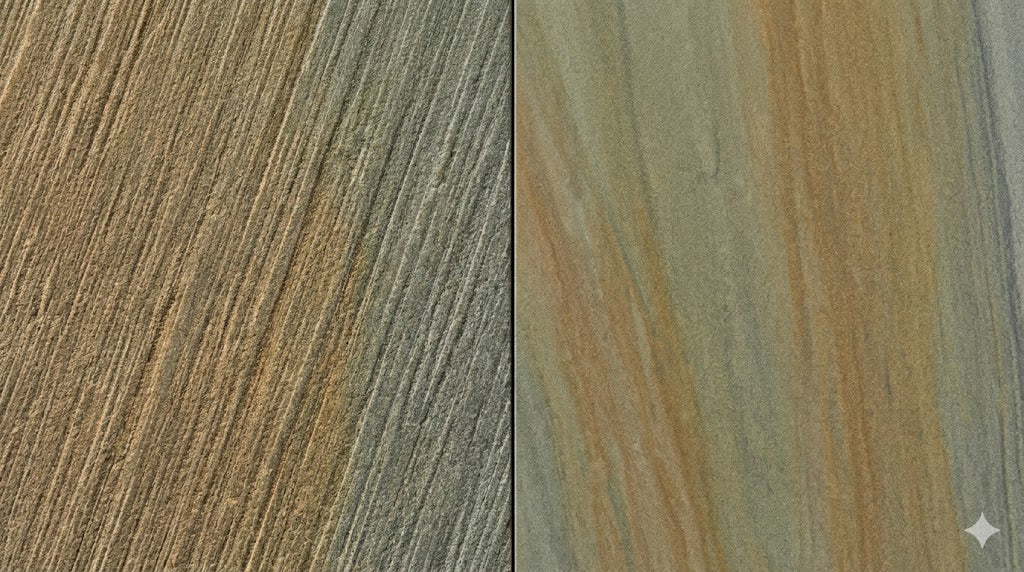




Riven vs Sawn Sandstone: What's the Difference?
Riven and sawn are the two main finishes you'll find in Indian sandstone paving. They're the same stone from the same quarries — the difference is entirely in how the surface is finished. That difference affects how the stone looks, feels underfoot, installs, ages, and suits different garden styles. This guide explains both finishes so you can choose the right one for your project.
The quick comparison
| Riven | Sawn & Honed | |
|---|---|---|
| Surface | Naturally split, textured, uneven | Machine-cut, smooth, flat |
| Edges | Hand-dressed, slightly irregular | Sawn straight, clean and uniform |
| Thickness | Calibrated to 22mm (±2-3mm natural variation) | Calibrated to 22mm (±1mm, more precise) |
| Joint width | 8–12mm (wider to accommodate irregular edges) | 5–8mm (tighter, cleaner look) |
| Feel underfoot | Textured, tactile, natural grip | Smooth, cool, contemporary |
| Slip resistance | Good — natural texture provides grip | Lower — smooth surface, consider textured porcelain if slip is a concern |
| Style | Traditional, cottage, rustic, period | Contemporary, modern, urban, minimalist |
| DIY difficulty | Easier — forgiving of small errors | Harder — precision required, errors visible |
| Price | Typically 10–20% cheaper | Slight premium for the additional processing |
| How it ages | Develops character — patina, softening, mellowing | Ages more slowly — retains clean lines longer |
Riven sandstone: the traditional finish
Riven sandstone is split along the stone's natural sedimentary layers — the cleft planes formed millions of years ago. This creates a gently undulating surface with natural texture and character. No two slabs look the same. The edges are hand-dressed (trimmed by hand), giving them a slightly irregular profile that produces wider, more informal joints when laid.
This is the most popular finish for Indian sandstone in the UK. It's what most people picture when they think of a sandstone patio — the traditional, timeless look that works with cottage gardens, period properties, and informal planting schemes.
Why landscapers prefer riven for most jobs: the textured surface and irregular edges are forgiving. Small imperfections in the mortar bed, slight variations in joint width, and minor alignment issues all disappear into the natural character of the stone. A riven patio laid by a competent DIYer can look almost as good as one laid by a professional.
Traditional gardens, cottage properties, red brick houses, rural settings, informal planting, DIY installations, and anyone who wants a patio that looks like it's always been there.
Sawn sandstone: the contemporary finish
Sawn sandstone is cut with diamond blades to produce a flat, smooth surface with clean, straight edges. The surface is then honed to a consistent finish — not polished to a gloss, but smoothed to remove the saw marks. The result is a contemporary, architectural look with tight, uniform joints.
Sawn sandstone reads as more deliberate and designed than riven. It pairs naturally with modern architecture — glass extensions, white render, steel planters, architectural grasses. It also works well as a transition from indoor tiled floors to outdoor paving, particularly when the colour and format are similar.
Why sawn is harder to install: the straight edges and smooth surface expose every imperfection. A slab that's 2mm higher than its neighbour is invisible on riven — on sawn, it catches the eye immediately. Joint widths need to be consistent. The mortar bed needs to be more precise. And because the smooth back surface doesn't bond as readily with mortar, priming every slab with SBR slurry is essential (not just recommended, as with riven).
A note on chipping: sawn sandstone has sharp, precise edges. These edges are more vulnerable to chipping during transport and handling than the already-irregular edges of riven stone. Minor edge chipping is normal and not a defect — it's a characteristic of the finish. If perfect, chip-free edges are essential to your design, consider porcelain (which is harder and more chip-resistant) as an alternative.
Modern extensions, contemporary gardens, white render properties, minimalist planting, indoor-outdoor transitions, professional installations, and anyone who wants clean lines and a designed look.
Can you mix riven and sawn?
Yes, and it can look excellent when done deliberately. The most common approach is sawn sandstone for the main patio area (clean, contemporary, easy to furnish) with riven sandstone for paths, borders, or steps leading to it (adding texture and variety). The key is keeping the colour consistent — mixing Kandla Grey sawn with Kandla Grey riven works because the colour ties them together even though the textures differ.
What doesn't work is mixing them randomly within the same area. A patio with alternating riven and sawn slabs looks like a mistake, not a design choice.
Which should you choose? Real scenarios
"We have a Victorian terraced house with a small back garden"
The property has character — original brickwork, maybe a bay window, established planting. You want the patio to feel like it belongs.
→ Riven (Raj Green or Rippon Buff)"We've just finished a rear extension with bifold doors"
The interior has large-format floor tiles. You want the patio to feel like an extension of the indoor space with a seamless transition.
→ Sawn (Kandla Grey 900×600)"I'm laying this myself over a couple of weekends"
First time laying paving. You want something that's forgiving of beginner mistakes and still looks good.
→ Riven (any colour)"We want a formal entertaining area with outdoor dining"
Clean lines, table and chairs, maybe a built-in barbecue. Furniture needs to sit flat without rocking.
→ Sawn (Kandla Grey or Fossil Mint)"Budget is tight — we want the most patio for our money"
Maximum coverage at minimum cost, without compromising on quality.
→ Riven (typically 10–20% cheaper than sawn)A note on textured sandstone
There's a third finish worth mentioning: textured sandstone. This is sandstone that's been surface-treated to add extra grip — shot-blasted, bush-hammered, or otherwise mechanically textured. It sits somewhere between riven and sawn in appearance, with a more uniform texture than riven but more grip than sawn.
Textured sandstone is the best choice when slip resistance is the primary concern — pool surrounds, areas near water features, or patios that stay damp and shaded. We stock a textured sandstone range if this applies to your project.
See both finishes in person
Order samples of riven and sawn sandstone in your preferred colour. A sample in your hand tells you more than any guide.
Browse Riven Browse SawnFrequently asked questions
Is riven sandstone slippery?
Generally no — the natural texture provides good grip even when wet. It's one of the safest paving surfaces for gardens with children or elderly family members. If you need extra reassurance, our textured range offers enhanced slip resistance.
Is sawn sandstone more expensive than riven?
Typically 10–20% more per square metre because of the additional processing (diamond cutting and honing). The stone itself is the same quality — you're paying for the extra manufacturing step.
Can I use sawn sandstone for a driveway?
Sandstone is generally not recommended for driveways due to the weight of vehicles. For driveways, consider granite or porcelain paving, which are denser and more resistant to the point loads and turning forces from car tyres.
Does riven sandstone hold water?
The textured surface can hold small amounts of water in the natural undulations, which evaporates quickly in normal conditions. If puddles persist, it usually indicates a fall issue with the installation rather than a problem with the stone itself. Properly laid riven sandstone with a 1-in-60 fall drains effectively.